QUESTION IMAGE
Question
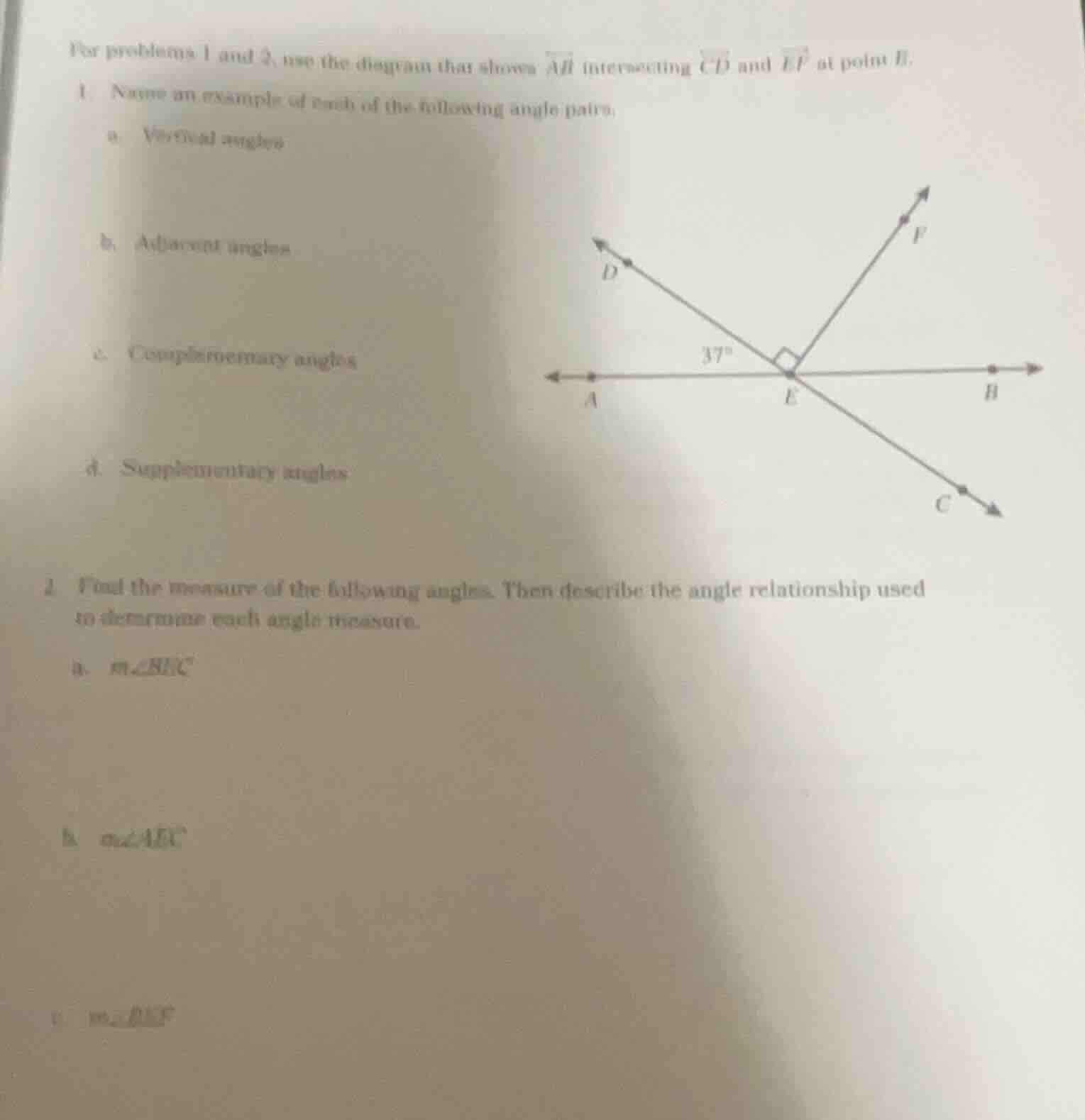
for problems 1 and 2, use the diagram that shows $overleftrightarrow{ab}$ intersecting $overleftrightarrow{cd}$ and $overleftrightarrow{ef}$ at point $e$.
- name an example of each of the following angle pairs:
a. vertical angles
b. adjacent angles
c. complementary angles
d. supplementary angles
- find the measure of the following angles. then describe the angle relationship used to determine each angle measure.
a. $m\angle bec$
b. $m\angle aec$
c. $m\angle bef$
Problem 1
a. Vertical angles
Vertical angles are formed by two intersecting lines and are opposite each other. In the diagram, $\angle AED$ and $\angle BEC$ are vertical angles (or $\angle AEC$ and $\angle BED$).
Adjacent angles share a common side and vertex. For example, $\angle AED$ and $\angle DEF$ share vertex $E$ and side $ED$, or $\angle AED$ and $\angle AEC$ (they share side $AE$ and vertex $E$).
Complementary angles sum to $90^\circ$. Given $\angle AED = 37^\circ$ and there's a right angle (let's say $\angle DEF$ is part of a right angle with $\angle AED$), so $\angle AED$ and $\angle DEF$: $37^\circ + 53^\circ = 90^\circ$ (since the right angle is $90^\circ$, $90 - 37 = 53$). So $\angle AED$ and $\angle DEF$ are complementary.

Snap & solve any problem in the app
Get step-by-step solutions on Sovi AI
Photo-based solutions with guided steps
Explore more problems and detailed explanations
$\angle AED$ and $\angle BEC$ (or $\angle AEC$ and $\angle BED$)