QUESTION IMAGE
Question
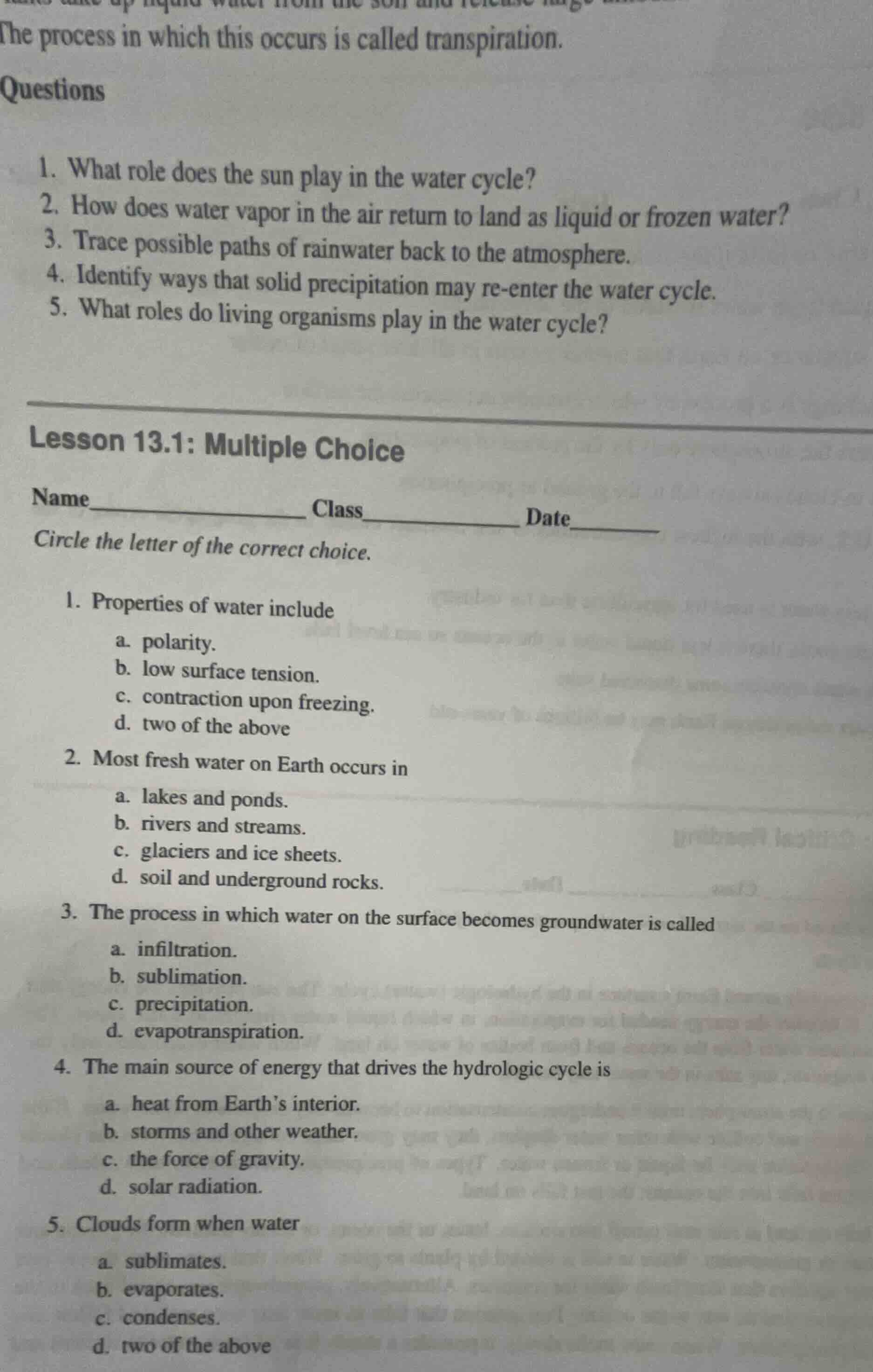
the process in which this occurs is called transpiration.
questions
- what role does the sun play in the water cycle?
- how does water vapor in the air return to land as liquid or frozen water?
- trace possible paths of rainwater back to the atmosphere.
- identify ways that solid precipitation may re - enter the water cycle.
- what roles do living organisms play in the water cycle?
lesson 13.1: multiple choice
name_____________ class_________ date_____
circle the letter of the correct choice.
- properties of water include
a. polarity.
b. low surface tension.
c. contraction upon freezing.
d. two of the above
- most fresh water on earth occurs in
a. lakes and ponds.
b. rivers and streams.
c. glaciers and ice sheets.
d. soil and underground rocks.
- the process in which water on the surface becomes groundwater is called
a. infiltration.
b. sublimation.
c. precipitation.
d. evapotranspiration.
- the main source of energy that drives the hydrologic cycle is
a. heat from earth’s interior.
b. storms and other weather.
c. the force of gravity.
d. solar radiation.
- clouds form when water
a. sublimates.
b. evaporates.
c. condenses.
d. two of the above
Question 1 (Multiple Choice - Properties of water)
- Option a: Water is a polar molecule (has a positive and negative end), so polarity is a property of water.
- Option b: Water has high surface tension (due to hydrogen bonding), so "low surface tension" is incorrect.
- Option c: Water expands upon freezing (ice is less dense than liquid water), so "contraction upon freezing" is incorrect.
- Since only option a is correct, but let's re - check. Wait, maybe I made a mistake. Wait, water is polar (a is correct). Surface tension of water is high (so b is wrong). Water expands when freezing (so c is wrong). So the correct answer should be a? But wait, the option d is "two of the above". Wait, maybe I messed up. Wait, no, water's properties: polarity (yes), high surface tension (so b is wrong), expansion on freezing (so c is wrong). So only a is correct. But let's check again.
Wait, maybe the question has a typo or my memory is off. Wait, standard properties of water: polarity, high surface tension, expands when freezing. So option a is correct, b and c are incorrect. So the correct answer is a. But let's check the options again. The options are a. polarity, b. low surface tension, c. contraction upon freezing, d. two of the above. So since only a is correct, the answer is a.
- Option a: Lakes and ponds contain fresh water, but not the most.
- Option b: Rivers and streams have fresh water, but their volume is small compared to glaciers.
- Option c: Glaciers and ice sheets (polar ice caps, etc.) contain about 68% of the world's fresh water, which is the largest reservoir of fresh water on Earth.
- Option d: Soil and underground rocks (groundwater) have fresh water, but less than glaciers.
So the correct answer is c.
- Option a: Infiltration is the process by which water on the surface (like from rain, rivers) soaks into the ground and becomes groundwater.
- Option b: Sublimation is the process of a solid changing directly to a gas (e.g., dry ice to $CO_2$), not related to surface water to groundwater.
- Option c: Precipitation is water falling from the atmosphere (rain, snow, etc.), not the process of surface water becoming groundwater.
- Option d: Evapotranspiration is the combination of evaporation (from water bodies) and transpiration (from plants) to release water vapor into the atmosphere, not related to surface water becoming groundwater.
So the correct answer is a.

Snap & solve any problem in the app
Get step-by-step solutions on Sovi AI
Photo-based solutions with guided steps
Explore more problems and detailed explanations
a. polarity