QUESTION IMAGE
Question
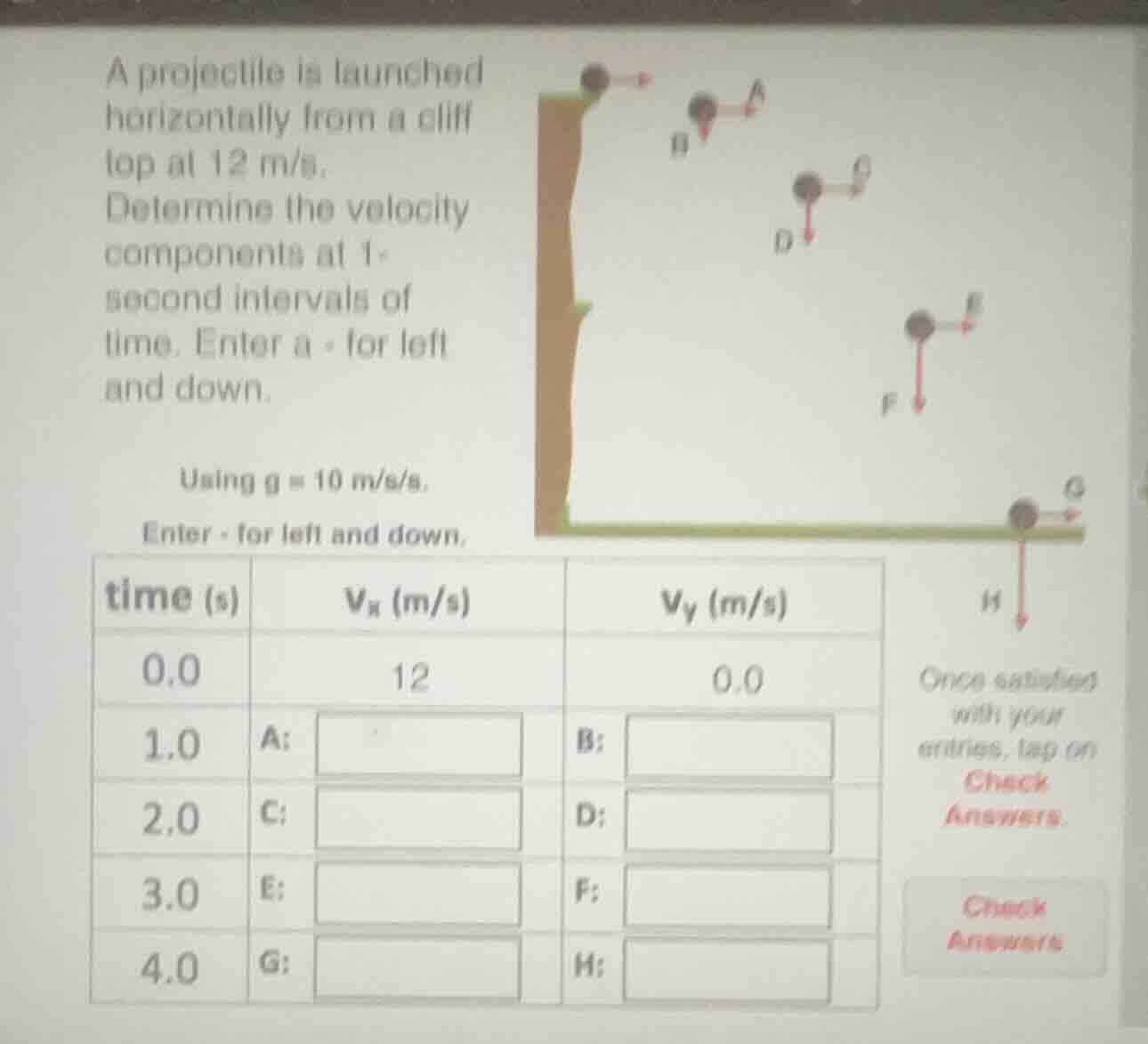
a projectile is launched horizontally from a cliff top at 12 m/s. determine the velocity components at 1 - second intervals of time. enter a - for left and down. using g = 10 m/s/s. enter - for left and down. time (s) | vₓ (m/s) | vᵧ (m/s) 0.0 | 12 | 0.0 1.0 | a: | b: 2.0 | c: | d: 3.0 | e: | f: 4.0 | g: | h: once satisfied with your entries, tap on check answers. check answers (there is also an image of a projectiles motion with different points labeled a - h)
Step1: Analyze Horizontal Velocity
In horizontal projectile motion, there is no acceleration in the horizontal direction (assuming no air resistance). So the horizontal velocity (\(v_x\)) remains constant throughout the motion. The initial horizontal velocity is \(12\) m/s (to the right, so positive as per the problem's sign convention where left is negative, right is positive). So for all time intervals, \(v_x = 12\) m/s (or \(+12\) m/s).
Step2: Analyze Vertical Velocity
In vertical direction, the projectile is in free - fall (since it's launched horizontally, initial vertical velocity \(u_y = 0\) m/s). The acceleration in vertical direction \(a_y=-g=- 10\) m/s² (negative because down is considered negative as per problem's sign convention? Wait, no, the problem says "Enter a - for left and down". Wait, initial vertical velocity is 0. The vertical velocity as a function of time is given by \(v_y=u_y + a_y t\). Here, \(u_y = 0\) m/s, \(a_y=- 10\) m/s² (because down is negative). Wait, no, let's re - check: if down is negative, then acceleration due to gravity is acting downwards, so \(a_y=-g=- 10\) m/s². Then \(v_y=0+( - 10)t=- 10t\) m/s.
For \(t = 1.0\) s:
- Horizontal velocity (\(v_x\)): Since horizontal velocity is constant, \(v_x = 12\) m/s (so A: \(+12\) or \(12\))
- Vertical velocity (\(v_y\)): Using \(v_y=u_y+gt\) (wait, maybe I messed up the sign. If down is negative, then \(v_y=-gt\). Wait, no, let's think again. The problem says "Enter a - for left and down". So if the velocity is downwards, we use a negative sign. The initial vertical velocity \(u_y = 0\). The vertical acceleration \(a = g=10\) m/s² downwards. So using the equation \(v = u+at\), where \(u = 0\), \(a=- 10\) m/s² (because down is negative) or \(a = 10\) m/s² downwards (so \(v_y=- 10t\) if up is positive, or \(v_y = 10t\) with a negative sign because down is negative. Wait, maybe the problem considers down as negative, so:
For vertical motion:
\(v_y=u_y+at\), \(u_y = 0\), \(a=-g=- 10\) m/s². So \(v_y=0+( - 10)t=- 10t\) m/s.
So for \(t = 1\) s: \(v_y=- 10\times1=- 10\) m/s (so B: \(- 10\))
For \(t = 2.0\) s:
- Horizontal velocity (\(v_x\)): Still \(12\) m/s (C: \(12\))
- Vertical velocity (\(v_y\)): \(v_y=- 10\times2=- 20\) m/s (D: \(- 20\))
For \(t = 3.0\) s:
- Horizontal velocity (\(v_x\)): \(12\) m/s (E: \(12\))
- Vertical velocity (\(v_y\)): \(v_y=- 10\times3=- 30\) m/s (F: \(- 30\))
For \(t = 4.0\) s:
- Horizontal velocity (\(v_x\)): \(12\) m/s (G: \(12\))
- Vertical velocity (\(v_y\)): \(v_y=- 10\times4=- 40\) m/s (H: \(- 40\))

Snap & solve any problem in the app
Get step-by-step solutions on Sovi AI
Photo-based solutions with guided steps
Explore more problems and detailed explanations
- At \(t = 1.0\) s:
- A ( \(v_x\)): \(12\)
- B ( \(v_y\)): \(- 10\)
- At \(t = 2.0\) s:
- C ( \(v_x\)): \(12\)
- D ( \(v_y\)): \(- 20\)
- At \(t = 3.0\) s:
- E ( \(v_x\)): \(12\)
- F ( \(v_y\)): \(- 30\)
- At \(t = 4.0\) s:
- G ( \(v_x\)): \(12\)
- H ( \(v_y\)): \(- 40\)