QUESTION IMAGE
Question
prompt below
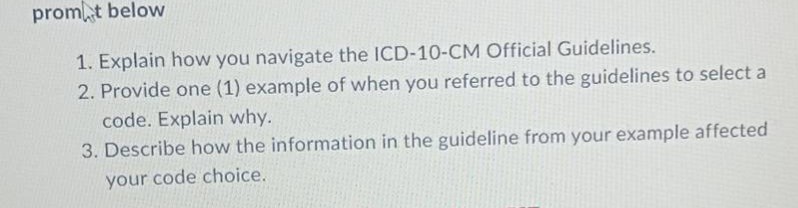
- explain how you navigate the icd - 10 - cm official guidelines.
- provide one (1) example of when you referred to the guidelines to select a code. explain why.
- describe how the information in the guideline from your example affected your code choice.
Brief Explanations
- The navigation process follows a structured, condition-driven review of relevant guideline sections to ensure compliance.
- The example uses a common diabetic complication, where the guideline mandates combination coding to reflect the causal link between diabetes and the ulcer, avoiding incorrect separate coding.
- The guideline's rule on combination codes directly changed the code selection by replacing two unlinked codes with one code that properly documents the clinical relationship between the patient's conditions, which is required for accurate medical coding and billing.

Snap & solve any problem in the app
Get step-by-step solutions on Sovi AI
Photo-based solutions with guided steps
Explore more problems and detailed explanations
- I navigate the ICD-10-CM Official Guidelines by first identifying the main condition, then cross-referencing the guideline sections for that condition type (e.g., infectious diseases, neoplasms), reviewing chapter-specific rules, and verifying coding conventions like laterality or combination codes.
- Example: When coding a patient with a diabetic foot ulcer, I referred to the guidelines. The guidelines specify that diabetic complications (including ulcers) must be linked to the diabetes code using a combination code if available, rather than coding diabetes and the ulcer separately. I used this because the initial draft had two separate codes, but the guideline required a single combined code to reflect the causal relationship.
- The guideline specified that diabetic foot ulcers are classified under combination codes that include both the diabetes type and the ulcer location/severity (e.g., E11.621 for Type 2 diabetes with foot ulcer). This meant I abandoned the separate codes for Type 2 diabetes (E11.9) and pressure ulcer of foot (L89.619) and instead used the single combination code, which accurately captures the connection between the diabetes and the ulcer, ensuring compliance with coding rules for causal relationships.