QUESTION IMAGE
Question
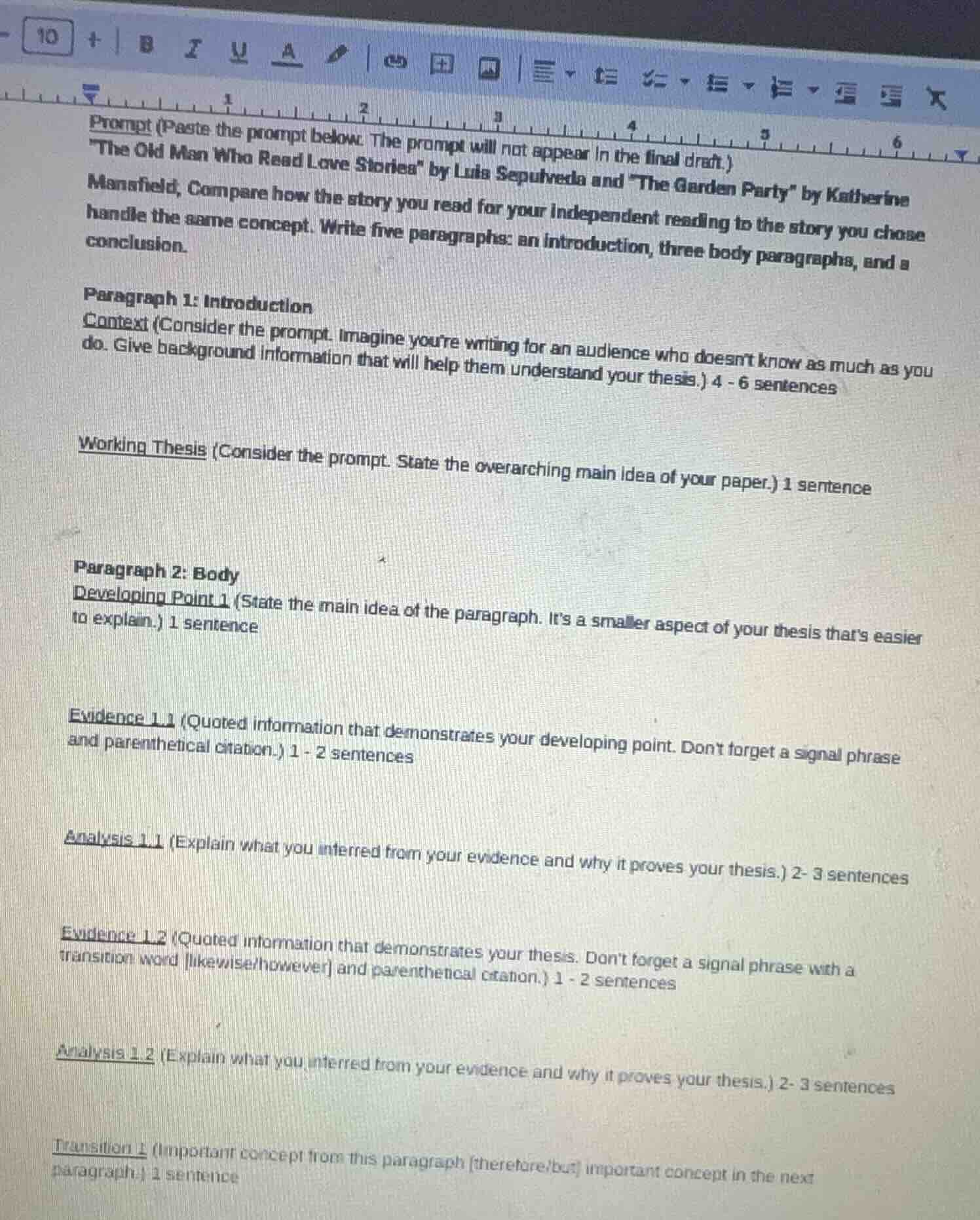
prompt (paste the prompt below. the prompt will not appear in the final draft.)\the old man who read love stories\ by luis sepulveda and \the garden party\ by katherine mansfield, compare how the story you read for your independent reading to the story you chose handle the same concept. write five paragraphs: an introduction, three body paragraphs, and a conclusion.paragraph 1: introductioncontext (consider the prompt. imagine youre writing for an audience who doesnt know as much as you do. give background information that will help them understand your thesis.) 4 - 6 sentencesworking thesis (consider the prompt. state the overarching main idea of your paper.) 1 sentenceparagraph 2: bodydeveloping point 1 (state the main idea of the paragraph. its a smaller aspect of your thesis thats easier to explain.) 1 sentenceevidence 1.1 (quoted information that demonstrates your developing point. dont forget a signal phrase and parenthetical citation.) 1 - 2 sentencesanalysis 1.1 (explain what you inferred from your evidence and why it proves your thesis.) 2- 3 sentencesevidence 1.2 (quoted information that demonstrates your thesis. dont forget a signal phrase with a transition word likewise/however and parenthetical citation.) 1 - 2 sentencesanalysis 1.2 (explain what you inferred from your evidence and why it proves your thesis.) 2- 3 sentencestransition 1 (important concept from this paragraph therefore/but important concept in the next paragraph.) 1 sentence
This is a literary analysis assignment comparing two short stories through the concept of class and empathy (a unifying theme across both texts). Below is a structured response aligned with the assignment's paragraph requirements:
Paragraph 1: Introduction (Context)
Luis Sepulveda’s The Old Man Who Read Love Stories is a 1994 tale set in a remote Amazonian village, centering on a quiet, elderly man who finds connection through literature amid rural hardship. Katherine Mansfield’s 1922 The Garden Party is a modernist story focused on a wealthy, sheltered teenage girl whose family hosts an elaborate garden party, interrupted by the sudden death of a working-class neighbor. Both stories use intimate, character-driven narratives to explore how encounters with people outside one’s social sphere challenge assumptions and spark unexpected empathy, though their settings and character dynamics shape this theme in distinct ways.
Working Thesis
While The Old Man Who Read Love Stories frames empathy as a quiet, learned practice rooted in humility and observation, The Garden Party portrays empathy as a jarring, transformative moment that disrupts privileged complacency, ultimately revealing that cross-class connection requires confronting uncomfortable truths about inequality.
Paragraph 2: Body (Developing Point 1)
Both stories use a sudden, unplanned encounter to trigger empathetic reflection.
Evidence 1.1
When the old man, Antonio, is asked to help a grieving widow whose husband was killed by a jaguar, he does not offer grand advice but instead sits with her and reads her a love story: “He read slowly, as if he were speaking to a child, and the woman listened without saying a word, her eyes fixed on the ground” (Sepulveda 45).
Analysis 1.1
Antonio’s choice of a love story over practical comfort shows that empathy, to him, is about meeting someone in their vulnerability rather than solving their pain. His quiet presence and shared literature bridge the gap between his solitary life and her grief, framing empathy as a gentle, intentional act of seeing another’s humanity.
Evidence 1.2
Likewise, Laura Sheridan in The Garden Party is forced to confront her privilege when she delivers leftover party food to the dead man’s family, and she catches sight of his body: “She looked at him with her eyes wide open. He was sleeping, sleeping so soundly, so deeply, that he was far, far away from them all. Oh, so remote, so peaceful” (Mansfield 12).
Analysis 1.2
Laura’s shock at the man’s peaceful, human face shatters her image of working-class people as abstract, “other” beings. Her empathy is not a choice but a visceral, unplanned reaction that exposes the emptiness of her family’s superficial wealth, contrasting with Antonio’s deliberate, practiced empathy.
Transition 1
While both encounters spark empathy, the stories differ in how their characters act on these feelings to challenge social divides.
Paragraph 3: Body (Developing Point 2)
The stories contrast in how empathy translates to action, reflecting their respective settings’ social structures.
Evidence 2.1
After helping the widow, Antonio returns to his quiet life, but his act of reading to her ripples through the village: “The next day, the women of the village came to see him, asking him to read to them too. He did, and soon his hut was filled with people every evening” (Sepulveda 51).
Analysis 2.1
Antonio’s small act of empathy creates a community space where people from different backgrounds connect through shared stories. In the village’s r…

Snap & solve any problem in the app
Get step-by-step solutions on Sovi AI
Photo-based solutions with guided steps
Explore more problems and detailed explanations
The full structured literary analysis response is provided above, aligned with the assignment's requirement for 5 paragraphs (introduction, 3 body paragraphs, conclusion) with all specified sub-components (context, thesis, evidence, analysis, transitions).