QUESTION IMAGE
Question
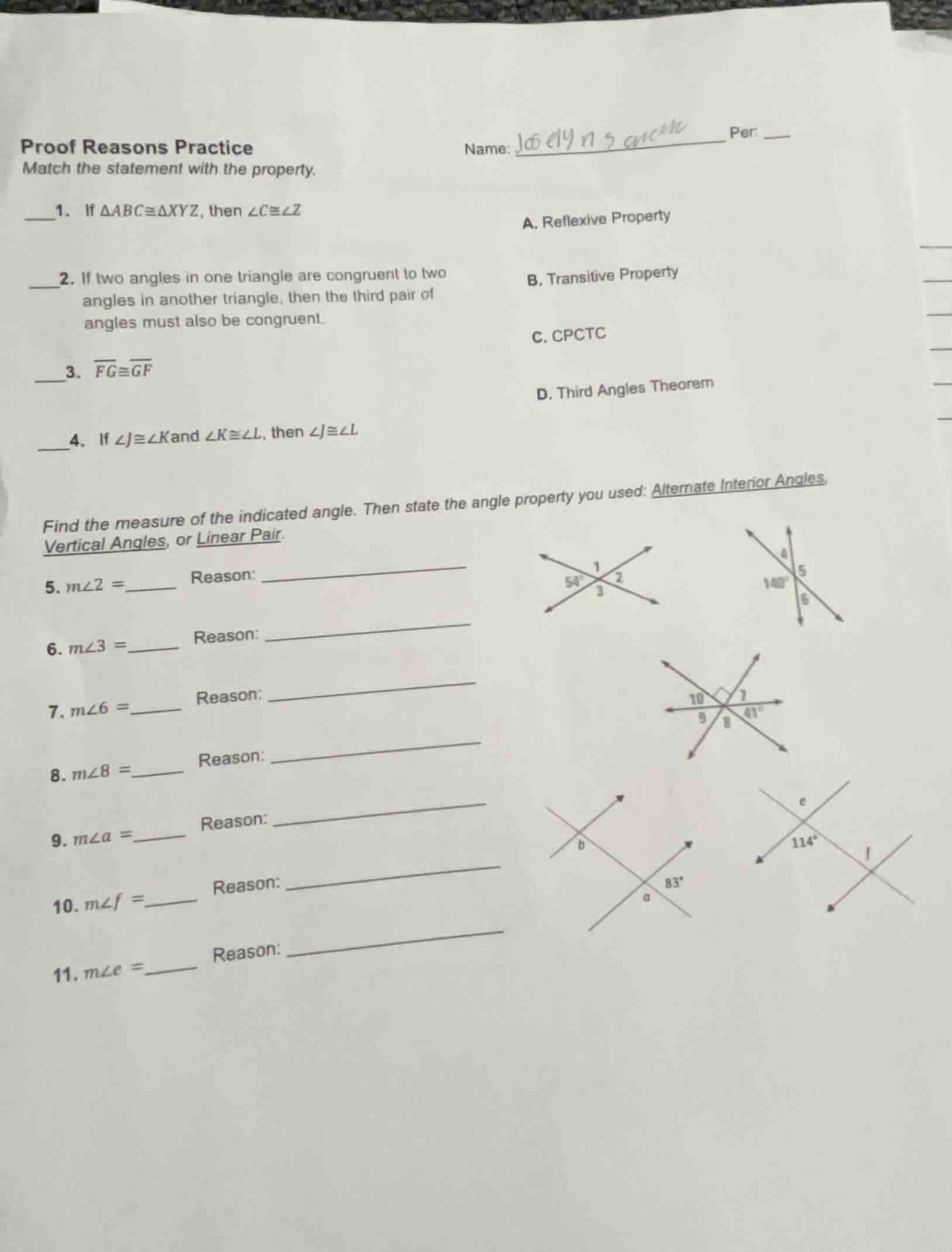
proof reasons practice
match the statement with the property.
- if $\triangle abc\cong\triangle xyz$, then $\angle c\cong\angle z$
- if two angles in one triangle are congruent to two angles in another triangle, then the third pair of angles must also be congruent.
- $\overline{fg}\cong\overline{gf}$
- if $\angle j\cong\angle k$ and $\angle k\cong\angle l$, then $\angle j\cong\angle l$
a. reflexive property
b. transitive property
c. cpctc
d. third angles theorem
find the measure of the indicated angle. then state the angle property you used: alternate interior angles, vertical angles, or linear pair.
- $m\angle 2 = \underline{\quad\quad}$ reason: $\underline{\quad\quad}$
- $m\angle 3 = \underline{\quad\quad}$ reason: $\underline{\quad\quad}$
- $m\angle 6 = \underline{\quad\quad}$ reason: $\underline{\quad\quad}$
- $m\angle 8 = \underline{\quad\quad}$ reason: $\underline{\quad\quad}$
- $m\angle a = \underline{\quad\quad}$ reason: $\underline{\quad\quad}$
- $m\angle f = \underline{\quad\quad}$ reason: $\underline{\quad\quad}$
- $m\angle e = \underline{\quad\quad}$ reason: $\underline{\quad\quad}$
Step1: Match statements to properties
- If $\triangle ABC \cong \triangle XYZ$, then $\angle C \cong \angle Z$ corresponds to CPCTC (Corresponding Parts of Congruent Triangles are Congruent).
- If two angles in one triangle are congruent to two angles in another triangle, then the third pair of angles must also be congruent corresponds to the Third Angles Theorem.
- $\overline{FG} \cong \overline{GF}$ corresponds to the Reflexive Property (a segment is congruent to itself).
- If $\angle J \cong \angle K$ and $\angle K \cong \angle L$, then $\angle J \cong \angle L$ corresponds to the Transitive Property.
Step2: Calculate angle 2 measure
$\angle 2$ forms a linear pair with the $54^\circ$ angle. Linear pairs sum to $180^\circ$.
$m\angle 2 = 180^\circ - 54^\circ = 126^\circ$
Step3: Calculate angle 3 measure
$\angle 3$ is a vertical angle to the $54^\circ$ angle, so they are congruent.
$m\angle 3 = 54^\circ$
Step4: Calculate angle 6 measure
$\angle 6$ is a vertical angle to the $140^\circ$ angle, so they are congruent.
$m\angle 6 = 140^\circ$
Step5: Calculate angle 8 measure
$\angle 8$ forms a linear pair with the $41^\circ$ angle. Linear pairs sum to $180^\circ$.
$m\angle 8 = 180^\circ - 41^\circ = 139^\circ$
Step6: Calculate angle a measure
$\angle a$ is a vertical angle to the $83^\circ$ angle, so they are congruent.
$m\angle a = 83^\circ$
Step7: Calculate angle f measure
$\angle f$ forms a linear pair with the $114^\circ$ angle. Linear pairs sum to $180^\circ$.
$m\angle f = 180^\circ - 114^\circ = 66^\circ$
Step8: Calculate angle e measure
$\angle e$ is a vertical angle to the $114^\circ$ angle, so they are congruent.
$m\angle e = 114^\circ$

Snap & solve any problem in the app
Get step-by-step solutions on Sovi AI
Photo-based solutions with guided steps
Explore more problems and detailed explanations
Matching Section:
- C. CPCTC
- D. Third Angles Theorem
- A. Reflexive Property
- B. Transitive Property
Angle Measure Section:
- $m\angle 2 = 126^\circ$, Reason: Linear Pair
- $m\angle 3 = 54^\circ$, Reason: Vertical Angles
- $m\angle 6 = 140^\circ$, Reason: Vertical Angles
- $m\angle 8 = 139^\circ$, Reason: Linear Pair
- $m\angle a = 83^\circ$, Reason: Vertical Angles
- $m\angle f = 66^\circ$, Reason: Linear Pair
- $m\angle e = 114^\circ$, Reason: Vertical Angles