QUESTION IMAGE
Question
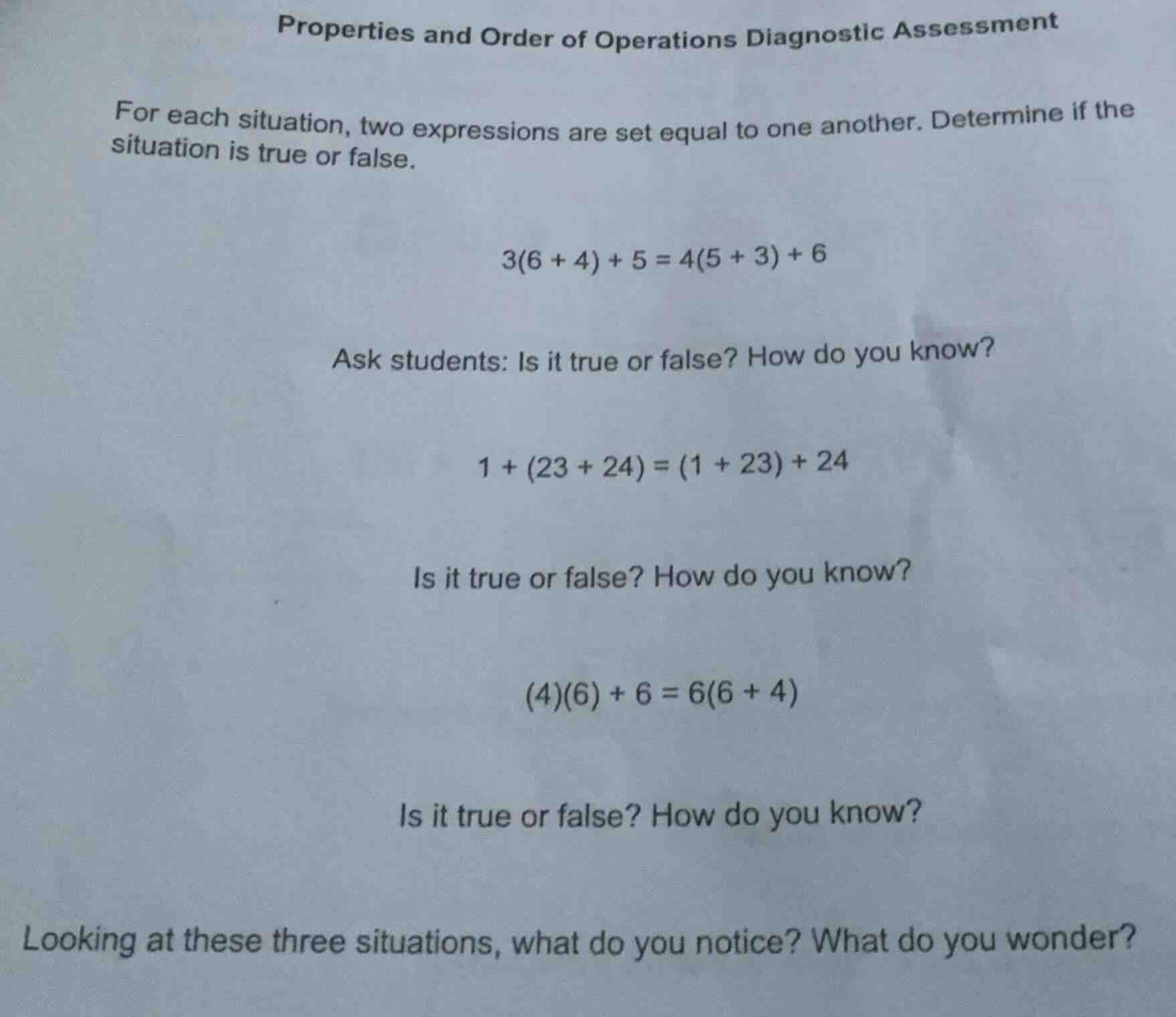
properties and order of operations diagnostic assessment
for each situation, two expressions are set equal to one another. determine if the
situation is true or false.
\\(3(6 + 4) + 5 = 4(5 + 3) + 6\\)
ask students: is it true or false? how do you know?
\\(1 + (23 + 24) = (1 + 23) + 24\\)
is it true or false? how do you know?
\\((4)(6) + 6 = 6(6 + 4)\\)
is it true or false? how do you know?
looking at these three situations, what do you notice? what do you wonder?
Step1: Evaluate left side of first equation
Calculate parentheses first, then multiply, then add:
$3(6+4)+5 = 3(10)+5 = 30+5 = 35$
Step2: Evaluate right side of first equation
Calculate parentheses first, then multiply, then add:
$4(5+3)+6 = 4(8)+6 = 32+6 = 38$
Step3: Compare first equation results
$35
eq 38$, so the first statement is false.
Step4: Evaluate left side of second equation
Calculate inner parentheses first, then add:
$1+(23+24) = 1+47 = 48$
Step5: Evaluate right side of second equation
Calculate inner parentheses first, then add:
$(1+23)+24 = 24+24 = 48$
Step6: Compare second equation results
$48 = 48$, so the second statement is true.
Step7: Evaluate left side of third equation
Multiply first, then add:
$(4)(6)+6 = 24+6 = 30$
Step8: Evaluate right side of third equation
Calculate parentheses first, then multiply:
$6(6+4) = 6(10) = 60$
Step9: Compare third equation results
$30
eq 60$, so the third statement is false.
Step10: Analyze patterns/observations
The second equation follows the associative property of addition, which guarantees equality. The other equations do not follow valid arithmetic properties, leading to unequal results.

Snap & solve any problem in the app
Get step-by-step solutions on Sovi AI
Photo-based solutions with guided steps
Explore more problems and detailed explanations
- $3(6 + 4) + 5 = 4(5 + 3) + 6$: False, since the left side equals 35 and the right side equals 38.
- $1 + (23 + 24) = (1 + 23) + 24$: True, since both sides equal 48 (this follows the associative property of addition, which states $(a+b)+c = a+(b+c)$).
- $(4)(6) + 6 = 6(6 + 4)$: False, since the left side equals 30 and the right side equals 60.
Observations:
- Equations that follow a valid arithmetic property (like the associative property of addition) are true, while those that do not apply proper properties or order of operations are false.
- The order of operations (parentheses first, then multiplication/division, then addition/subtraction) is critical to correctly evaluating each side of the equations.
Questions to wonder:
- How can we rearrange the false equations to make them true?
- What other arithmetic properties can we use to quickly verify if similar equations are true or false?