QUESTION IMAGE
Question
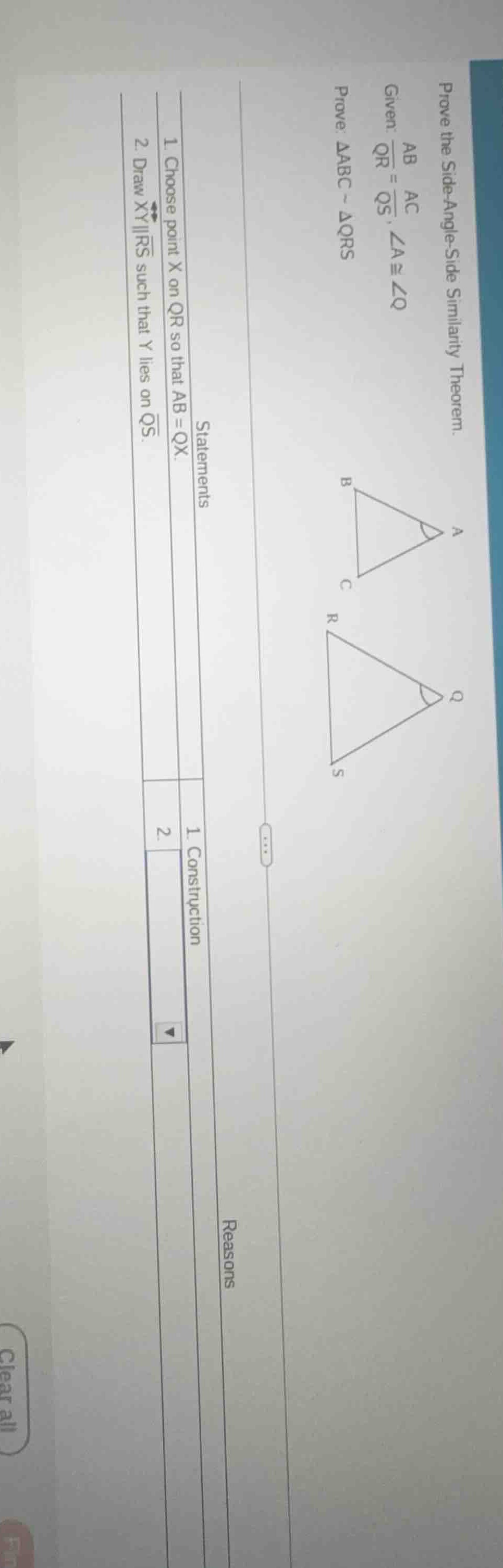
prove the side - angle - side similarity theorem.
given: \\(\frac{ab}{qr}=\frac{ac}{qs}\\), \\(\angle a\cong\angle q\\)
prove: \\(\triangle abc\sim\triangle qrs\\)
statements
- choose point x on qr so that ab = qx.
- draw \\(xy\parallel rs\\) such that y lies on \\(\overline{qs}\\).
reasons
- construction
2.
Step1: State given info
$\frac{AB}{QR} = \frac{AC}{QS}$, $\angle A \cong \angle Q$
Step2: Construct segment XY
Choose $X$ on $\overline{QR}$: $AB = QX$; draw $\overline{XY} \parallel \overline{RS}$, $Y$ on $\overline{QS}$
Step3: Prove $\Delta QXY \sim \Delta QRS$
By Basic Proportionality Theorem (AA similarity: $\angle Q$ common, $\angle QXY \cong \angle QRS$, $\angle QYX \cong \angle QSR$), so $\frac{QX}{QR} = \frac{QY}{QS}$
Step4: Substitute QX = AB
$\frac{AB}{QR} = \frac{QY}{QS}$. Given $\frac{AB}{QR} = \frac{AC}{QS}$, so $QY = AC$
Step5: Prove $\Delta ABC \cong \Delta QXY$
By SAS congruence: $AB = QX$, $\angle A \cong \angle Q$, $AC = QY$
Step6: Link congruence to similarity
Since $\Delta ABC \cong \Delta QXY$ and $\Delta QXY \sim \Delta QRS$, then $\Delta ABC \sim \Delta QRS$

Snap & solve any problem in the app
Get step-by-step solutions on Sovi AI
Photo-based solutions with guided steps
Explore more problems and detailed explanations
$\Delta ABC \sim \Delta QRS$ is proven via construction, similarity of triangles, congruence, and transitivity of similarity.
Completed Statement-Reason Table:
| Statements | Reasons |
|---|---|
| 2. Draw $\overline{XY} \parallel \overline{RS}$ such that $Y$ lies on $\overline{QS}$ | 2. Construction (Parallel Postulate) |
| 3. $\Delta QXY \sim \Delta QRS$ | 3. AA Similarity Postulate |
| 4. $\frac{QX}{QR} = \frac{QY}{QS}$ | 4. Corresponding sides of similar triangles are proportional |
| 5. $\frac{AB}{QR} = \frac{QY}{QS}$ | 5. Substitution ($AB = QX$) |
| 6. $\frac{AB}{QR} = \frac{AC}{QS}$ | 6. Given |
| 7. $QY = AC$ | 7. Transitive property of equal ratios |
| 8. $\Delta ABC \cong \Delta QXY$ | 8. SAS Congruence Postulate |
| 9. $\Delta ABC \sim \Delta QRS$ | 9. Transitivity of similarity (if $\cong$ then $\sim$, and $\Delta QXY \sim \Delta QRS$) |