QUESTION IMAGE
Question
2.6 ps - 9
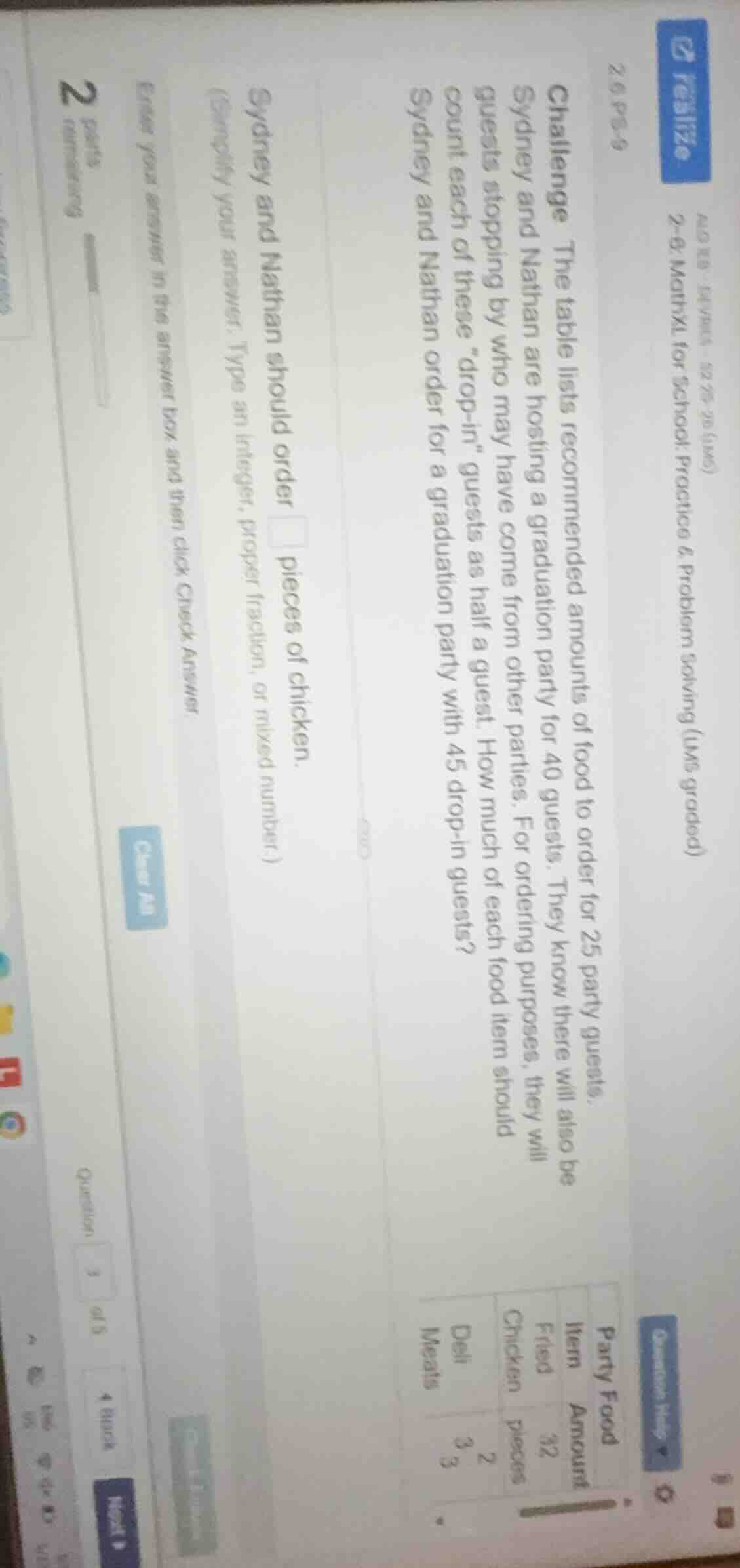
challenge the table lists recommended amounts of food to order for 25 party guests.
sydney and nathan are hosting a graduation party for 40 guests. they know there will also be guests stopping by who may have come from other parties. for ordering purposes, they will count each of these \drop - in\ guests as half a guest. how much of each food item should sydney and nathan order for a graduation party with 45 drop - in guests?
sydney and nathan should order
(simplify your answer. type an integer, proper fraction, or mixed number.)
pieces of chicken.
enter your answer in the answer box and then click check answer.
2 points
remaining
question 3 of 5
back
next
Step1: Find per - guest amount
For 25 guests, the amount of fried chicken is \(32\frac{2}{3}\) pieces (or \(\frac{98}{3}\) pieces). First, find the amount of chicken per guest. We divide the total chicken for 25 guests by 25. So, per - guest chicken amount \(=\frac{98}{3}\div25=\frac{98}{3}\times\frac{1}{25}=\frac{98}{75}\) pieces per guest.
Step2: Calculate for 45 guests
Now, we need to find the amount of chicken for 45 guests. We multiply the per - guest amount by 45. So, total chicken for 45 guests \(=\frac{98}{75}\times45\). We can simplify this: \(45\) and \(75\) have a common factor of \(15\). \(45\div15 = 3\) and \(75\div15=5\). So, \(\frac{98\times3}{5}=\frac{294}{5}=58\frac{4}{5}\) (or we can also do it as \(\frac{98}{75}\times45=\frac{98\times45}{75}=\frac{98\times3}{5}=\frac{294}{5} = 58.8\)). But since the original amount was a mixed number, we can present it as a mixed number.
Wait, maybe there is a better way. Let's re - examine the table. If the table says for 25 guests, the amount of fried chicken is \(32\frac{2}{3}\) (which is \(\frac{98}{3}\)) pieces. The number of guests they are expecting is 40 (original) plus 45 drop - in? Wait, no, the problem says "a graduation party with 45 drop - in guests". Wait, maybe I misread. Wait, the problem: "The table lists recommended amounts of food to order for 25 party guests. Sydney and Nathan are hosting a graduation party for 40 guests. They know there will also be guests stopping by who may have come from other parties. For ordering purposes, they will count each of these 'drop - in' guests as half a guest. How much of each food item should Sydney and Nathan order for a graduation party with 45 drop - in guests?" Wait, maybe the total number of "equivalent" guests is \(40 + 45\times0.5=40 + 22.5 = 62.5\) guests? Wait, no, maybe I misread the problem.
Wait, let's start over. The table is for 25 guests. Let's assume the fried chicken for 25 guests is \(32\frac{2}{3}\) (i.e., \(\frac{98}{3}\)) pieces.
First, find the amount per "equivalent" guest. Wait, the problem says "count each of these 'drop - in' guests as half a guest". So, the 40 guests are full guests, and 45 drop - in guests are counted as \(45\times0.5 = 22.5\) guests. So total equivalent guests \(=40+22.5 = 62.5\) guests.
Now, find the amount per guest from the 25 - guest table. So, per guest amount of fried chicken \(=\frac{98}{3}\div25=\frac{98}{75}\) pieces per guest.
Now, total equivalent guests are \(62.5\). So total chicken \(=\frac{98}{75}\times62.5\). Since \(62.5=\frac{125}{2}\), then \(\frac{98}{75}\times\frac{125}{2}=\frac{98\times125}{75\times2}=\frac{98\times5}{6}=\frac{490}{6}=\frac{245}{3}=81\frac{2}{3}\)? Wait, this is different from before. I must have misread the problem.
Wait, let's re - read the problem: "Sydney and Nathan are hosting a graduation party for 40 guests. They know there will also be guests stopping by who may have come from other parties. For ordering purposes, they will count each of these 'drop - in' guests as half a guest. How much of each food item should Sydney and Nathan order for a graduation party with 45 drop - in guests?"
Ah! So the total number of "equivalent" guests is \(40+45\times0.5=40 + 22.5 = 62.5\) guests.
Now, the table is for 25 guests. So, first, find the amount per guest for 25 guests. Let's take the fried chicken: for 25 guests, it's \(32\frac{2}{3}=\frac{98}{3}\) pieces.
So, amount per guest \(=\frac{98}{3}\div25=\frac{98}{75}\) pieces per guest.
Now, total equivalent guests \(=62.5=\frac{125}{2}\)
Total chicken \(=\frac{98}{75}\times\frac{12…

Snap & solve any problem in the app
Get step-by-step solutions on Sovi AI
Photo-based solutions with guided steps
Explore more problems and detailed explanations
\(81\frac{2}{3}\) (or \(\frac{245}{3}\))