QUESTION IMAGE
Question
6 pts
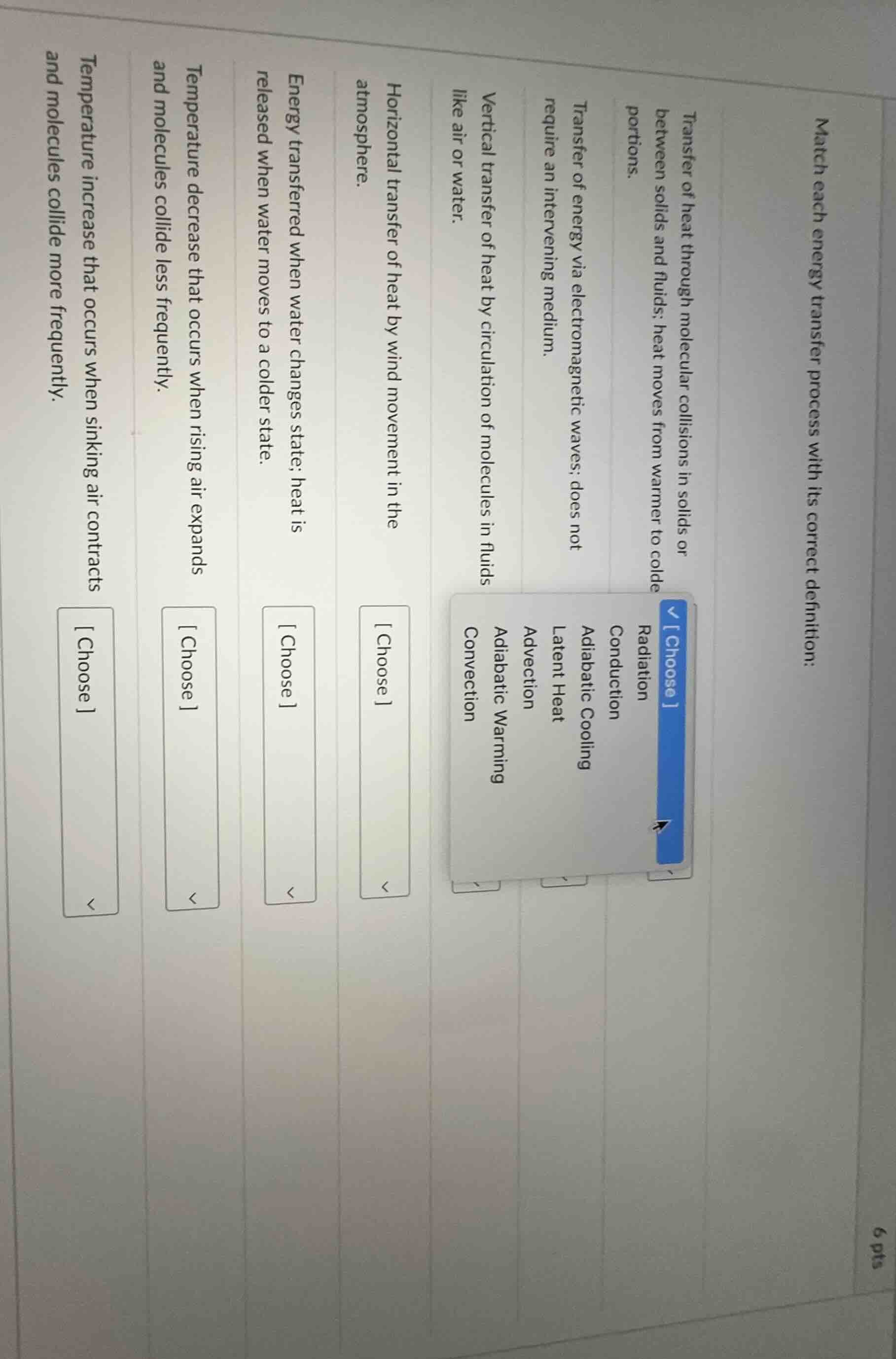
match each energy transfer process with its correct definition:
transfer of heat through molecular collisions in solids or between solids and fluids; heat moves from warmer to colder portions.
transfer of energy via electromagnetic waves; does not require an intervening medium.
vertical transfer of heat by circulation of molecules in fluids like air or water.
horizontal transfer of heat by wind movement in the atmosphere.
energy transferred when water changes state; heat is released when water moves to a colder state.
temperature decrease that occurs when rising air expands and molecules collide less frequently.
temperature increase that occurs when sinking air contracts and molecules collide more frequently.
choose
radiation
conduction
adiabatic cooling
latent heat
advection
adiabatic warming
convection
Each definition is matched to the corresponding heat transfer/energy process based on core characteristics of each term:
- Conduction relies on molecular collisions for heat transfer between solids/fluids.
- Radiation transfers energy via electromagnetic waves without a medium.
- Convection is vertical heat transfer via fluid circulation.
- Advection is horizontal heat transfer via wind in the atmosphere.
- Latent Heat involves energy transfer during water state changes.
- Adiabatic Cooling happens when rising air expands, lowering temperature and molecular collisions.
- Adiabatic Warming happens when sinking air contracts, raising temperature and molecular collisions.

Snap & solve any problem in the app
Get step-by-step solutions on Sovi AI
Photo-based solutions with guided steps
Explore more problems and detailed explanations
- Transfer of heat through molecular collisions in solids or between solids and fluids; heat moves from warmer to colder portions. → Conduction
- Transfer of energy via electromagnetic waves; does not require an intervening medium. → Radiation
- Vertical transfer of heat by circulation of molecules in fluids like air or water. → Convection
- Horizontal transfer of heat by wind movement in the atmosphere. → Advection
- Energy transferred when water changes state; heat is released when water moves to a colder state. → Latent Heat
- Temperature decrease that occurs when rising air expands and molecules collide less frequently. → Adiabatic Cooling
- Temperature increase that occurs when sinking air contracts and molecules collide more frequently. → Adiabatic Warming