QUESTION IMAGE
Question
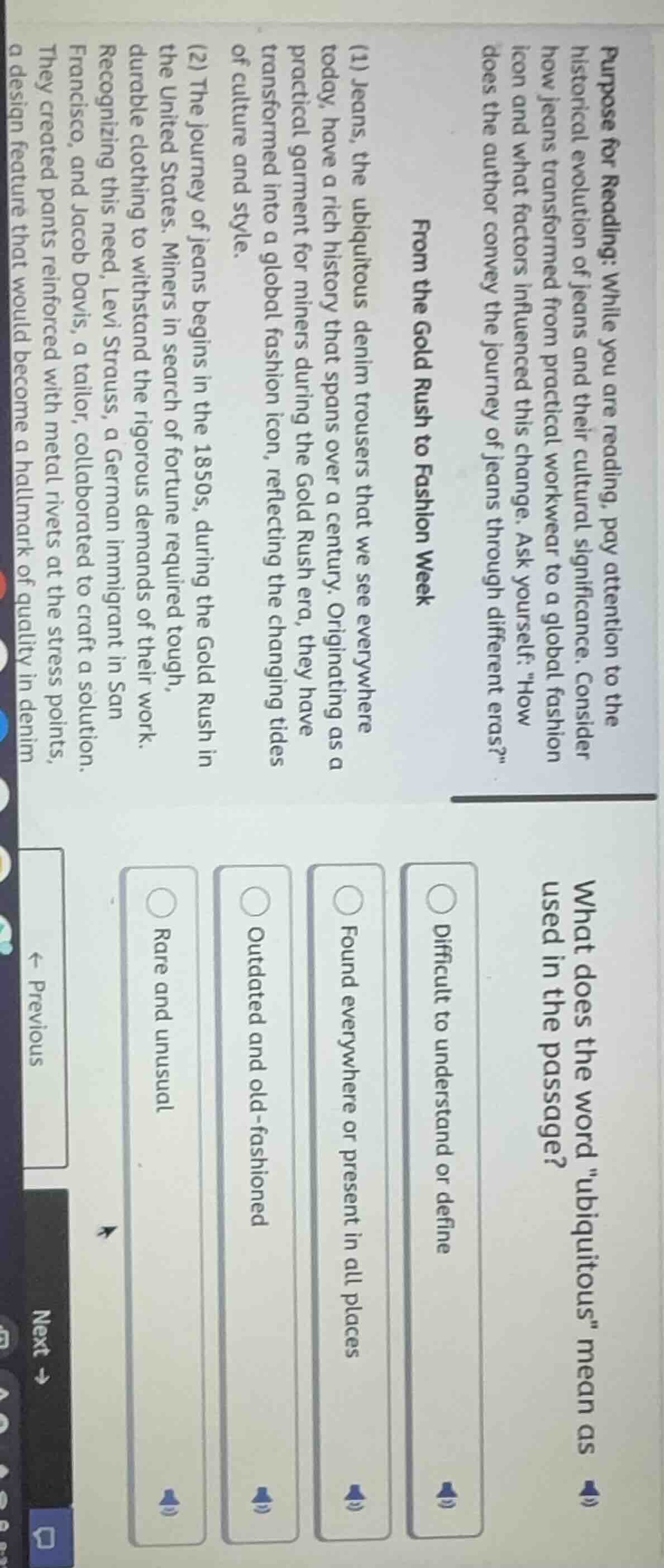
purpose for reading: while you are reading, pay attention to the historical evolution of jeans and their cultural significance. consider how jeans transformed from practical workwear to a global fashion icon and what factors influenced this change. ask yourself: \how does the author convey the journey of jeans through different eras?\
from the gold rush to fashion week
(1) jeans, the ubiquitous denim trousers that we see everywhere today, have a rich history that spans over a century. originating as a practical garment for miners during the gold rush era, they have transformed into a global fashion icon, reflecting the changing tides of culture and style.
(2) the journey of jeans begins in the 1850s, during the gold rush in the united states. miners in search of fortune required tough, durable clothing to withstand the rigorous demands of their work. recognizing this need, levi strauss, a german immigrant in san francisco, and jacob davis, a tailor, collaborated to craft a solution. they created pants reinforced with metal rivets at the stress points, a design feature that would become a hallmark of quality in denim
what does the word \ubiquitous\ mean as used in the passage?
○ difficult to understand or define
○ found everywhere or present in all places
○ outdated and old - fashioned
○ rare and unusual
To determine the meaning of "ubiquitous" in the passage, we analyze the context. The sentence says "the ubiquitous denim trousers that we see everywhere today". The phrase "we see everywhere" implies that the denim trousers are present in all places or found everywhere. Let's check the options:
- "Difficult to understand or define" does not match the context of being seen everywhere.
- "Outdated and old - fashioned" is incorrect as the passage talks about jeans being a global fashion icon, not old - fashioned.
- "Rare and unusual" is the opposite of what "we see everywhere" suggests.
- "Found everywhere or present in all places" matches the context of "we see everywhere" in the passage.

Snap & solve any problem in the app
Get step-by-step solutions on Sovi AI
Photo-based solutions with guided steps
Explore more problems and detailed explanations
C. Found everywhere or present in all places (assuming the option with this text is labeled as such; if the original options had labels like A, B, C, D, and this is option C, then it would be C. Found everywhere or present in all places)