QUESTION IMAGE
Question
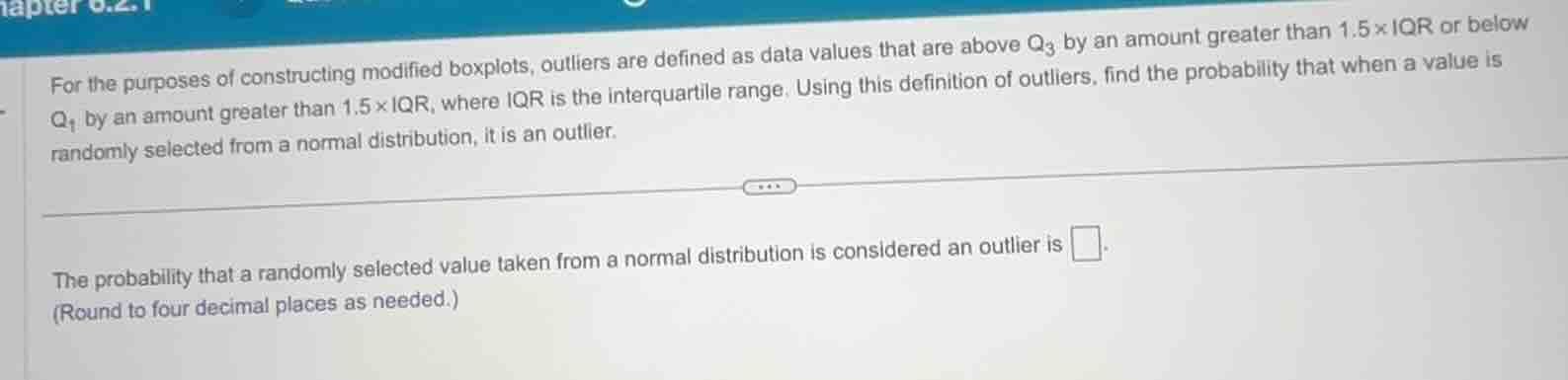
for the purposes of constructing modified boxplots, outliers are defined as data values that are above ( q_3 ) by an amount greater than ( 1.5 \times \text{iqr} ) or below ( q_1 ) by an amount greater than ( 1.5 \times \text{iqr} ), where iqr is the interquartile range. using this definition of outliers, find the probability that when a value is randomly selected from a normal distribution, it is an outlier.
the probability that a randomly selected value taken from a normal distribution is considered an outlier is (square).
(round to four decimal places as needed.)
Step1: Define standard normal quartiles
For a standard normal distribution $Z \sim N(0,1)$, $Q_1$ is the 25th percentile: $z_{0.25} \approx -0.6745$, and $Q_3$ is the 75th percentile: $z_{0.75} \approx 0.6745$.
Step2: Calculate IQR
Compute interquartile range:
$IQR = Q_3 - Q_1 = 0.6745 - (-0.6745) = 1.349$
Step3: Find outlier thresholds
Calculate lower and upper bounds:
Lower bound: $Q_1 - 1.5 \times IQR = -0.6745 - 1.5 \times 1.349 = -0.6745 - 2.0235 = -2.698$
Upper bound: $Q_3 + 1.5 \times IQR = 0.6745 + 1.5 \times 1.349 = 0.6745 + 2.0235 = 2.698$
Step4: Calculate tail probabilities
Find $P(Z < -2.698) \approx 0.0035$, and $P(Z > 2.698) \approx 0.0035$ (due to symmetry of normal distribution).
Step5: Total outlier probability
Sum the two tail probabilities:
$P(\text{outlier}) = 0.0035 + 0.0035 = 0.0070$

Snap & solve any problem in the app
Get step-by-step solutions on Sovi AI
Photo-based solutions with guided steps
Explore more problems and detailed explanations
0.0070