QUESTION IMAGE
Question
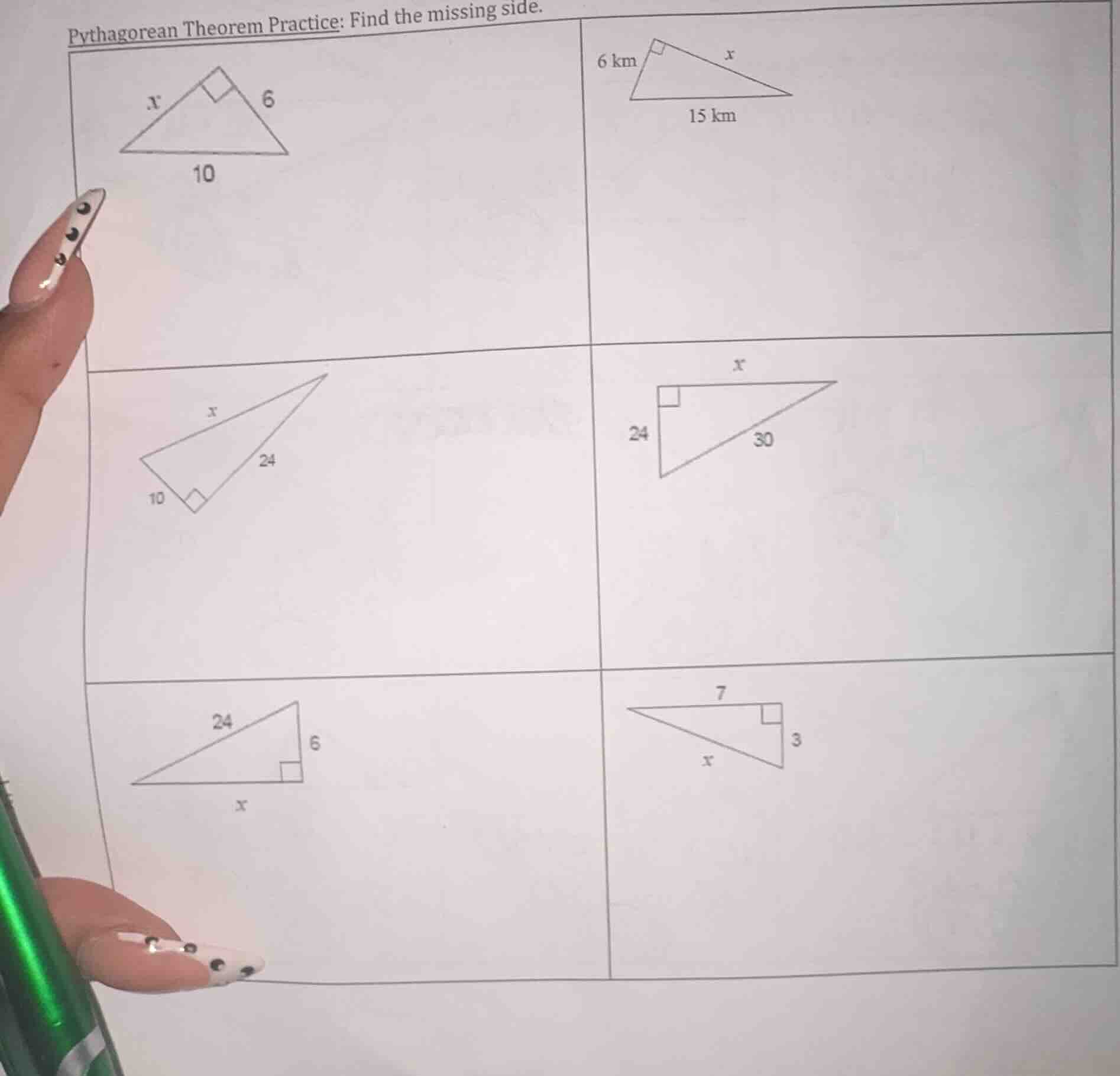
pythagorean theorem practice: find the missing side.
(first triangle: right triangle with legs 6 and x, hypotenuse 10; second triangle: right triangle with leg 6 km, leg 15 km, hypotenuse x; third triangle: right triangle with leg 10, leg 24, hypotenuse x; fourth triangle: right triangle with leg 24, hypotenuse 30, leg x; fifth triangle: right triangle with leg 6, hypotenuse 24, leg x; sixth triangle: right triangle with leg 7, leg 3, hypotenuse x)
Top - Left Triangle
Step1: Identify sides (leg, leg, hypotenuse)
We have a right - triangle with one leg \(a = 6\), hypotenuse \(c=10\), and the other leg \(x\). The Pythagorean theorem is \(a^{2}+x^{2}=c^{2}\), so we can re - arrange it to \(x^{2}=c^{2}-a^{2}\)
Step2: Substitute values
Substitute \(a = 6\) and \(c = 10\) into the formula: \(x^{2}=10^{2}-6^{2}=100 - 36=64\)
Step3: Solve for x
Take the square root of both sides: \(x=\sqrt{64} = 8\)
Top - Right Triangle
Step1: Identify sides (leg, leg, hypotenuse)
We have a right - triangle with one leg \(a = 6\), one leg \(b = 15\)? Wait, no. Wait, the right - angle is between the side of length \(6\) and the other leg, and \(x\) is the hypotenuse? Wait, no. Wait, in a right - triangle, the hypotenuse is the longest side. So if the legs are \(6\) and let's say the other leg is \(b\), and hypotenuse is \(x\)? Wait, no, the side of length \(15\) is longer than \(6\), so the legs are \(6\) and the other leg, and hypotenuse is \(15\)? Wait, no, the right - angle is at the vertex with the \(6\) and the other leg. So using Pythagorean theorem \(a^{2}+b^{2}=c^{2}\), where \(a = 6\), \(b\) is the unknown leg, and \(c = 15\)? Wait, no, that can't be. Wait, maybe I made a mistake. Wait, the triangle has sides \(6\) (one leg), \(x\) (the hypotenuse), and the other leg is \(15\)? No, \(15>6\), but hypotenuse should be the longest. So maybe the legs are \(6\) and the other leg, and hypotenuse is \(x\). Wait, no, the length of \(15\) is the base. Wait, let's re - examine. The right - angle is between the side of length \(6\) and the vertical side? Wait, no, the triangle has a right - angle, one side is \(6\) (a leg), the base is \(15\) (a leg), and \(x\) is the hypotenuse. Then by Pythagorean theorem \(x^{2}=6^{2}+15^{2}=36 + 225=261\), \(x=\sqrt{261}\approx16.16\). Wait, maybe I misidentified the sides. Wait, the problem says "find the missing side". Let's check again. If the right - angle is at the corner with the \(6\) and the side \(x\), then the legs are \(6\) and \(x\), and hypotenuse is \(15\). Then \(6^{2}+x^{2}=15^{2}\), \(x^{2}=225 - 36 = 189\), \(x=\sqrt{189}\approx13.75\). Wait, maybe the original triangle: the right - angle is between the side of length \(6\) and the other leg, and the side of length \(15\) is the hypotenuse. So \(a = 6\), \(c = 15\), find \(b=x\). Then \(x^{2}=c^{2}-a^{2}=15^{2}-6^{2}=225 - 36 = 189\), \(x=\sqrt{189}=3\sqrt{21}\approx13.75\)
Middle - Left Triangle
Step1: Identify sides (leg, leg, hypotenuse)
We have a right - triangle with legs \(a = 10\) and \(b = 24\), and hypotenuse \(x\). Using Pythagorean theorem \(x^{2}=a^{2}+b^{2}\)
Step2: Substitute values
Substitute \(a = 10\) and \(b = 24\) into the formula: \(x^{2}=10^{2}+24^{2}=100 + 576=676\)
Step3: Solve for x
Take the square root of both sides: \(x=\sqrt{676}=26\)
Middle - Right Triangle

Snap & solve any problem in the app
Get step-by-step solutions on Sovi AI
Photo-based solutions with guided steps
Explore more problems and detailed explanations
s:
- Top - Left: \(x = 8\)
- Top - Right: \(x=\sqrt{189}\approx13.75\) (or \(3\sqrt{21}\))
- Middle - Left: \(x = 26\)
- Middle - Right: \(x = 18\)
- Bottom - Left: \(x = 6\sqrt{15}\approx23.24\)
- Bottom - Right: \(x=\sqrt{58}\approx7.62\)