QUESTION IMAGE
Question
q3, assignment 19: principles vs. practices
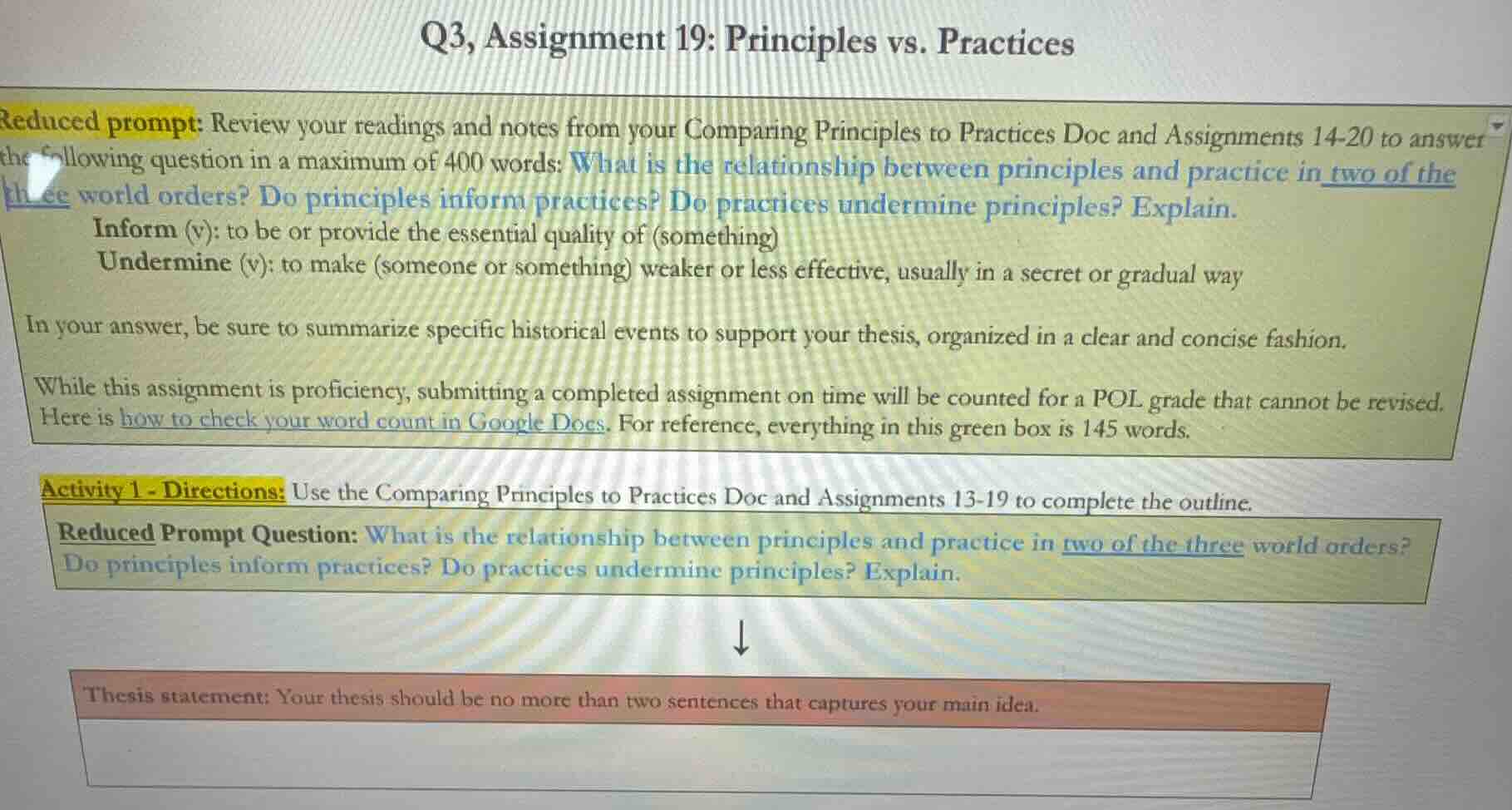
reduced prompt: review your readings and notes from your comparing principles to practices doc and assignments 14-20 to answer the following question in a maximum of 400 words: what is the relationship between principles and practice in two of the three world orders? do principles inform practices? do practices undermine principles? explain.
inform (v): to be or provide the essential quality of (something)
undermine (v): to make (someone or something) weaker or less effective, usually in a secret or gradual way
in your answer, be sure to summarize specific historical events to support your thesis, organized in a clear and concise fashion.
while this assignment is proficiency, submitting a completed assignment on time will be counted for a pol grade that cannot be revised.
here is how to check your word count in google docs. for reference, everything in this green box is 145 words.
activity 1 - directions: use the comparing principles to practices doc and assignments 13-19 to complete the outline.
reduced prompt question: what is the relationship between principles and practice in two of the three world orders? do principles inform practices? do practices undermine principles? explain.
thesis statement: your thesis should be no more than two sentences that captures your main idea.
The response addresses the relationship between principles and practices in the post-WWII liberal international order and the Cold War bipolar order, with historical evidence. The thesis frames the dynamic as bidirectional: principles often guide formal practices but are frequently undermined by pragmatic state actions.
For the liberal international order, the principle of collective security (from the UN Charter) informed the creation of the UN Security Council, a practice meant to prevent global conflict. However, the 1950 Korean War showed practices undermining this principle: the US led a military coalition without formal UN Security Council approval (due to a Soviet boycott), bypassing the collective security framework to pursue anti-communist goals.
For the Cold War bipolar order, the principle of self-determination (from the UN Charter) informed decolonization practices, as colonial powers like Britain granted independence to states such as India in 1947. Yet, both US and Soviet practices undermined this principle: the US backed authoritarian regimes in South Vietnam (1955-1975) to stop communist expansion, while the Soviet Union invaded Hungary in 1956 to crush a popular uprising seeking self-rule, prioritizing bloc control over the principle of self-determination.

Snap & solve any problem in the app
Get step-by-step solutions on Sovi AI
Photo-based solutions with guided steps
Explore more problems and detailed explanations
Thesis Statement:
In the post-WWII liberal international order and Cold War bipolar order, principles typically inform the formal structures of global practices, but state self-interest regularly undermines these foundational principles.
Supporting Details:
- Post-WWII Liberal International Order:
- Principle: Collective security (UN Charter)
- Informed Practice: Creation of the UN Security Council to coordinate global conflict response
- Undermining Practice: US-led intervention in the 1950 Korean War without full UN Security Council authorization (exploiting a Soviet boycott) to advance anti-communist aims, bypassing the collective security framework.
- Cold War Bipolar Order:
- Principle: Self-determination (UN Charter)
- Informed Practice: Decolonization of states like India (1947) as colonial powers recognized the right to self-rule
- Undermining Practice: Soviet invasion of Hungary (1956) to suppress a pro-democracy uprising, and US support for authoritarian regimes in South Vietnam (1955-1975), both prioritizing bloc power over the principle of self-determination.