QUESTION IMAGE
Question
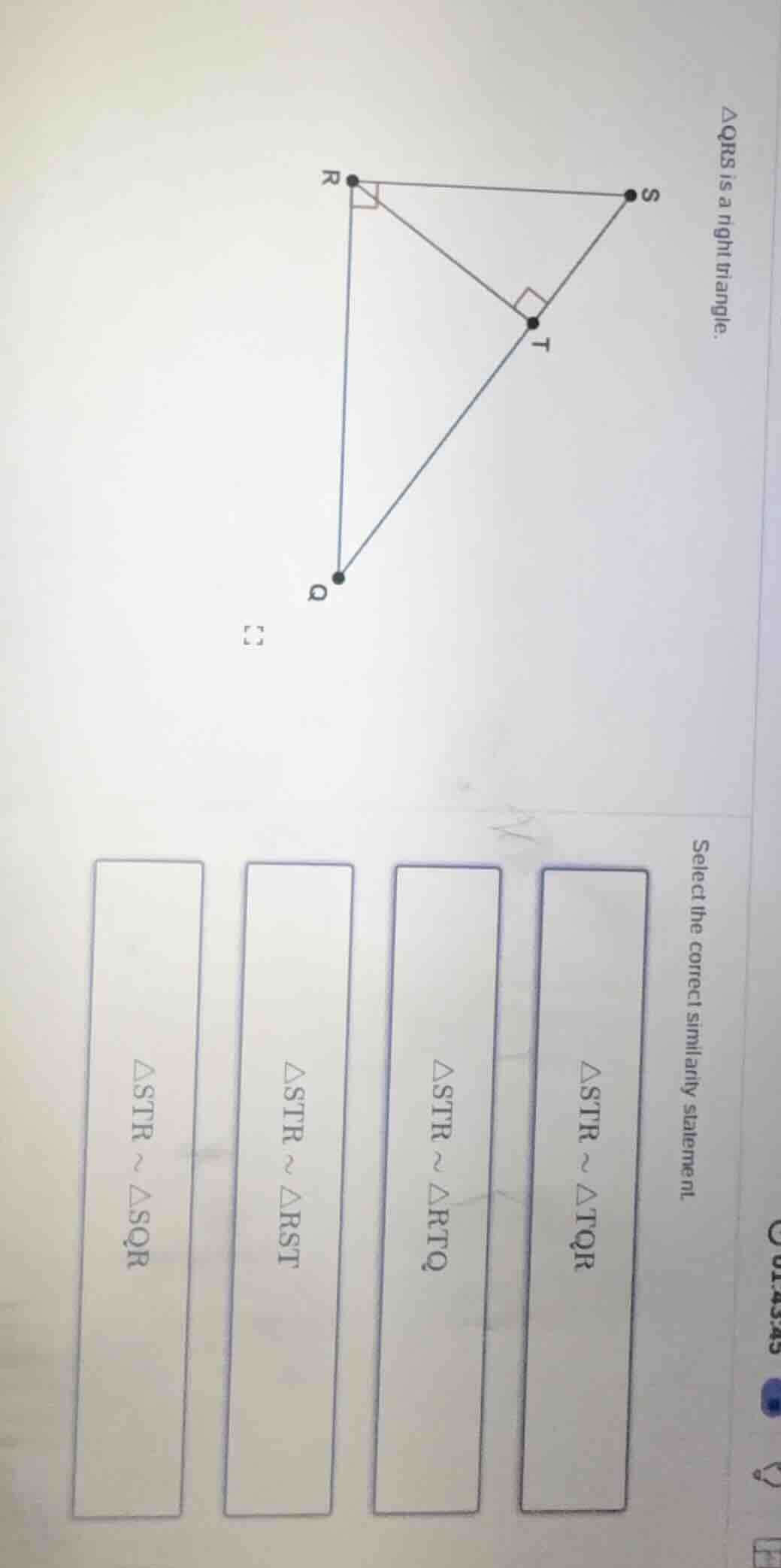
△qrs is a right triangle.
select the correct similarity statement.
△str ~ △tqr
△str ~ △rtq
△str ~ △rst
△str ~ △sqr
Step1: Recall Similar Triangles in Right Triangles
In a right triangle, when an altitude is drawn to the hypotenuse, the two smaller triangles are similar to the original triangle and to each other. Here, \(\triangle QRS\) is a right triangle with right angle at \(R\), and \(RT\) (or \(ST\)?) is an altitude? Wait, looking at the diagram, \(\angle R\) and \(\angle T\) are right angles. So \(\triangle STR\) and \(\triangle SQR\): Wait, no, let's check angles.
For \(\triangle STR\) and \(\triangle SQR\): \(\angle S\) is common. \(\angle STR = \angle SQR = 90^\circ\)? Wait, no, \(\triangle QRS\) is right at \(R\), so \(\angle R = 90^\circ\). \(\triangle STR\) is right at \(T\), \(\triangle SQR\) is right at \(R\). Wait, maybe better to use AA similarity.
Wait, let's list the triangles:
- \(\triangle STR\): right at \(T\), angles: \(\angle S\), \(\angle T = 90^\circ\), \(\angle R\) (of \(\triangle STR\))? Wait, no, vertices: \(S\), \(T\), \(R\). So \(\angle at T\) is right.
- \(\triangle SQR\): right at \(R\), vertices \(S\), \(Q\), \(R\). \(\angle at R\) is right.
Now, \(\angle S\) is common to both \(\triangle STR\) and \(\triangle SQR\). And both have a right angle (\(\angle T = 90^\circ\) and \(\angle R = 90^\circ\)). So by AA similarity, \(\triangle STR \sim \triangle SQR\) because they share \(\angle S\) and both have a right angle. Wait, but let's check the other options.
Option 2: \(\triangle STR \sim \triangle RST\). But \(\triangle RST\) is the same as \(\triangle STR\) (same vertices), so not similar in a non-trivial way.
Option 3: \(\triangle STR \sim \triangle RTQ\). Let's check angles. \(\triangle RTQ\) is right at \(T\)? Wait, \(\angle T\) in \(\triangle RTQ\): the diagram shows \(\angle at T\) is right? Wait, original triangle \(\triangle QRS\) is right at \(R\), and \(T\) is a point on \(QS\) (since \(T\) is on \(QS\), as the right angle at \(T\) is on \(QS\)). So \(QS\) is the hypotenuse of \(\triangle QRS\), and \(T\) is the foot of the altitude from \(R\) to \(QS\)? Wait, no, the right angle at \(T\) is between \(ST\) and \(RT\)? Wait, maybe I misread the diagram.
Wait, the diagram: \(\triangle QRS\) is right at \(R\) (so \(QR \perp RS\)). Then \(T\) is a point on \(QS\) such that \(RT \perp QS\) (since \(\angle at T\) is right). So then, in right triangle \(QRS\), with altitude \(RT\) to hypotenuse \(QS\), we have the three similar triangles: \(\triangle QRS \sim \triangle STR \sim \triangle RTQ\)? Wait, no, the three similar triangles are \(\triangle QRS\), \(\triangle QRT\), and \(\triangle RST\). Wait, maybe I messed up the labels.
Wait, let's correct: In right triangle \(QRS\) (right at \(R\)), when we draw an altitude from \(R\) to hypotenuse \(QS\), meeting at \(T\), then:
- \(\triangle QRS \sim \triangle QRT\) (AA: \(\angle Q\) common, right angles at \(R\) and \(T\))
- \(\triangle QRS \sim \triangle RST\) (AA: \(\angle S\) common, right angles at \(R\) and \(T\))
- \(\triangle QRT \sim \triangle RST\) (AA: right angles and \(\angle Q + \angle S = 90^\circ\), so \(\angle Q = \angle RST\) and \(\angle S = \angle QRT\))
Now, \(\triangle STR\) is \(\triangle RST\) (same as \(\triangle RST\)). Wait, the options:
- \(\triangle STR \sim \triangle SQR\): \(\triangle SQR\) is \(\triangle QRS\) (same as \(\triangle QRS\)). So \(\triangle RST \sim \triangle QRS\) (which is true, as \(\triangle RST \sim \triangle QRS\) by AA: \(\angle S\) common, right angles). So \(\triangle STR\) (which is \(\triangle RST\)) is similar to \(\triangle SQR\) (which is \(\triangle QRS\)). So that's correct.
Wait, maybe t…

Snap & solve any problem in the app
Get step-by-step solutions on Sovi AI
Photo-based solutions with guided steps
Explore more problems and detailed explanations
A. \(\triangle STR \sim \triangle SQR\)