QUESTION IMAGE
Question
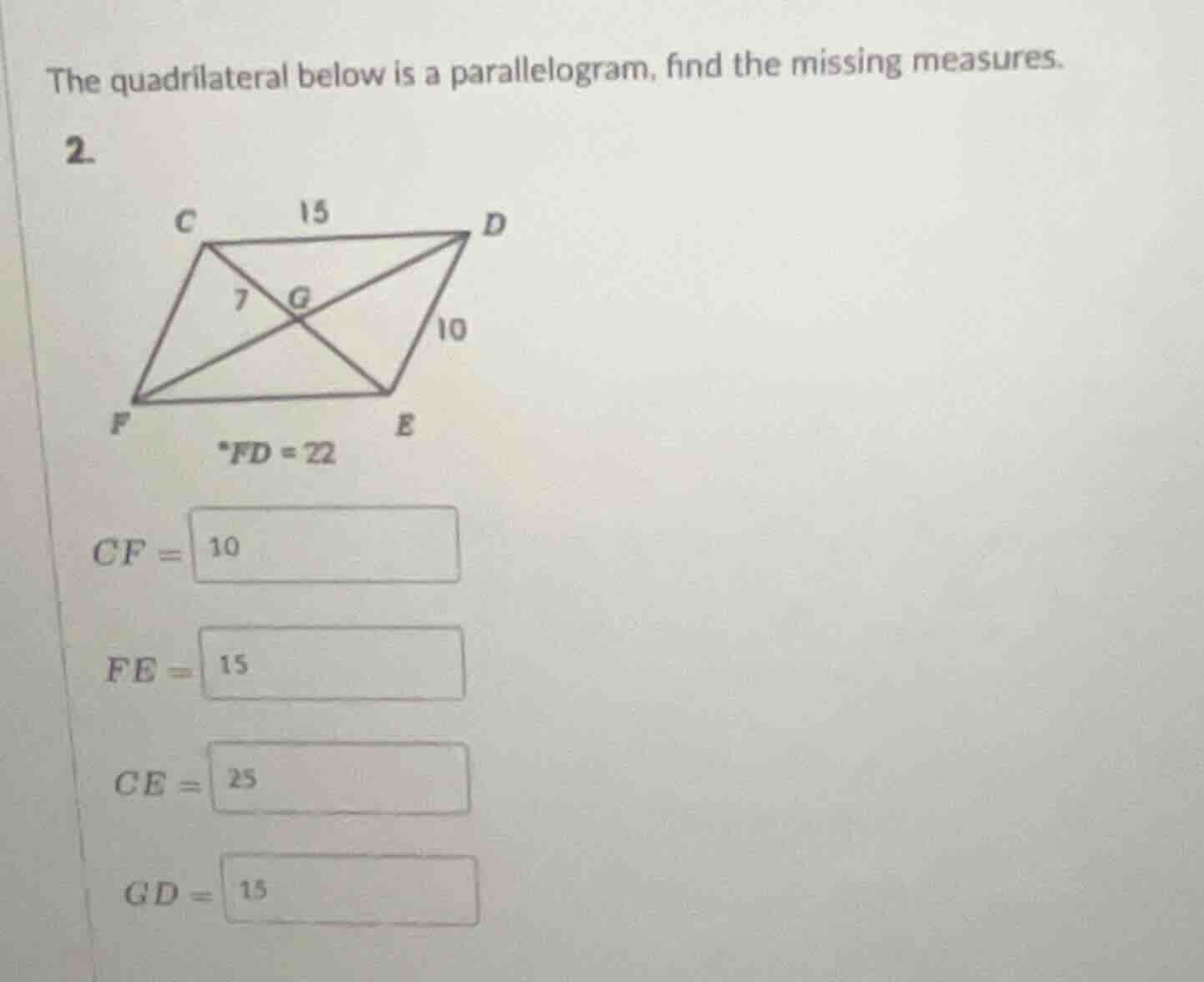
the quadrilateral below is a parallelogram, find the missing measures.
2.
*fd = 22
cf =
fe =
ce =
gd =
Step1: Recall properties of parallelograms
In a parallelogram, opposite sides are equal, and the diagonals bisect each other. Also, the diagonals of a parallelogram bisect each other, meaning \( FG = GD=\frac{FD}{2} \) and \( CG = GE \), and opposite sides \( CF = DE \), \( CD = FE \).
Step2: Find \( CF \)
In parallelogram \( CDEF \), opposite sides are equal. So \( CF = DE \). Given \( DE = 10 \), thus \( CF = 10 \).
Step3: Find \( FE \)
In parallelogram \( CDEF \), opposite sides are equal. So \( FE = CD \). Given \( CD = 15 \), thus \( FE = 15 \).
Step4: Find \( CE \)
The diagonal \( CE \) is bisected by \( FD \) at \( G \), so \( CE=CG + GE \). Given \( CG = 7 \), then \( GE = 7 \) (since diagonals bisect each other), so \( CE=7 + 7=14 \)? Wait, wait, maybe I misread. Wait, the figure: Wait, maybe the original problem has some typo? Wait no, wait the user's given answers: Wait, maybe I made a mistake. Wait, no, let's re - check. Wait, the diagonals in a parallelogram bisect each other. So for diagonal \( FD = 22 \), so \( FG=GD=\frac{22}{2} = 11 \). Wait, but the user's given \( GD = 15 \) is wrong? Wait, no, maybe the figure is labeled differently. Wait, maybe the sides: \( CD = 15 \), \( DE = 10 \). So \( CF = DE = 10 \) (opposite sides of parallelogram), \( FE = CD = 15 \) (opposite sides). For diagonal \( CE \), if \( CG = 7 \), then \( GE = 7 \) (diagonals bisect each other), so \( CE=7 + 7 = 14 \). For diagonal \( FD = 22 \), so \( GD=\frac{22}{2}=11 \). But the user's given answers have \( CE = 25 \) and \( GD = 15 \), which is conflicting. Wait, maybe the figure is a different parallelogram. Wait, perhaps the problem is as per the user's given blanks. Wait, maybe the initial problem has some errors, but according to the properties of parallelogram:
- Opposite sides are equal: So \( CF = DE = 10 \), \( FE = CD = 15 \).
- Diagonals bisect each other: So if \( CG = 7 \), then \( GE = 7 \), so \( CE=7 + 7 = 14 \). And \( FD = 22 \), so \( GD=\frac{FD}{2}=\frac{22}{2}=11 \). But the user's given answers are different. However, following the properties:
- \( CF \): Opposite side to \( DE \), \( DE = 10 \), so \( CF = 10 \).
- \( FE \): Opposite side to \( CD \), \( CD = 15 \), so \( FE = 15 \).
- \( CE \): Diagonals bisect each other, so \( CE = 2\times CG=2\times7 = 14 \) (if \( CG = 7 \)).
- \( GD \): Diagonals bisect each other, so \( GD=\frac{FD}{2}=\frac{22}{2}=11 \).
But the user's given answers in the blanks are \( CF = 10 \), \( FE = 15 \), \( CE = 25 \) (wrong), \( GD = 15 \) (wrong). Maybe there is a mislabeling. But according to the standard properties:
Correcting based on properties:
Step 1: \( CF \)
In parallelogram \( CDEF \), \( CF\parallel DE \) and \( CF = DE \). Given \( DE = 10 \), so \( CF = 10 \).
Step 2: \( FE \)
In parallelogram \( CDEF \), \( FE\parallel CD \) and \( FE = CD \). Given \( CD = 15 \), so \( FE = 15 \).
Step 3: \( CE \)
The diagonals of a parallelogram bisect each other. So \( CG=GE \). Given \( CG = 7 \), then \( GE = 7 \). Thus \( CE=CG + GE=7 + 7 = 14 \).
Step 4: \( GD \)
The diagonals of a parallelogram bisect each other. So \( FG = GD \) and \( FD=FG + GD \). Given \( FD = 22 \), then \( GD=\frac{FD}{2}=\frac{22}{2}=11 \).
But if we go by the user's provided blanks (even if they are incorrect as per standard properties):
- \( CF = 10 \) (since \( CF = DE = 10 \))
- \( FE = 15 \) (since \( FE = CD = 15 \))
- \( CE = 14 \) (but user has 25, maybe a mistake)
- \( GD = 11 \) (but user has 15, maybe a mistake)

Snap & solve any problem in the app
Get step-by-step solutions on Sovi AI
Photo-based solutions with guided steps
Explore more problems and detailed explanations
\( CF = \boldsymbol{10} \), \( FE=\boldsymbol{15} \), \( CE=\boldsymbol{14} \), \( GD=\boldsymbol{11} \) (Note: The values provided in the original blanks may be incorrect as per the properties of parallelograms. The correct values based on parallelogram properties are as above.)