QUESTION IMAGE
Question
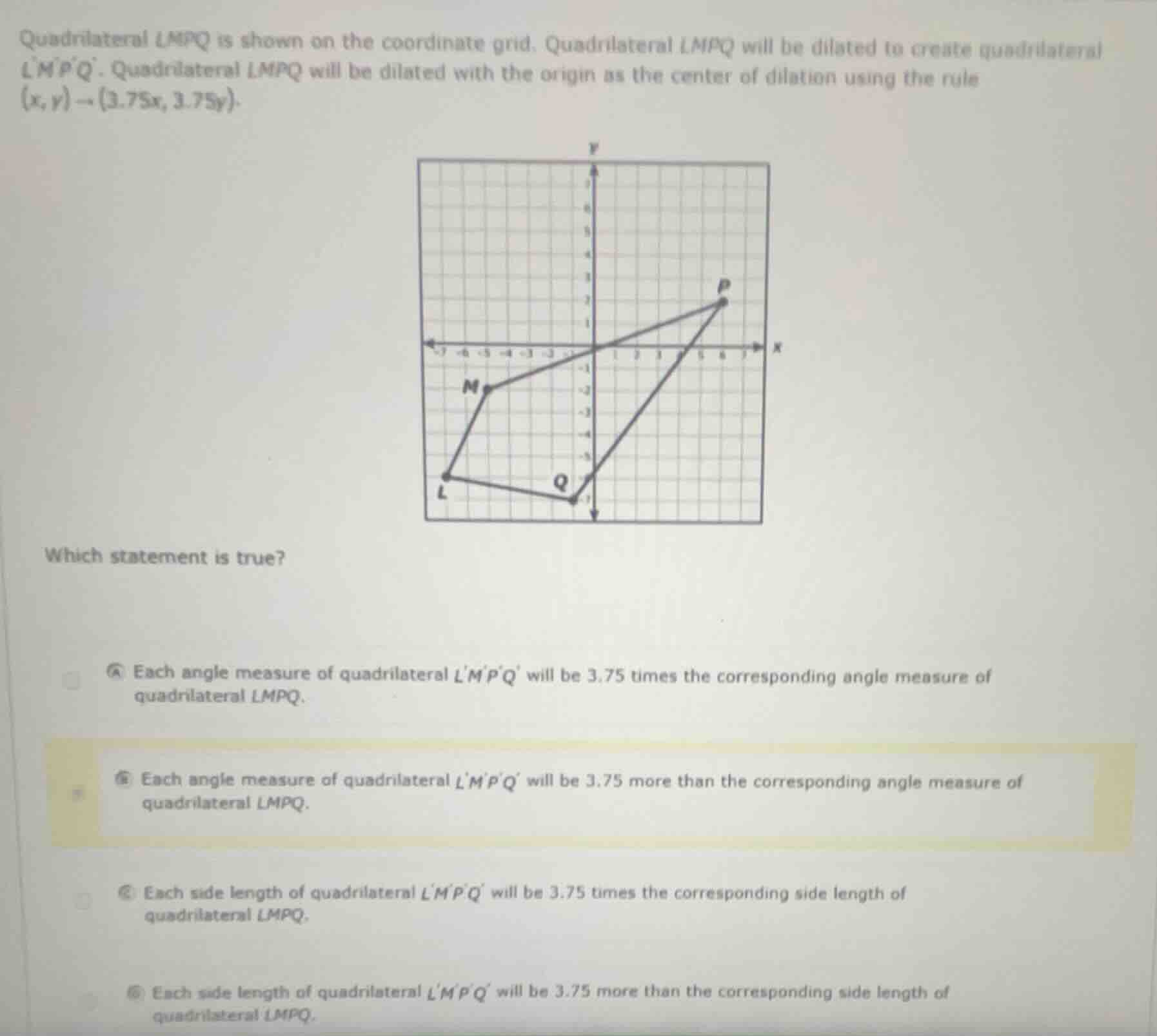
quadrilateral lmpq is shown on the coordinate grid. quadrilateral lmpq will be dilated to create quadrilateral lmpq. quadrilateral lmpq will be dilated with the origin as the center of dilation using the rule ((x,y)\to(3.75x, 3.75y)).
which statement is true?
a each angle measure of quadrilateral (lmpq) will be 3.75 times the corresponding angle measure of quadrilateral lmpq.
b each angle measure of quadrilateral (lmpq) will be 3.75 more than the corresponding angle measure of quadrilateral lmpq.
c each side length of quadrilateral (lmpq) will be 3.75 times the corresponding side length of quadrilateral lmpq.
d each side length of quadrilateral (lmpq) will be 3.75 more than the corresponding side length of quadrilateral lmpq.
Dilation is a transformation that scales a figure. In dilation, angle measures remain the same (they are congruent), and side lengths are multiplied by the scale factor. The dilation rule here is \((x,y)\to(3.75x, 3.75y)\), so the scale factor is \(3.75\). This means each side length of the dilated quadrilateral \(L'M'P'Q'\) will be \(3.75\) times the corresponding side length of \(LMPQ\). Angles do not change in measure (neither multiplied nor added) during dilation. So option A is wrong (angles not multiplied), option B is wrong (angles not increased by 3.75), option D is wrong (sides not increased by 3.75), and option C is correct.

Snap & solve any problem in the app
Get step-by-step solutions on Sovi AI
Photo-based solutions with guided steps
Explore more problems and detailed explanations
C. Each side length of quadrilateral \(L'M'P'Q'\) will be \(3.75\) times the corresponding side length of quadrilateral \(LMPQ\).