QUESTION IMAGE
Question
question 1-21
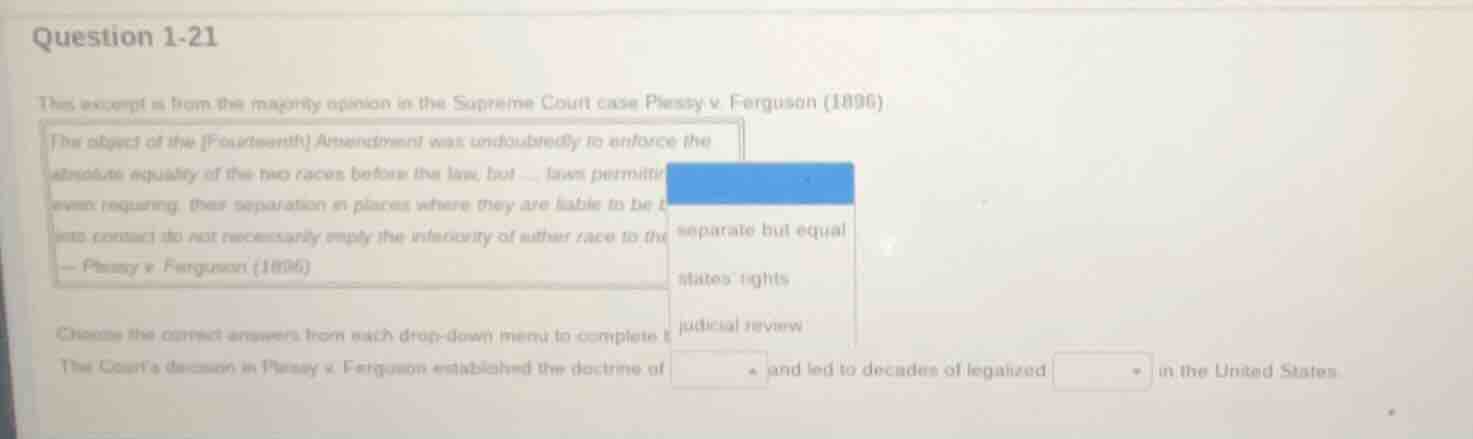
this excerpt is from the majority opinion in the supreme court case plessy v. ferguson (1896)
the object of the fourteenth amendment was undoubtedly to enforce the absolute equality of the two races before the law, but... laws permitting even requiring their separation in places where they are liable to be brought into contact do not necessarily imply the inferiority of either race to the other. — plessy v. ferguson (1896)
choose the correct answers from each drop - down menu to complete the sentence.
the court’s decision in plessy v. ferguson established the doctrine of dropdown 1 and led to decades of legalized dropdown 2 in the united states.
dropdown 1 options: separate but equal, states’ rights, judicial review
dropdown 2 options: (not fully shown in ocr, but context related to racial segregation)
- The Supreme Court's 1896 Plessy v. Ferguson decision explicitly established the "separate but equal" doctrine, which held that racial segregation in public facilities was constitutional as long as the facilities for each race were equal.
- This doctrine directly led to decades of legalized racial segregation (Jim Crow laws) across the United States, enforcing systemic racial separation in schools, transportation, public spaces, and more.

Snap & solve any problem in the app
Get step-by-step solutions on Sovi AI
Photo-based solutions with guided steps
Explore more problems and detailed explanations
The Court's decision in Plessy v. Ferguson established the doctrine of separate but equal, and led to decades of legalized racial segregation in the United States.