QUESTION IMAGE
Question
question 6 of 10
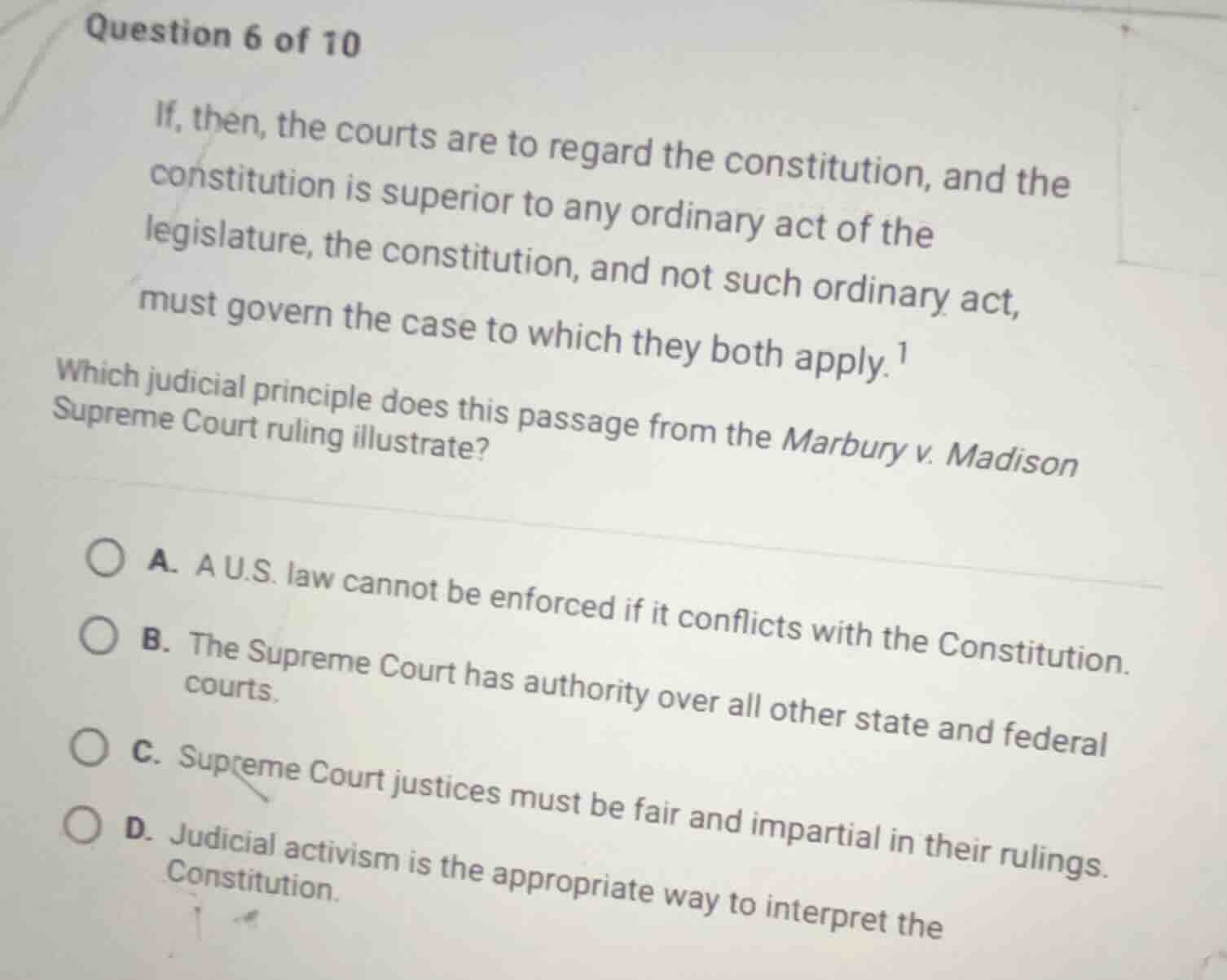
if, then, the courts are to regard the constitution, and the constitution is superior to any ordinary act of the legislature, the constitution, and not such ordinary act, must govern the case to which they both apply.
which judicial principle does this passage from the marbury v. madison supreme court ruling illustrate?
a. a u.s. law cannot be enforced if it conflicts with the constitution.
b. the supreme court has authority over all other state and federal courts.
c. supreme court justices must be fair and impartial in their rulings.
d. judicial activism is the appropriate way to interpret the constitution.
The passage from Marbury v. Madison states that the Constitution is superior to ordinary legislative acts, and when both apply to a case, the Constitution governs. This directly reflects the principle of judicial review, which holds that laws conflicting with the Constitution are unenforceable. Option B refers to hierarchical authority of the Supreme Court, C to judicial impartiality, and D to judicial activism, none of which match the passage's focus on constitutional supremacy over conflicting laws.

Snap & solve any problem in the app
Get step-by-step solutions on Sovi AI
Photo-based solutions with guided steps
Explore more problems and detailed explanations
A. A U.S. law cannot be enforced if it conflicts with the Constitution.