QUESTION IMAGE
Question
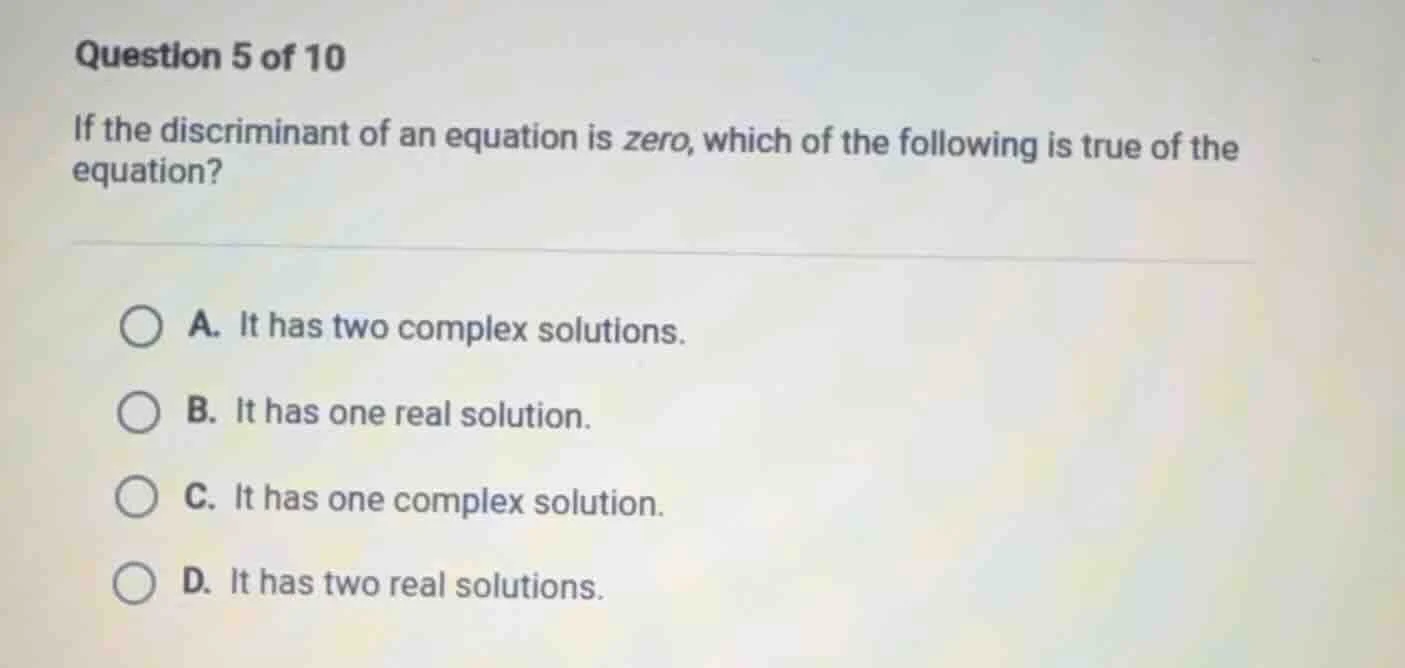
question 5 of 10
if the discriminant of an equation is zero, which of the following is true of the
equation?
a. it has two complex solutions.
b. it has one real solution.
c. it has one complex solution.
d. it has two real solutions.
For a quadratic equation \(ax^{2}+bx + c = 0\) (\(a
eq0\)), the discriminant is given by \(D=b^{2}-4ac\). When \(D = 0\), the quadratic formula \(x=\frac{-b\pm\sqrt{D}}{2a}\) becomes \(x=\frac{-b\pm\sqrt{0}}{2a}=\frac{-b}{2a}\), which means there is one real solution (a repeated root). Also, real numbers are a subset of complex numbers, but the key here is about the nature of the roots in terms of real - complex and the number of distinct roots. Option A is incorrect because if discriminant is zero, the two "complex" solutions (since real numbers are complex) are equal (a repeated root), but we usually describe it as one real solution. Option C is incorrect as we don't say one complex solution in this context (the root is real). Option D is incorrect because discriminant zero means the two roots are equal, so it's one real solution (with multiplicity two), not two distinct real solutions.

Snap & solve any problem in the app
Get step-by-step solutions on Sovi AI
Photo-based solutions with guided steps
Explore more problems and detailed explanations
B. It has one real solution.