QUESTION IMAGE
Question
question 4 of 10
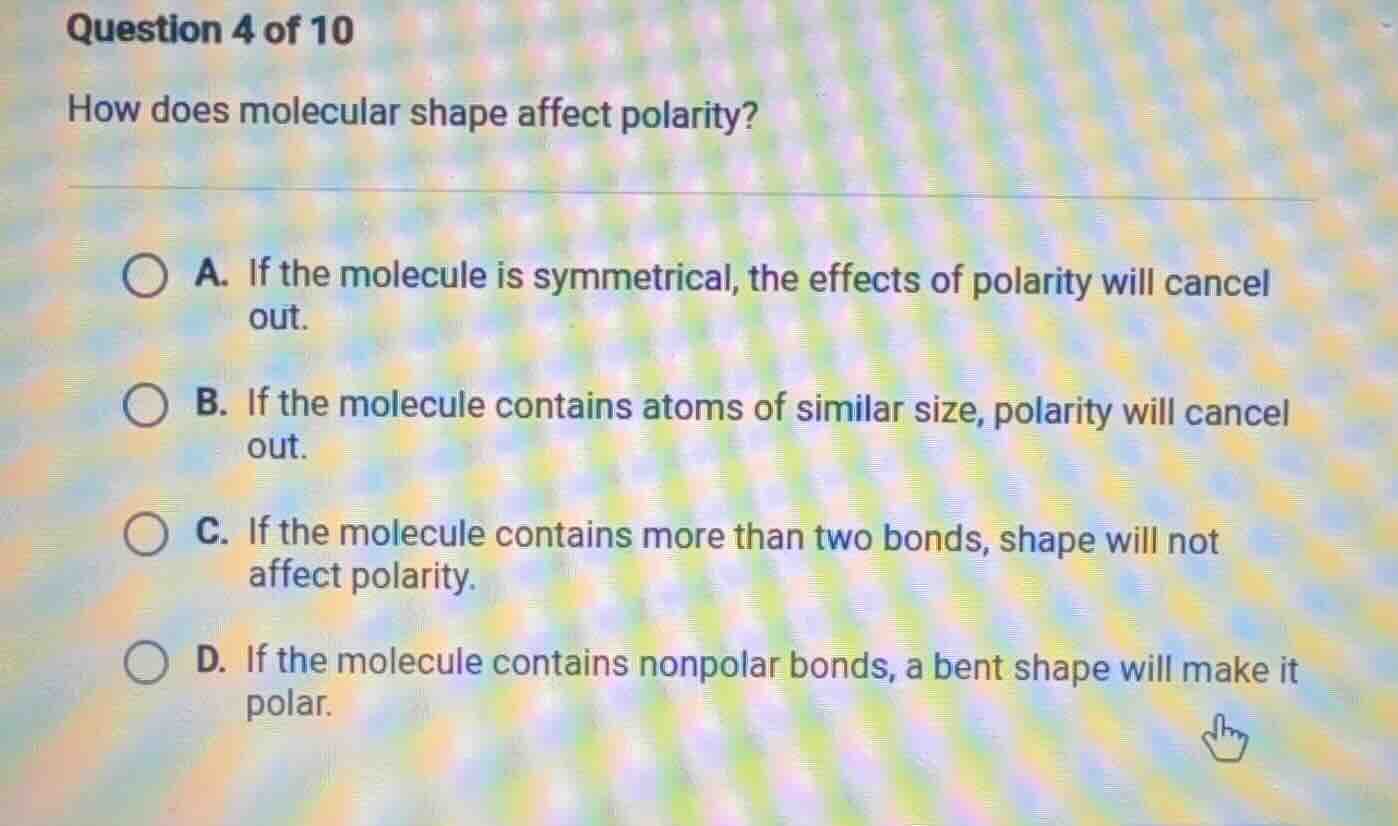
how does molecular shape affect polarity?
a. if the molecule is symmetrical, the effects of polarity will cancel
out.
b. if the molecule contains atoms of similar size, polarity will cancel
out.
c. if the molecule contains more than two bonds, shape will not
affect polarity.
d. if the molecule contains nonpolar bonds, a bent shape will make it
polar.
To determine how molecular shape affects polarity, we analyze each option:
- Option A: In a symmetrical molecule (e.g., \( \text{CO}_2 \) which is linear and symmetrical), the dipole moments of polar bonds can cancel out, resulting in a nonpolar molecule. This aligns with the concept of molecular polarity and shape.
- Option B: Atom size is not the determining factor for polarity cancellation; it's the molecular geometry and bond dipoles.
- Option C: Molecules with more than two bonds (e.g., \( \text{NH}_3 \), \( \text{CH}_4 \)) have their polarity strongly influenced by shape.
- Option D: A molecule with nonpolar bonds (e.g., \( \text{O}_2 \)) will remain nonpolar regardless of shape, as nonpolar bonds don't have a dipole moment to be affected by shape.
So, Option A correctly describes the relationship between molecular symmetry (shape) and polarity cancellation.

Snap & solve any problem in the app
Get step-by-step solutions on Sovi AI
Photo-based solutions with guided steps
Explore more problems and detailed explanations
A. If the molecule is symmetrical, the effects of polarity will cancel out.