QUESTION IMAGE
Question
question 2 of 10
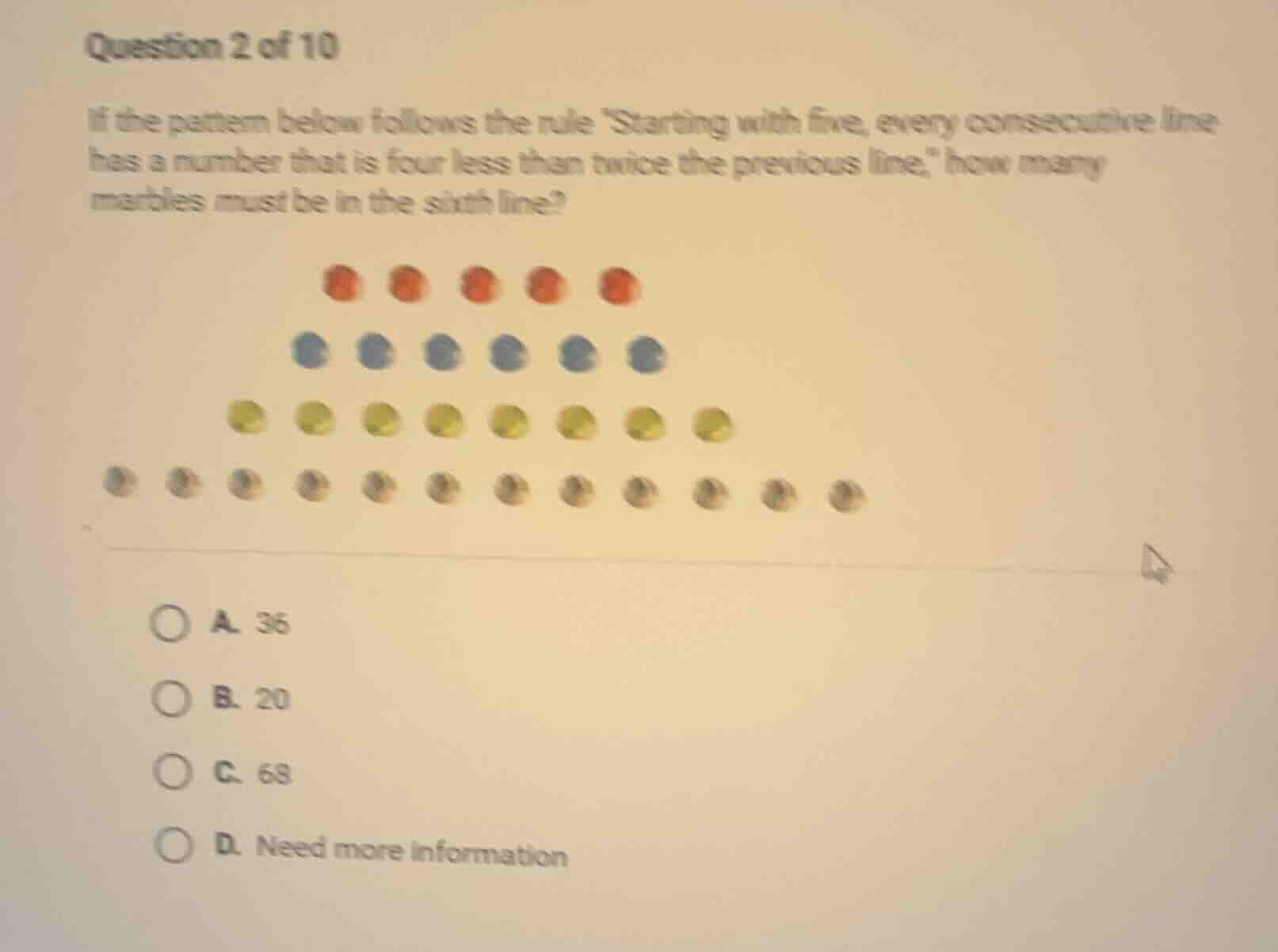
if the pattern below follows the rule starting with five, every consecutive line has a number that is four less than twice the previous line, how many marbles must be in the sixth line?
a. 36
b. 20
c. 68
d. need more information
Step1: Define the first term and the recurrence relation
Let \( a_n \) be the number of marbles in the \( n \)-th line. We know that \( a_1 = 5 \) (starting with five), and the rule is \( a_{n}=2a_{n - 1}-4 \) for \( n\geq2 \) (every consecutive line has a number that is four less than twice the previous line).
Step2: Calculate the second term (\( n = 2 \))
Substitute \( n = 2 \) and \( a_1=5 \) into the recurrence relation:
\( a_2=2a_1 - 4=2\times5-4 = 10 - 4=6 \)
Step3: Calculate the third term (\( n = 3 \))
Substitute \( n = 3 \) and \( a_2 = 6 \) into the recurrence relation:
\( a_3=2a_2-4=2\times6 - 4=12 - 4 = 8 \)
Step4: Calculate the fourth term (\( n = 4 \))
Substitute \( n = 4 \) and \( a_3 = 8 \) into the recurrence relation:
\( a_4=2a_3-4=2\times8-4 = 16 - 4=12 \)
Step5: Calculate the fifth term (\( n = 5 \))
Substitute \( n = 5 \) and \( a_4 = 12 \) into the recurrence relation:
\( a_5=2a_4-4=2\times12-4=24 - 4 = 20 \)
Step6: Calculate the sixth term (\( n = 6 \))
Substitute \( n = 6 \) and \( a_5 = 20 \) into the recurrence relation:
\( a_6=2a_5-4=2\times20-4=40 - 4 = 36 \)
Wait, but let's check the given figure. The first line (red) has 5, second (blue) has 6? Wait, no, the blue line in the figure has 6? Wait, the green line has 8, the next (the fourth) has 12. Wait, but according to the calculation above, when we follow the rule \( a_n=2a_{n - 1}-4 \):
Wait, maybe I made a mistake in the initial term. Wait, the problem says "starting with five", so \( a_1 = 5 \). Then:
\( a_2=2\times5 - 4=6 \)
\( a_3=2\times6 - 4 = 8 \)
\( a_4=2\times8 - 4=12 \)
\( a_5=2\times12 - 4 = 20 \)
\( a_6=2\times20 - 4=36 \)
But let's check the figure:
First line (red): 5 marbles.
Second line (blue): 6 marbles? Wait, the blue line in the image has 6? Wait, the green line has 8, the next (fourth) has 12, then the fifth line would be \( 2\times12 - 4 = 20 \), sixth line \( 2\times20 - 4 = 36 \). So the answer should be 36.
Wait, but let's re - check the calculation:
\( a_1=5 \)
\( a_2=2(5)-4 = 10 - 4=6 \)
\( a_3=2(6)-4=12 - 4 = 8 \)
\( a_4=2(8)-4 = 16 - 4=12 \)
\( a_5=2(12)-4=24 - 4 = 20 \)
\( a_6=2(20)-4=40 - 4 = 36 \)
Yes, that's correct. So the sixth line has 36 marbles.

Snap & solve any problem in the app
Get step-by-step solutions on Sovi AI
Photo-based solutions with guided steps
Explore more problems and detailed explanations
A. 36