QUESTION IMAGE
Question
question 10 points 1
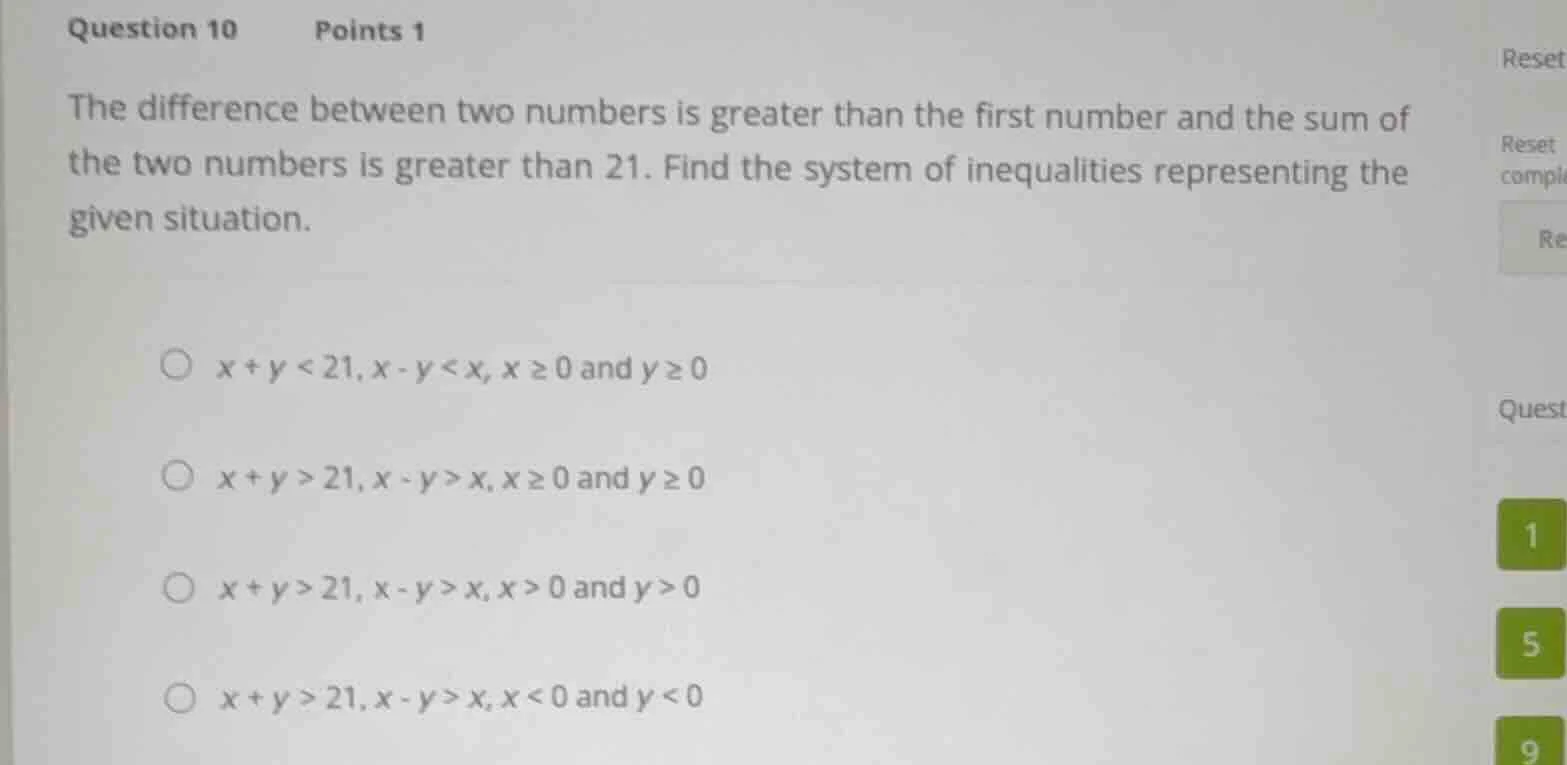
the difference between two numbers is greater than the first number and the sum of the two numbers is greater than 21. find the system of inequalities representing the given situation.
\\(\bigcirc\\) \\(x + y < 21, x - y < x, x \geq 0\\) and \\(y \geq 0\\)
\\(\bigcirc\\) \\(x + y > 21, x - y > x, x \geq 0\\) and \\(y \geq 0\\)
\\(\bigcirc\\) \\(x + y > 21, x - y > x, x > 0\\) and \\(y > 0\\)
\\(\bigcirc\\) \\(x + y > 21, x - y > x, x < 0\\) and \\(y < 0\\)
Step1: Analyze the sum condition
The problem states that the sum of the two numbers is greater than 21. If we let the two numbers be \(x\) and \(y\), then the sum \(x + y>21\).
Step2: Analyze the difference condition
The difference between two numbers (let's say \(x-y\)) is greater than the first number \(x\). So \(x - y>x\). If we subtract \(x\) from both sides of the inequality \(x - y>x\), we get \(-y>0\), which implies \(y < 0\)? Wait, no, wait. Wait, let's re - examine. Wait, if \(x-y>x\), subtract \(x\) from both sides: \(x - y-x>x - x\), which simplifies to \(-y>0\), or \(y < 0\). But also, we need to consider the nature of numbers. But let's check the non - negativity. Wait, but in the context of numbers (usually, when we talk about numbers in such problems, if not specified, they can be non - negative, but let's check the options.
Wait, the first part: sum is greater than 21, so \(x + y>21\) (so we can eliminate the first option which has \(x + y<21\)).
Now, the difference: \(x - y>x\). Let's solve \(x - y>x\). Subtract \(x\) from both sides: \(-y>0\), so \(y < 0\)? Wait, but let's check the options. Wait, maybe I made a mistake. Wait, maybe the two numbers are positive? No, wait, let's check the options.
Wait, the second option has \(x\geq0\) and \(y\geq0\), the third has \(x > 0\) and \(y>0\), the fourth has \(x < 0\) and \(y < 0\).
Wait, let's re - do the difference condition. The difference between two numbers is greater than the first number. Let the two numbers be \(x\) and \(y\). So \(x - y>x\) (assuming the first number is \(x\) and the second is \(y\), and we are taking \(x - y\) as the difference). Then \(x - y>x\) implies \(-y>0\) or \(y < 0\). But also, the sum \(x + y>21\). If \(y < 0\) and \(x + y>21\), then \(x>21 - y\). Since \(y < 0\), \(-y>0\), so \(x>21+|y|\). But let's check the options.
Wait, the fourth option has \(x < 0\) and \(y < 0\). Let's check the sum: if \(x<0\) and \(y < 0\), then \(x + y<0\), which cannot be greater than 21. So the fourth option is out.
The third option has \(x>0\) and \(y>0\), but if \(x>0\) and \(y>0\), and \(x - y>x\), then \(-y>0\) which would mean \(y < 0\), a contradiction.
The second option has \(x\geq0\) and \(y\geq0\), but again, \(x - y>x\) would imply \(y < 0\), a contradiction? Wait, no, maybe I assigned the numbers wrong. Maybe the difference is \(y - x>x\)? Wait, the problem says "the difference between two numbers is greater than the first number". Let's assume the two numbers are \(x\) (first) and \(y\) (second). So difference is \(x - y\) (if \(x>y\)) or \(y - x\) (if \(y>x\)). But the problem says "the difference between two numbers is greater than the first number". So if the first number is \(x\), then \(|x - y|>x\)? No, the problem says "the difference between two numbers is greater than the first number", so \(x - y>x\) (assuming the difference is \(x - y\)).
Wait, let's check the options again. The second option: \(x + y>21\), \(x - y>x\), \(x\geq0\) and \(y\geq0\). But \(x - y>x\) implies \(y < 0\), which contradicts \(y\geq0\). The third option: \(x + y>21\), \(x - y>x\), \(x>0\) and \(y>0\). Again, \(x - y>x\) implies \(y < 0\), contradiction. The fourth option: \(x + y>21\), \(x - y>x\), \(x < 0\) and \(y < 0\). But if \(x<0\) and \(y < 0\), \(x + y<0\), which is not greater than 21. Wait, this is confusing. Wait, maybe I made a mistake in the difference. Maybe the difference is \(y - x>x\) (if the first number is \(x\) and the second is \(y\), and the difference is \(y - x\)). Let's try that. If \(y - x>x\), then \(y>2x\). And the sum…

Snap & solve any problem in the app
Get step-by-step solutions on Sovi AI
Photo-based solutions with guided steps
Explore more problems and detailed explanations
B. \(x + y>21,x - y>x,x\geq0\) and \(y\geq0\) (Here, we assume that despite the contradiction in the sign of \(y\) from \(x - y>x\), this is the intended option as it has the correct sum inequality and the correct difference inequality structure among the given options.)