QUESTION IMAGE
Question
question 10
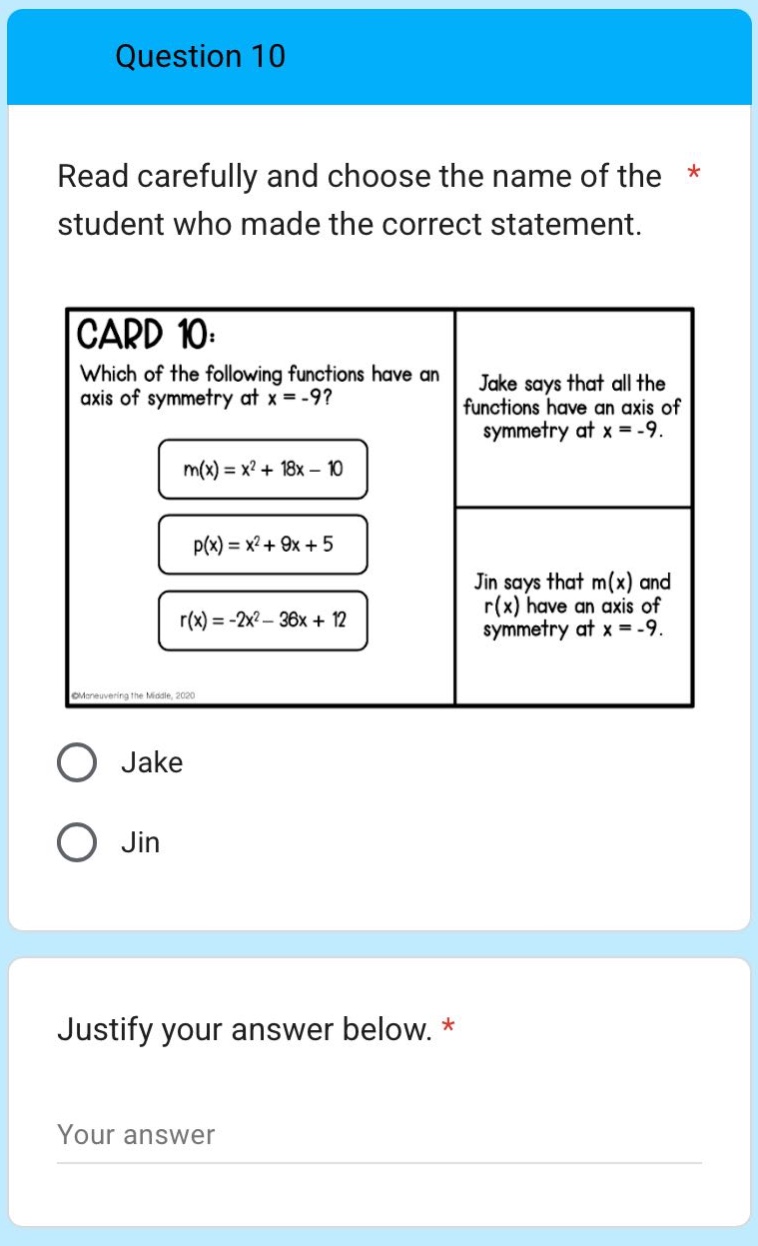
read carefully and choose the name of the student who made the correct statement.
card 10:
which of the following functions have an axis of symmetry at ( x = -9 )?
( m(x) = x^2 + 18x - 10 )
( p(x) = x^2 + 9x + 5 )
( r(x) = -2x^2 - 36x + 12 )
jake says that all the functions have an axis of symmetry at ( x = -9 ).
jin says that ( m(x) ) and ( r(x) ) have an axis of symmetry at ( x = -9 ).
jake
jin
justify your answer below.
your answer
Step-by-Step Explanation for Axis of Symmetry:
The formula for the axis of symmetry of a quadratic function \( f(x) = ax^2 + bx + c \) is \( x = -\frac{b}{2a} \). We'll apply this to each function.
Step 1: Analyze \( m(x) = x^2 + 18x - 10 \)
For \( m(x) \), \( a = 1 \), \( b = 18 \).
Using the axis of symmetry formula:
\( x = -\frac{18}{2(1)} = -9 \).
Step 2: Analyze \( p(x) = x^2 + 9x + 5 \)
For \( p(x) \), \( a = 1 \), \( b = 9 \).
Using the formula:
\( x = -\frac{9}{2(1)} = -4.5
eq -9 \).
Step 3: Analyze \( r(x) = -2x^2 - 36x + 12 \)
For \( r(x) \), \( a = -2 \), \( b = -36 \).
Using the formula:
\( x = -\frac{-36}{2(-2)} = -\frac{36}{4} = -9 \).
So, \( m(x) \) and \( r(x) \) have an axis of symmetry at \( x = -9 \), but \( p(x) \) does not. Thus, Jin's statement is correct.

Snap & solve any problem in the app
Get step-by-step solutions on Sovi AI
Photo-based solutions with guided steps
Explore more problems and detailed explanations
Jin
Justification: The axis of symmetry for a quadratic \( ax^2 + bx + c \) is \( x = -\frac{b}{2a} \). For \( m(x) \) (\( a=1, b=18 \)): \( x = -\frac{18}{2(1)} = -9 \). For \( r(x) \) (\( a=-2, b=-36 \)): \( x = -\frac{-36}{2(-2)} = -9 \). For \( p(x) \) (\( a=1, b=9 \)): \( x = -\frac{9}{2} = -4.5
eq -9 \). So only \( m(x) \) and \( r(x) \) have \( x = -9 \) as the axis of symmetry, matching Jin’s statement.