QUESTION IMAGE
Question
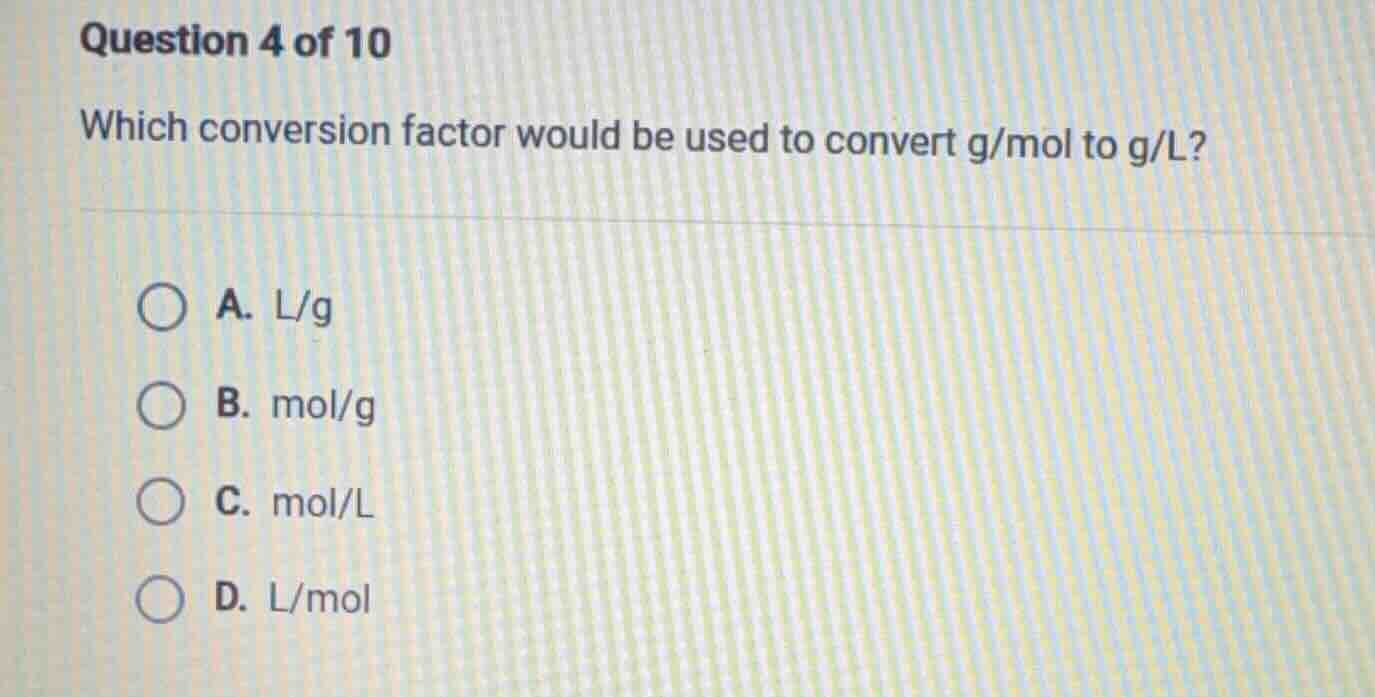
question 4 of 10
which conversion factor would be used to convert g/mol to g/l?
a. l/g
b. mol/g
c. mol/l
d. l/mol
To convert from \(\text{g/mol}\) to \(\text{g/L}\), we analyze the units. Let the conversion factor be \(x\). We want \(\frac{\text{g}}{\text{mol}} \times x=\frac{\text{g}}{\text{L}}\). Solving for \(x\), we get \(x = \frac{\text{mol}}{\text{L}}\) (wait, no—wait, let's do dimensional analysis. We have \(\frac{\text{g}}{\text{mol}}\) and we want \(\frac{\text{g}}{\text{L}}\). So we need to multiply \(\frac{\text{g}}{\text{mol}}\) by a factor that has \(\text{mol}\) in the numerator and \(\text{L}\) in the denominator? No, wait: \(\frac{\text{g}}{\text{mol}} \times \frac{\text{mol}}{\text{L}}=\frac{\text{g}}{\text{L}}\). Wait, no, that would be \(\frac{\text{g}}{\text{mol}} \times \frac{\text{mol}}{\text{L}}=\frac{\text{g}}{\text{L}}\). Wait, but let's check the options. Wait, option C is \(\text{mol/L}\), but wait, no—wait, maybe I made a mistake. Wait, no: \(\frac{\text{g}}{\text{mol}} \times \frac{\text{mol}}{\text{L}}=\frac{\text{g}}{\text{L}}\). Wait, but let's check the options. Wait, the options are A. L/g, B. mol/g, C. mol/L, D. L/mol. Wait, no—wait, maybe I messed up. Wait, let's re-express. We have \(\text{g/mol}\) (grams per mole) and we want \(\text{g/L}\) (grams per liter). So we need to relate moles to liters. The conversion factor should be such that when we multiply \(\text{g/mol}\) by (mol/L), we get \(\text{g/L}\). Wait, \(\frac{\text{g}}{\text{mol}} \times \frac{\text{mol}}{\text{L}}=\frac{\text{g}}{\text{L}}\). So the conversion factor is \(\text{mol/L}\)? But wait, no—wait, maybe I got the direction wrong. Wait, no, let's think again. Suppose we have a substance with molar mass \(M = \text{g/mol}\), and we want to find its density in \(\text{g/L}\). The density \(
ho\) (in \(\text{g/L}\)) is related to molarity \(c\) (in \(\text{mol/L}\)) by \(
ho = M \times c\). So \(c=\frac{
ho}{M}\), but here we are converting \(M\) (g/mol) to \(
ho\) (g/L), so \(
ho = M \times c\), where \(c\) is in mol/L. So to get \(
ho\) (g/L) from \(M\) (g/mol), we multiply by \(c\) (mol/L). Wait, but the question is about the conversion factor to convert g/mol to g/L. So if we have a value in g/mol, and we multiply by (mol/L), we get g/L. So the conversion factor is mol/L? But wait, the options: option C is mol/L. Wait, but let's check the options again. Wait, maybe I made a mistake. Wait, no—wait, let's do dimensional analysis. Let the conversion factor be \(CF\). We have:
\(\frac{\text{g}}{\text{mol}} \times CF = \frac{\text{g}}{\text{L}}\)
Solving for \(CF\):
\(CF = \frac{\text{g/L}}{\text{g/mol}} = \frac{\text{mol}}{\text{L}}\)
So \(CF\) is \(\text{mol/L}\), which is option C? Wait, but wait, the options are A. L/g, B. mol/g, C. mol/L, D. L/mol. Wait, but let's check with an example. Suppose a substance has a molar mass of 100 g/mol, and its molarity is 0.5 mol/L. Then its density is \(100 \text{ g/mol} \times 0.5 \text{ mol/L} = 50 \text{ g/L}\). So here, we multiplied g/mol by mol/L to get g/L. So the conversion factor is mol/L, which is option C. Wait, but wait, the original question is "which conversion factor would be used to convert g/mol to g/L". So the answer should be C. mol/L? Wait, but let me check again. Wait, no—wait, maybe I messed up the units. Wait, \(\frac{\text{g}}{\text{mol}} \times \frac{\text{mol}}{\text{L}} = \frac{\text{g}}{\text{L}}\). Yes, that's correct. So the conversion factor is mol/L, which is option C. Wait, but let me check the options again. The options are:
A. L/g
B. mol/g
C. mol/L
D. L/mol
So according to the dimensional analysis, the conversion factor is mol/L (option C). Wait, but I think I…

Snap & solve any problem in the app
Get step-by-step solutions on Sovi AI
Photo-based solutions with guided steps
Explore more problems and detailed explanations
C. mol/L