QUESTION IMAGE
Question
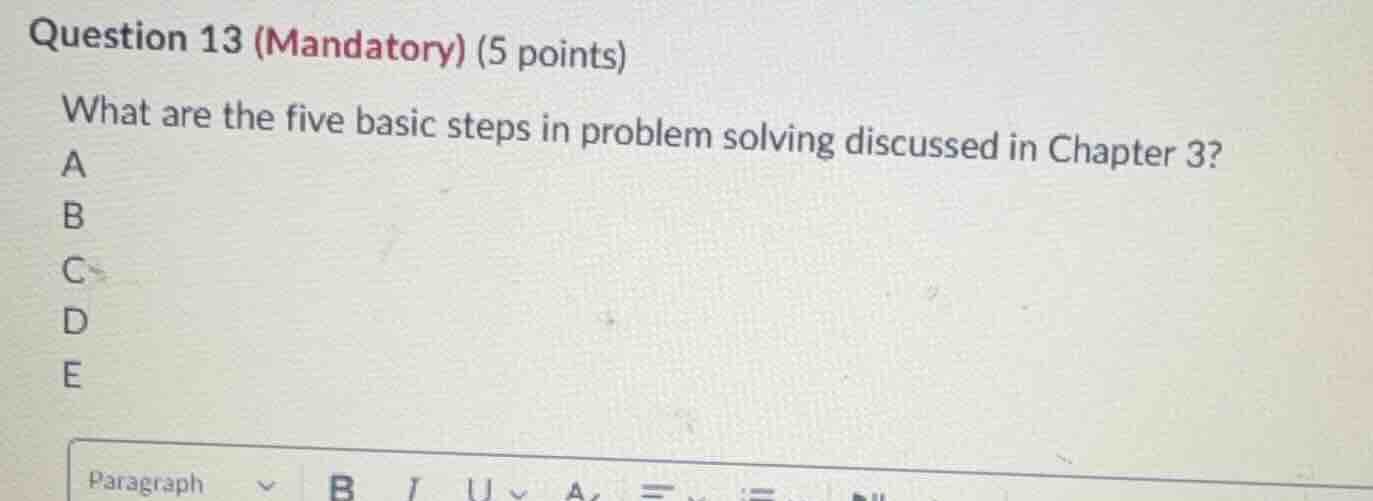
question 13 (mandatory) (5 points) what are the five basic steps in problem solving discussed in chapter 3? a b c d e
Since the options (A - E) are not provided, and the question refers to "Chapter 3" (without specifying the textbook or course), a general overview of common five - step problem - solving processes is as follows. A typical five - step problem - solving process (often taught in various fields like Business, Social Science for decision - making, or Natural Science for scientific inquiry) includes: 1. Define the problem (clearly identify what the problem is). 2. Gather information (collect relevant data or facts about the problem). 3. Generate possible solutions (brainstorm different ways to solve the problem). 4. Evaluate the solutions (assess the pros and cons of each solution). 5. Implement and follow up (put the chosen solution into action and check its effectiveness). However, without the specific context of the chapter, the exact steps might vary. If this is from a particular textbook (e.g., in a business or psychology context), the steps could be more specialized. For example, in a business problem - solving context, it might be related to decision - making steps, and in a psychology context (cognitive problem - solving), it could be about mental processes.

Snap & solve any problem in the app
Get step-by-step solutions on Sovi AI
Photo-based solutions with guided steps
Explore more problems and detailed explanations
Without the specific options (A - E) and the context of the chapter (textbook/course), a general five - step problem - solving process is: 1. Define the problem, 2. Gather information, 3. Generate solutions, 4. Evaluate solutions, 5. Implement and follow up. If you can provide the options or the textbook context, a more precise answer can be given.