QUESTION IMAGE
Question
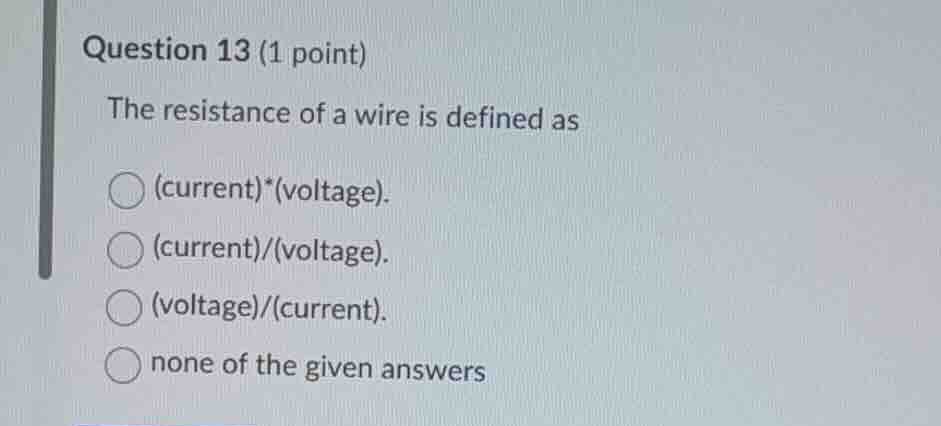
question 13 (1 point)
the resistance of a wire is defined as
(current)*(voltage).
(current)/(voltage).
(voltage)/(current).
none of the given answers
Brief Explanations
To determine the definition of the resistance of a wire, we use Ohm's Law, which is given by the formula \( V = IR \), where \( V \) is the voltage, \( I \) is the current, and \( R \) is the resistance. Rearranging this formula to solve for resistance \( R \), we get \( R=\frac{V}{I} \). This means resistance is defined as the ratio of voltage to current.
Now let's analyze each option:
- The first option, \( \text{(current)} \times \text{(voltage)} \), does not match the formula for resistance.
- The second option, \( \frac{\text{(current)}}{\text{(voltage)}} \), is the reciprocal of the correct formula for resistance.
- The third option, \( \frac{\text{(voltage)}}{\text{(current)}} \), matches the formula \( R = \frac{V}{I} \) from Ohm's Law.
- The fourth option, "none of the given answers", is incorrect because the third option is correct.

Snap & solve any problem in the app
Get step-by-step solutions on Sovi AI
Photo-based solutions with guided steps
Explore more problems and detailed explanations
C. (voltage)/(current)