QUESTION IMAGE
Question
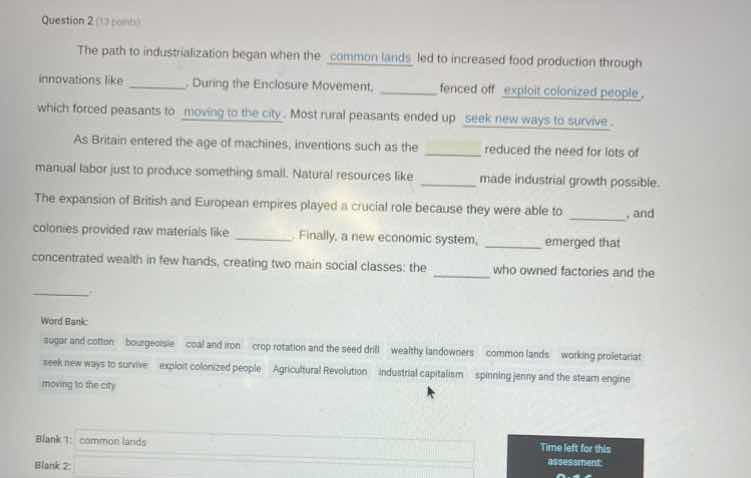
question 2 (13 points) the path to industrialization began when the common lands led to increased food production through innovations like ____. during the enclosure movement, __ fenced off exploit colonized people, which forced peasants to moving to the city. most rural peasants ended up seek new ways to survive. as britain entered the age of machines, inventions such as the __ reduced the need for lots of manual labor just to produce something small. natural resources like __ made industrial growth possible. the expansion of british and european empires played a crucial role because they were able to __, and colonies provided raw materials like __. finally, a new economic system, __ emerged that concentrated wealth in few hands, creating two main social classes: the __ who owned factories and the ____. word bank: sugar and cotton bourgeoisie coal and iron crop rotation and the seed drill wealthy landowners common lands working proletariat seek new ways to survive exploit colonized people agricultural revolution industrial capitalism spinning jenny and the steam engine moving to the city blank 1: common lands blank 2:
To solve this fill - in - the - blank question about the Industrial Revolution, we analyze each blank based on historical knowledge:
Blank 2
The first part of the passage is about the start of industrialization and the increase in food production. The "Agricultural Revolution" brought about innovations in farming. Among the given word bank, "crop rotation and the seed drill" are typical innovations of the Agricultural Revolution that boosted food production. So for Blank 2, the answer is "crop rotation and the seed drill".
Blank 3
During the Enclosure Movement, it was the "wealthy landowners" who fenced off the common lands. So Blank 3 should be filled with "wealthy landowners".
Blank 4
When the common lands were enclosed, peasants were forced to "moving to the city" (to find new means of livelihood as they lost their access to common lands for farming).
Blank 5
Most rural peasants, after being displaced, had to "seek new ways to survive" in the new situation.
Blank 6
In the age of machines, inventions like the "spinning jenny and the steam engine" reduced the need for a large amount of manual labor in small - scale production.
Blank 7
Natural resources such as "coal and iron" were essential for industrial growth (coal for energy, iron for making machinery).
Blank 8
The expansion of empires allowed them to "exploit colonized people" (to get cheap labor, markets, etc.).
Blank 9
Colonies provided raw materials like "sugar and cotton".
Blank 10
The new economic system that emerged was "industrial capitalism" which concentrated wealth in the hands of a few.
Blank 11
The class that owned the factories was the "bourgeoisie".
Blank 12
The other main social class was the "working proletariat" (the workers who had to sell their labor).
Final Answers for each blank:
Blank 2: crop rotation and the seed drill
Blank 3: wealthy landowners
Blank 4: moving to the city
Blank 5: seek new ways to survive
Blank 6: spinning jenny and the steam engine
Blank 7: coal and iron
Blank 8: exploit colonized people
Blank 9: sugar and cotton
Blank 10: industrial capitalism
Blank 11: bourgeoisie
Blank 12: working proletariat

Snap & solve any problem in the app
Get step-by-step solutions on Sovi AI
Photo-based solutions with guided steps
Explore more problems and detailed explanations
To solve this fill - in - the - blank question about the Industrial Revolution, we analyze each blank based on historical knowledge:
Blank 2
The first part of the passage is about the start of industrialization and the increase in food production. The "Agricultural Revolution" brought about innovations in farming. Among the given word bank, "crop rotation and the seed drill" are typical innovations of the Agricultural Revolution that boosted food production. So for Blank 2, the answer is "crop rotation and the seed drill".
Blank 3
During the Enclosure Movement, it was the "wealthy landowners" who fenced off the common lands. So Blank 3 should be filled with "wealthy landowners".
Blank 4
When the common lands were enclosed, peasants were forced to "moving to the city" (to find new means of livelihood as they lost their access to common lands for farming).
Blank 5
Most rural peasants, after being displaced, had to "seek new ways to survive" in the new situation.
Blank 6
In the age of machines, inventions like the "spinning jenny and the steam engine" reduced the need for a large amount of manual labor in small - scale production.
Blank 7
Natural resources such as "coal and iron" were essential for industrial growth (coal for energy, iron for making machinery).
Blank 8
The expansion of empires allowed them to "exploit colonized people" (to get cheap labor, markets, etc.).
Blank 9
Colonies provided raw materials like "sugar and cotton".
Blank 10
The new economic system that emerged was "industrial capitalism" which concentrated wealth in the hands of a few.
Blank 11
The class that owned the factories was the "bourgeoisie".
Blank 12
The other main social class was the "working proletariat" (the workers who had to sell their labor).
Final Answers for each blank:
Blank 2: crop rotation and the seed drill
Blank 3: wealthy landowners
Blank 4: moving to the city
Blank 5: seek new ways to survive
Blank 6: spinning jenny and the steam engine
Blank 7: coal and iron
Blank 8: exploit colonized people
Blank 9: sugar and cotton
Blank 10: industrial capitalism
Blank 11: bourgeoisie
Blank 12: working proletariat