QUESTION IMAGE
Question
question 14
1 pts
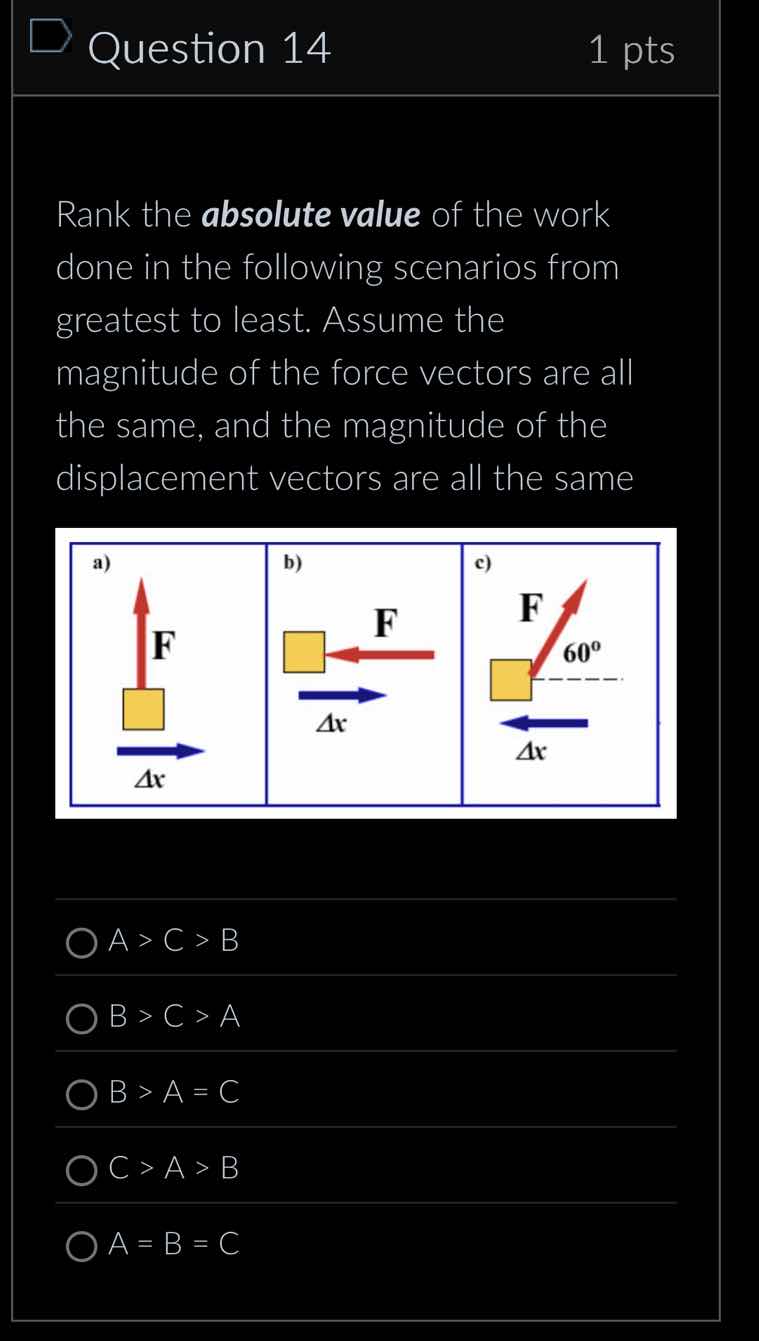
rank the absolute value of the work
done in the following scenarios from
greatest to least. assume the
magnitude of the force vectors are all
the same, and the magnitude of the
displacement vectors are all the same
a)
b)
c)
a > c > b
b > c > a
b > a = c
c > a > b
a = b = c
Step1: Recall the work formula
The work done by a force \( F \) over a displacement \( \Delta x \) is given by \( W = F \Delta x \cos\theta \), where \( \theta \) is the angle between the force and displacement vectors. The absolute value of work is \( |W| = |F \Delta x \cos\theta| \). Given \( |F| \) and \( |\Delta x| \) are constant, we analyze \( |\cos\theta| \) for each scenario.
Step2: Analyze scenario a
In scenario a, the force \( F \) is vertical and displacement \( \Delta x \) is horizontal. So the angle \( \theta \) between \( F \) and \( \Delta x \) is \( 90^\circ \). Then \( \cos(90^\circ) = 0 \), so \( |W_a| = |F \Delta x \cos(90^\circ)| = 0 \).
Step3: Analyze scenario b
In scenario b, the force \( F \) is horizontal (opposite to displacement direction, but we take absolute value of cosine). The angle \( \theta \) between \( F \) and \( \Delta x \) is \( 180^\circ \) (since force is opposite to displacement). \( \cos(180^\circ) = - 1 \), so \( |\cos(180^\circ)| = 1 \). Thus \( |W_b| = |F \Delta x \times 1| = F \Delta x \) (magnitude).
Step4: Analyze scenario c
In scenario c, the angle between \( F \) and \( \Delta x \) (displacement is opposite to the dashed line, so the angle between \( F \) and \( \Delta x \) is \( 180^\circ - 60^\circ = 120^\circ \)? Wait, no: displacement is to the left (blue arrow), force is at \( 60^\circ \) above the dashed line (which is to the right? Wait, no, the dashed line is horizontal, displacement \( \Delta x \) is to the left (blue arrow). The force \( F \) is at \( 60^\circ \) above the dashed line (which is a horizontal line, let's assume the dashed line is in the direction opposite to displacement? Wait, no, let's re - examine: displacement \( \Delta x \) is to the left (blue arrow), force \( F \) is at \( 60^\circ \) above the dashed line (which is a horizontal line, say, the dashed line is in the positive x - direction, but displacement is in negative x - direction. So the angle between \( F \) (which is at \( 60^\circ \) above positive x - axis) and displacement (negative x - direction, i.e., \( 180^\circ \) from positive x - axis) is \( \theta=180^\circ - 60^\circ = 120^\circ \)? Wait, no, maybe a simpler way: the angle between force and displacement. Displacement is to the left (let's take displacement direction as \( 180^\circ \) from positive x - axis), force is at \( 60^\circ \) from positive x - axis. So the angle between them is \( 180^\circ - 60^\circ = 120^\circ \), but \( \cos(120^\circ)=\cos(180 - 60)=-\cos(60^\circ)= - 0.5 \), so \( |\cos(120^\circ)| = 0.5 \). Wait, no, maybe I made a mistake. Wait, the displacement is to the left (blue arrow), force is at \( 60^\circ \) above the dashed line (which is a horizontal line, let's say the dashed line is in the direction of the displacement's opposite? No, the problem says "the magnitude of the displacement vectors are all the same". Let's re - define: in scenario c, displacement \( \Delta x \) is to the left (let's take that as the direction of \( \Delta x \)), and the force \( F \) makes \( 60^\circ \) with the dashed line (which is a horizontal line, say, the dashed line is parallel to the displacement's perpendicular? No, the dashed line is horizontal, and the force is at \( 60^\circ \) above the dashed line. So the angle between force \( F \) and displacement \( \Delta x \) (which is to the left) is \( 180^\circ - 60^\circ = 120^\circ \)? Wait, no, if displacement is to the left (let's say along negative x - axis) and force is at \( 60^\circ \) above positive x - axis, then the angle between \( F \) (positi…

Snap & solve any problem in the app
Get step-by-step solutions on Sovi AI
Photo-based solutions with guided steps
Explore more problems and detailed explanations
B > C > A