QUESTION IMAGE
Question
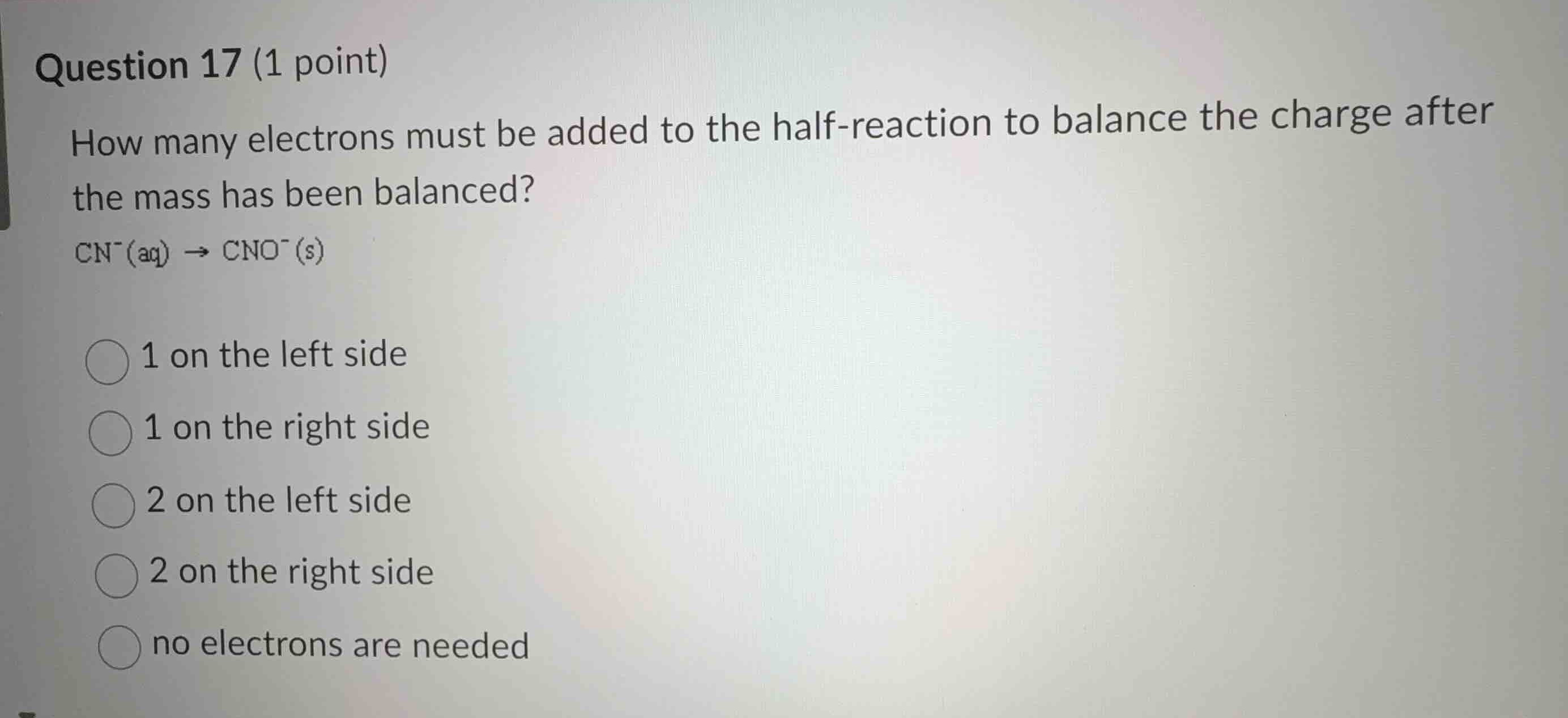
question 17 (1 point)
how many electrons must be added to the half-reaction to balance the charge after
the mass has been balanced?
$ce{cn^{-}(aq) -> cno^{-}(s)}$
1 on the left side
1 on the right side
2 on the left side
2 on the right side
no electrons are needed
Step1: Balance mass (atoms)
First, balance the non - O and non - H atoms. Here, C and N are already balanced (1 C and 1 N on each side). Then balance O by adding \(H_2O\) and balance H by adding \(H^+\) (in acidic medium, but since we can also consider basic medium, but let's first do mass balance). The unbalanced half - reaction is \(CN^-(aq)
ightarrow CNO^-(s)\). To balance O, we add 1 \(H_2O\) to the left side: \(CN^-(aq)+H_2O(l)
ightarrow CNO^-(s)\). Now balance H by adding \(2H^+\) to the right side: \(CN^-(aq)+H_2O(l)
ightarrow CNO^-(s)+2H^+\). (If we consider basic medium, we can add \(2OH^-\) to both sides to neutralize \(H^+\): \(CN^-(aq)+H_2O(l)+2OH^-(aq)
ightarrow CNO^-(s)+2H_2O(l)\), and then simplify to \(CN^-(aq)+2OH^-(aq)
ightarrow CNO^-(s)+H_2O(l)\). But for charge balance, let's first find the charge on each side before electron addition.)
Step2: Calculate charge on each side
For the left side (after mass balance, let's take the acidic medium first, but the charge calculation is similar in basic medium). The left side has \(CN^-\) and \(H_2O\) (charge of \(H_2O\) is 0) and \(H_2O\) is neutral. So charge on left: charge of \(CN^-\) is - 1. The right side has \(CNO^-\) (charge - 1) and \(2H^+\) (each \(H^+\) has charge + 1, so total + 2). So charge on right: \(-1 + 2\times(+1)=+1\).
Now, let's find the difference in charge. The left side has charge - 1, the right side has charge + 1. To balance the charge, we need to add electrons. Electrons have a charge of - 1. Let the number of electrons be \(n\). We want left charge + charge of electrons = right charge. So \(-1+(-n)= + 1\)? Wait, no. Wait, the oxidation state method: Let's find the oxidation state of C in \(CN^-\) and \(CNO^-\). In \(CN^-\), let oxidation state of C be \(x\), N is - 3 (common oxidation state of N in cyanide). So \(x+( - 3)=-1\), so \(x = + 2\). In \(CNO^-\), let oxidation state of C be \(y\), N is - 3, O is - 2. So \(y+( - 3)+( - 2)=-1\), so \(y=+4\). So C is oxidized from + 2 to + 4, so it loses 2 electrons? Wait, no, wait, maybe I made a mistake in oxidation state. Wait, in \(CN^-\), the oxidation state of C: N is - 3, so \(C + N=-1\), \(C-3=-1\), \(C = + 2\). In \(CNO^-\), N is - 3, O is - 2, so \(C+N + O=-1\), \(C-3 - 2=-1\), \(C = + 4\). So the change in oxidation state of C is \(+4-(+2)=+2\), which means it loses 2 electrons? Wait, no, wait the half - reaction is oxidation (C is oxidized), so electrons are lost (on the right side? No, in oxidation, electrons are products, so they are on the right side). Wait, maybe my mass balance was wrong. Let's start over.
Alternative approach: Let's balance the half - reaction for charge without considering H and O first. The half - reaction is \(CN^-
ightarrow CNO^-\). The oxidation state of C: in \(CN^-\), C is + 2 (as above), in \(CNO^-\), C is + 4. So the change in oxidation state is \(+4 - + 2=+2\), which means each C atom loses 2 electrons? Wait, no, the number of C atoms is 1. So the number of electrons lost is 2? Wait, no, wait the charge on \(CN^-\) is - 1, charge on \(CNO^-\) is - 1. Wait, maybe I messed up the mass balance. Wait, the correct mass balance for O: to go from \(CN^-\) (no O) to \(CNO^-\) (1 O), we need to add 1 O. In aqueous solution, O comes from \(H_2O\) (in acidic) or \(OH^-\) (in basic). So the correct half - reaction balancing (in basic medium, which is more likely for cyanide reactions):
- Balance non - O, non - H: \(CN^-
ightarrow CNO^-\) (C and N are balanced).
- Balance O: add 1 \(H_2O\) to the left: \(CN^-+H_2O
ightarrow CNO^-\)
- Balance H: add 2 \(H^+\) to…

Snap & solve any problem in the app
Get step-by-step solutions on Sovi AI
Photo-based solutions with guided steps
Explore more problems and detailed explanations
2 on the right side