QUESTION IMAGE
Question
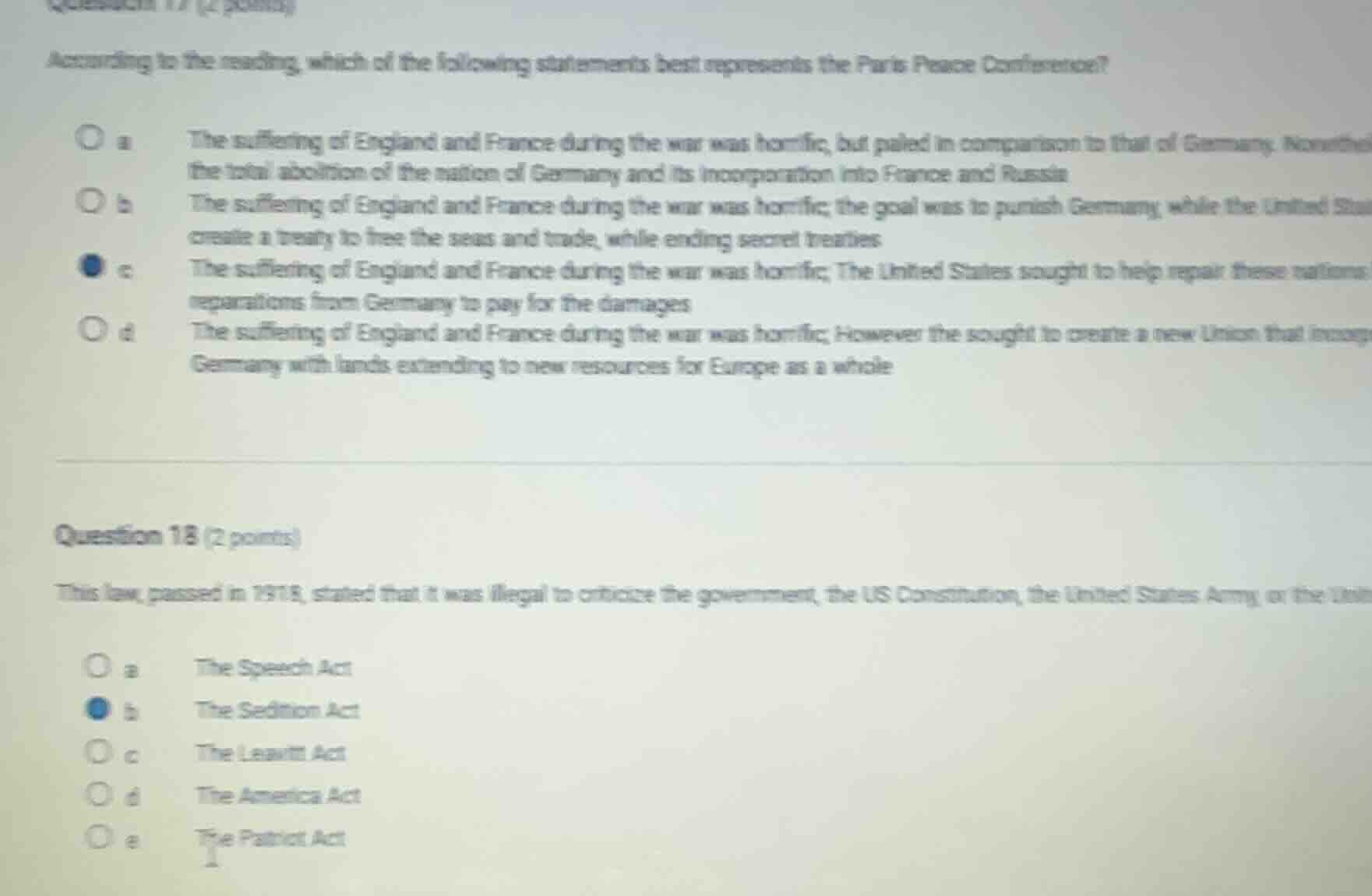
question 17 (2 points)according to the reading, which of the following statements best represents the paris peace conference?a. the suffering of england and france during the war was horrific, but paled in comparison to that of germany. nonetheles the total abolition of the nation of germany and its incorporation into france and russiab. the suffering of england and france during the war was horrific; the goal was to punish germany, while the united state create a treaty to free the seas and trade, while ending secret treatiesc. the suffering of england and france during the war was horrific; the united states sought to help repair these nations reparations from germany to pay for the damagesd. the suffering of england and france during the war was horrific; however the sought to create a new union that incorp germany with lands extending to new resources for europe as a wholequestion 18 (2 points)this law, passed in 1918, stated that it was illegal to criticize the government, the us constitution, the united states army, or the unita. the speech actb. the sedition actc. the leavitt actd. the america acte. the patriot act
For Question 17: The Paris Peace Conference saw France and Britain, who faced massive wartime suffering, focused on punishing Germany, while U.S. President Wilson pushed for his Fourteen Points, which included free seas, open trade, and ending secret treaties. Option b aligns with this dynamic.
For Question 18: The 1918 Sedition Act made it illegal to criticize the U.S. government, Constitution, military, or related institutions, matching the description in the question.

Snap & solve any problem in the app
Get step-by-step solutions on Sovi AI
Photo-based solutions with guided steps
Explore more problems and detailed explanations
Question 17: b. The suffering of England and France during the war was horrific; the goal was to punish Germany, while the United States sought to create a treaty to free the seas and trade, while ending secret treaties
Question 18: b. The Sedition Act