QUESTION IMAGE
Question
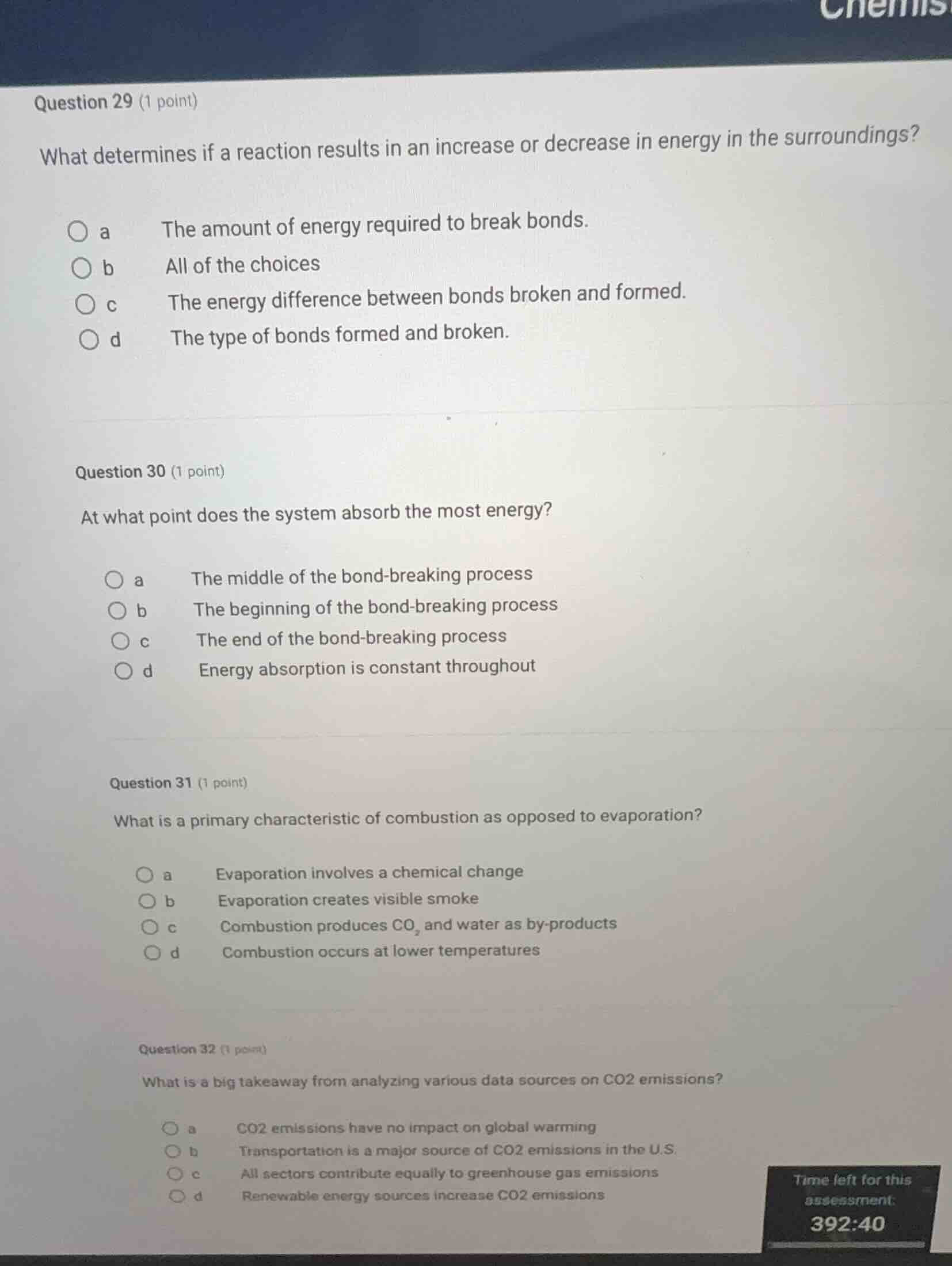
question 29 (1 point)
what determines if a reaction results in an increase or decrease in energy in the surroundings?
a the amount of energy required to break bonds.
b all of the choices
c the energy difference between bonds broken and formed.
d the type of bonds formed and broken.
question 30 (1 point)
at what point does the system absorb the most energy?
a the middle of the bond - breaking process
b the beginning of the bond - breaking process
c the end of the bond - breaking process
d energy absorption is constant throughout
question 31 (1 point)
what is a primary characteristic of combustion as opposed to evaporation?
a evaporation involves a chemical change
b evaporation creates visible smoke
c combustion produces co₂ and water as by - products
d combustion occurs at lower temperatures
question 32 (1 point)
what is a big takeaway from analyzing various data sources on co₂ emissions?
a co₂ emissions have no impact on global warming
b transportation is a major source of co₂ emissions in the u.s.
c all sectors contribute equally to greenhouse gas emissions
d renewable energy sources increase co₂ emissions
Question 29:
The energy change in surroundings depends on the net difference between energy to break bonds (endothermic, takes energy from surroundings) and energy released when forming bonds (exothermic, releases energy to surroundings. The type of bonds affects the energy values, and the net difference is the key driver.
Question 30:
Bond breaking requires energy input, and the maximum energy absorption occurs at the point where bonds are fully broken (end of the process), as this is the highest energy state of the system.
Question 31:
Combustion is a chemical reaction (reaction with oxygen) that typically produces $\text{CO}_2$ and water, while evaporation is a physical phase change with no chemical change, no smoke, and occurs at lower temperatures than combustion.
Question 32:
Data on U.S. $\text{CO}_2$ emissions consistently shows transportation is a top source; other options are incorrect (emissions drive warming, sectors do not contribute equally, renewables reduce emissions).

Snap & solve any problem in the app
Get step-by-step solutions on Sovi AI
Photo-based solutions with guided steps
Explore more problems and detailed explanations
Question 29: b. All of the choices
Question 30: c. The end of the bond-breaking process
Question 31: c. Combustion produces CO₂ and water as by-products
Question 32: b. Transportation is a major source of CO2 emissions in the U.S.