QUESTION IMAGE
Question
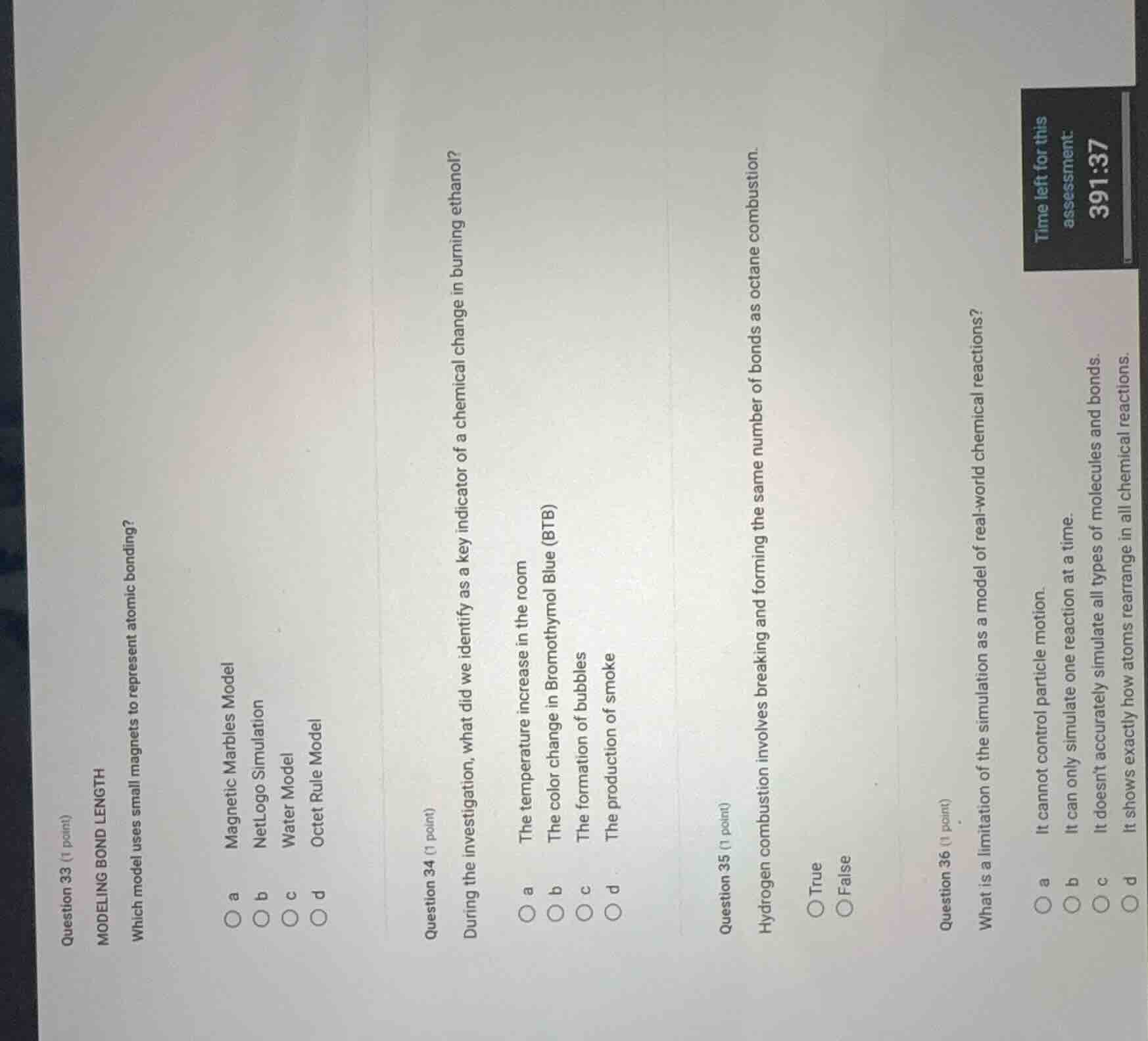
question 33 (1 point) modeling bond length which model uses small magnets to represent atomic bonding? a magnetic marbles model b netlogo simulation c water model d octet rule model question 34 (1 point) during the investigation, what did we identify as a key indicator of a chemical change in burning ethanol? a the temperature increase in the room b the color change in bromothymol blue (btb) c the formation of bubbles d the production of smoke question 35 (1 point) hydrogen combustion involves breaking and forming the same number of bonds as octane combustion. true false question 36 (1 point) what is a limitation of the simulation as a model of real - world chemical reactions? a it cannot control particle motion. b it can only simulate one reaction at a time. c it doesnt accurately simulate all types of molecules and bonds. d it shows exactly how atoms rearrange in all chemical reactions.
Question 33:
The Magnetic Marbles Model uses small magnets to represent the attractive forces of atomic bonding, where marbles stand for atoms and magnets represent the bonding interactions.
Question 34:
Burning ethanol is an exothermic reaction, which releases heat, causing a measurable temperature increase in the surrounding room, a clear indicator of chemical change.
Question 35:
Octane combustion: $\ce{C8H18 + 12.5O2 -> 8CO2 + 9H2O}$ involves breaking 7 C-C, 18 C-H, and ~25 O=O bonds, while hydrogen combustion: $\ce{2H2 + O2 -> 2H2O}$ involves breaking 2 H-H and 1 O=O bonds, forming 4 O-H bonds. The number of bonds broken/formed is vastly different.
Question 36:
Most chemical reaction simulations simplify real-world complexity; they cannot replicate all types of molecular structures, bond behaviors, and reaction conditions accurately.

Snap & solve any problem in the app
Get step-by-step solutions on Sovi AI
Photo-based solutions with guided steps
Explore more problems and detailed explanations
Question 33: a. Magnetic Marbles Model
Question 34: a. The temperature increase in the room
Question 35: False
Question 36: c. It doesn't accurately simulate all types of molecules and bonds.