QUESTION IMAGE
Question
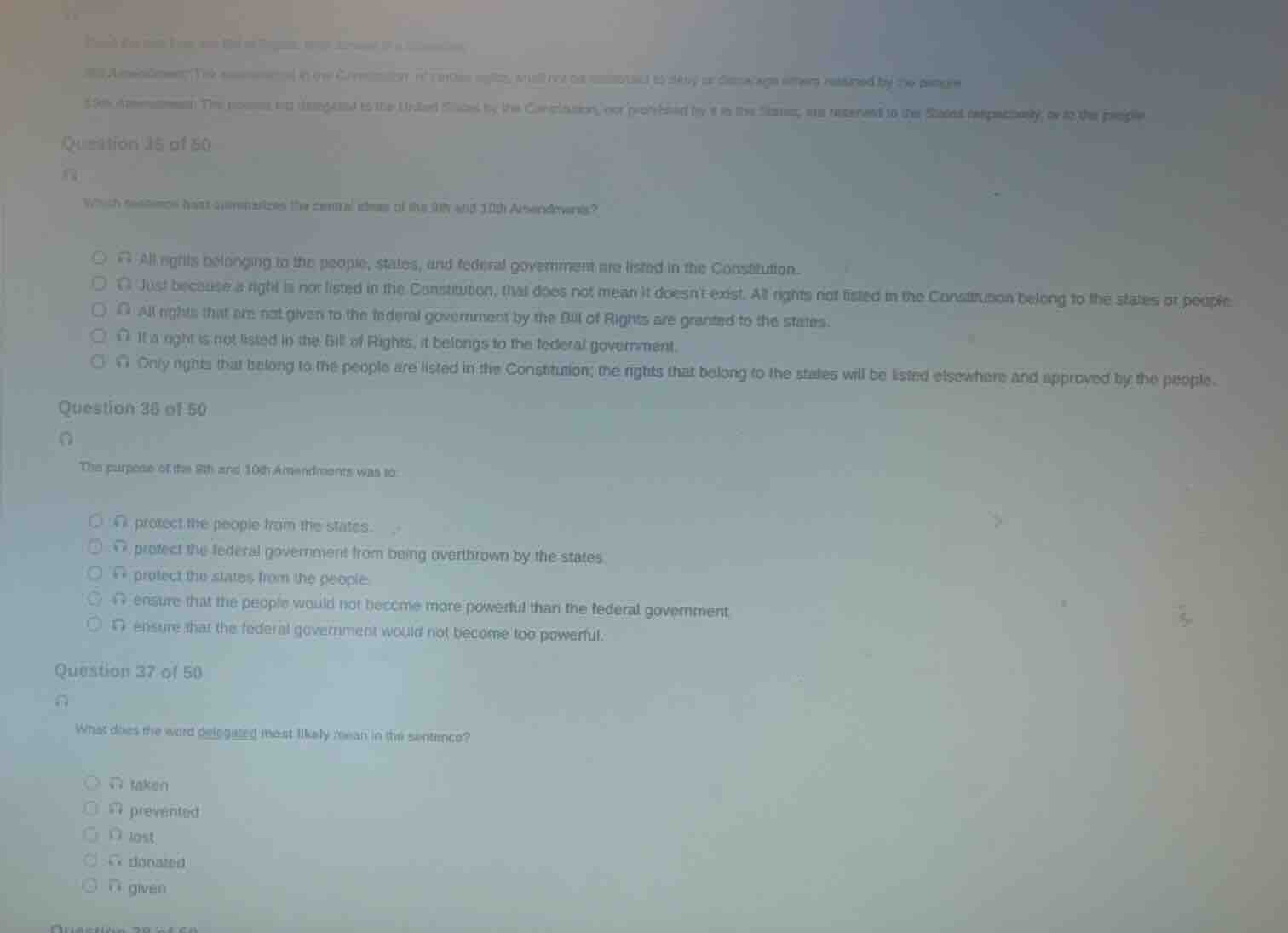
question 35 of 50
which sentence best summarizes the central ideas of the 9th and 10th amendments?
all rights belonging to the people, states, and federal government are listed in the constitution.
just because a right is not listed in the constitution, that does not mean it doesnt exist. all rights not listed in the constitution belong to the states or people.
all rights that are not given to the federal government by the bill of rights are granted to the states.
if a right is not listed in the bill of rights, it belongs to the federal government.
only rights that belong to the people are listed in the constitution; the rights that belong to the states will be listed elsewhere and approved by the people.
question 36 of 50
the purpose of the 9th and 10th amendments was to
protect the people from the states.
protect the federal government from being overthrown by the states.
protect the states from the people.
ensure that the people would not become more powerful than the federal government.
ensure that the federal government would not become too powerful.
question 37 of 50
what does the word delegated most likely mean in the sentence?
taken
prevented
lost
donated
given
Question 35
The 9th Amendment states that rights not listed in the Constitution still exist, and the 10th Amendment reserves powers not delegated to the federal government to the states or people. Option B matches this: it says unlisted rights still exist and belong to states/people. Option A is wrong (not all rights are listed). Option C is wrong (10th is about non - delegated powers, not just Bill of Rights). Option D is wrong (unlisted rights don't belong to federal). Option E is wrong (states' rights aren't approved by people this way).
The 9th and 10th Amendments limit federal power. The 9th protects unenumerated rights of people, and the 10th reserves powers to states/people. Option E says they ensure federal government isn't too powerful, which fits. Option A is wrong (they don't protect from states). Option B is wrong (not about overthrowing). Option C is wrong (not protecting states from people). Option D is wrong (not about people vs federal power balance in that way).
In the 10th Amendment context, "delegated" means powers given to the federal government. Among options, "given" (Option E) matches. "Taken" (A) is wrong. "Prevented" (B) is wrong. "Lost" (C) is wrong. "Donated" (D) is wrong as it's about official power assignment, not donation.

Snap & solve any problem in the app
Get step-by-step solutions on Sovi AI
Photo-based solutions with guided steps
Explore more problems and detailed explanations
B. Just because a right is not listed in the Constitution, that does not mean it doesn't exist. All rights not listed in the Constitution belong to the states or people.