QUESTION IMAGE
Question
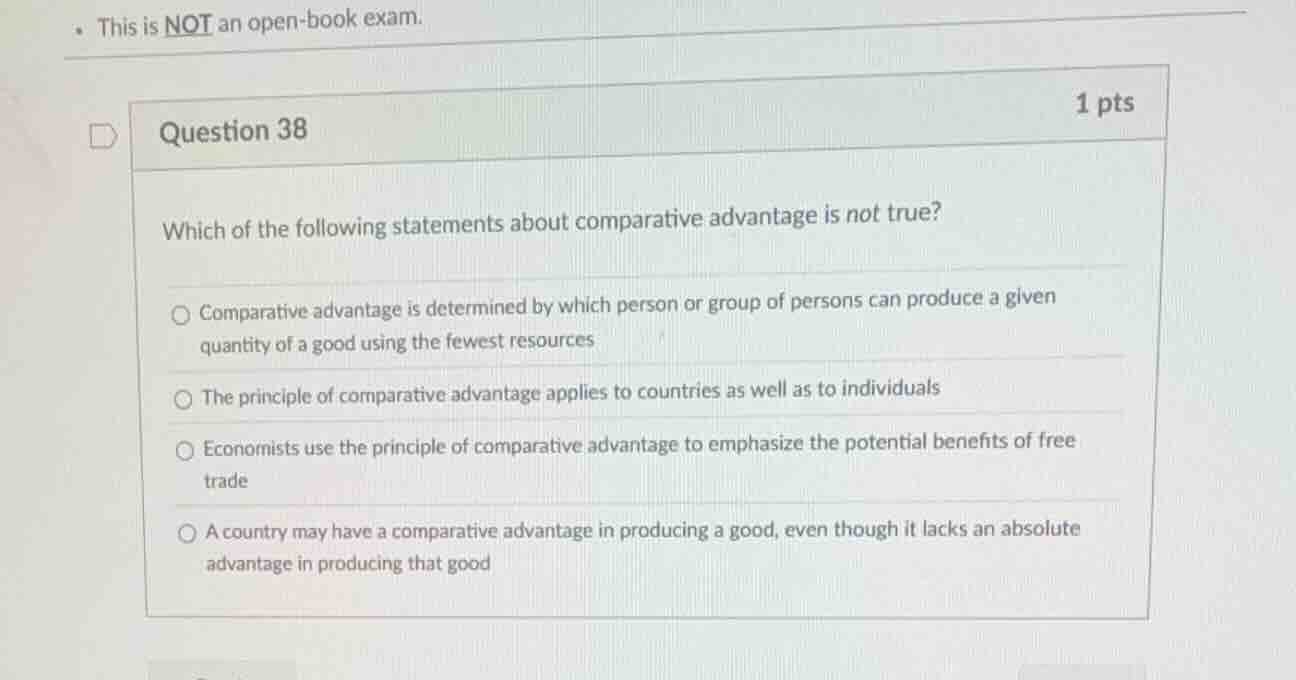
question 38
which of the following statements about comparative advantage is not true?
- comparative advantage is determined by which person or group of persons can produce a given quantity of a good using the fewest resources
- the principle of comparative advantage applies to countries as well as to individuals
- economists use the principle of comparative advantage to emphasize the potential benefits of free trade
- a country may have a comparative advantage in producing a good, even though it lacks an absolute advantage in producing that good
Brief Explanations
- Recall the definitions:
- Comparative advantage is about having a lower opportunity cost in producing a good, while absolute advantage is about producing a good using the fewest resources.
- The first option describes absolute advantage (using fewest resources), not comparative advantage.
- The second option is true: comparative advantage applies to countries and individuals.
- The third option is true: economists use comparative advantage to support free - trade benefits.
- The fourth option is true: a country can have comparative advantage (lower opportunity cost) even without absolute advantage (producing with fewest resources).

Snap & solve any problem in the app
Get step-by-step solutions on Sovi AI
Photo-based solutions with guided steps
Explore more problems and detailed explanations
A. Comparative advantage is determined by which person or group of persons can produce a given quantity of a good using the fewest resources