QUESTION IMAGE
Question
question 6.
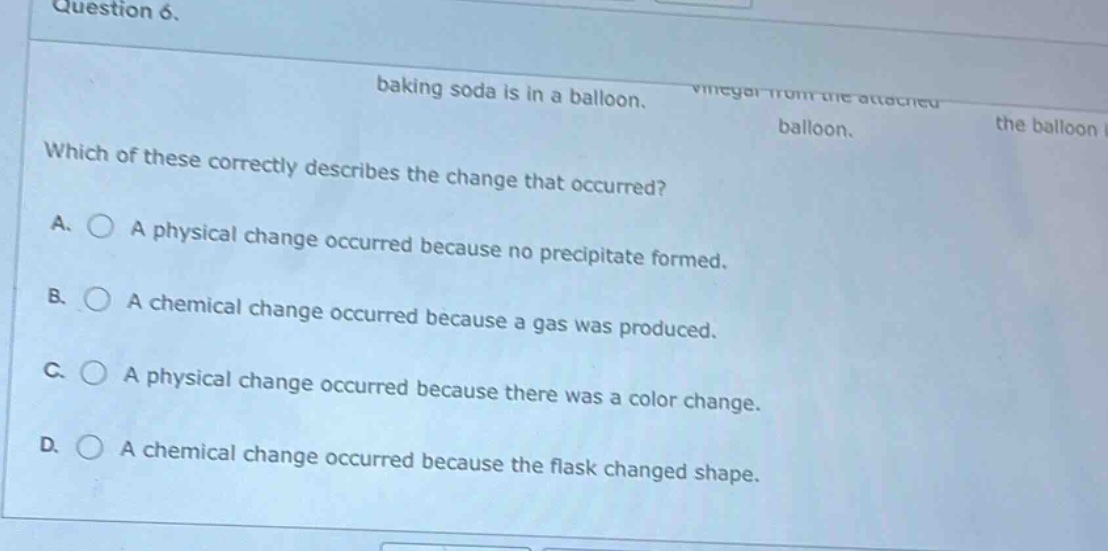
baking soda is in a balloon. vinegar from the attached balloon. the balloon
which of these correctly describes the change that occurred?
a. a physical change occurred because no precipitate formed.
b. a chemical change occurred because a gas was produced.
c. a physical change occurred because there was a color change.
d. a chemical change occurred because the flask changed shape.
Brief Explanations
- Analyze Option A: Physical changes don't involve new substances. Baking soda (sodium bicarbonate) and vinegar (acetic acid) react to form new substances (like carbon dioxide gas). Also, the absence of a precipitate doesn't define a physical change. So A is incorrect.
- Analyze Option B: Baking soda and vinegar react chemically: $\ce{NaHCO_{3} + CH_{3}COOH -> CH_{3}COONa + H_{2}O + CO_{2}↑}$. A gas (CO₂) is produced, indicating a new substance is formed, which is a chemical change. This matches the definition of a chemical change (formation of new substances, often with gas production, color change, precipitate, etc.).
- Analyze Option C: The reaction between baking soda and vinegar doesn't involve a color change, and it's a chemical change, not physical. So C is incorrect.
- Analyze Option D: The flask changing shape is a physical change (like expansion due to gas), but the core change (reaction) is chemical. The flask's shape change is a result of the gas produced from the chemical reaction, not the reason for the chemical change. So D is incorrect.

Snap & solve any problem in the app
Get step-by-step solutions on Sovi AI
Photo-based solutions with guided steps
Explore more problems and detailed explanations
B. A chemical change occurred because a gas was produced.