QUESTION IMAGE
Question
question
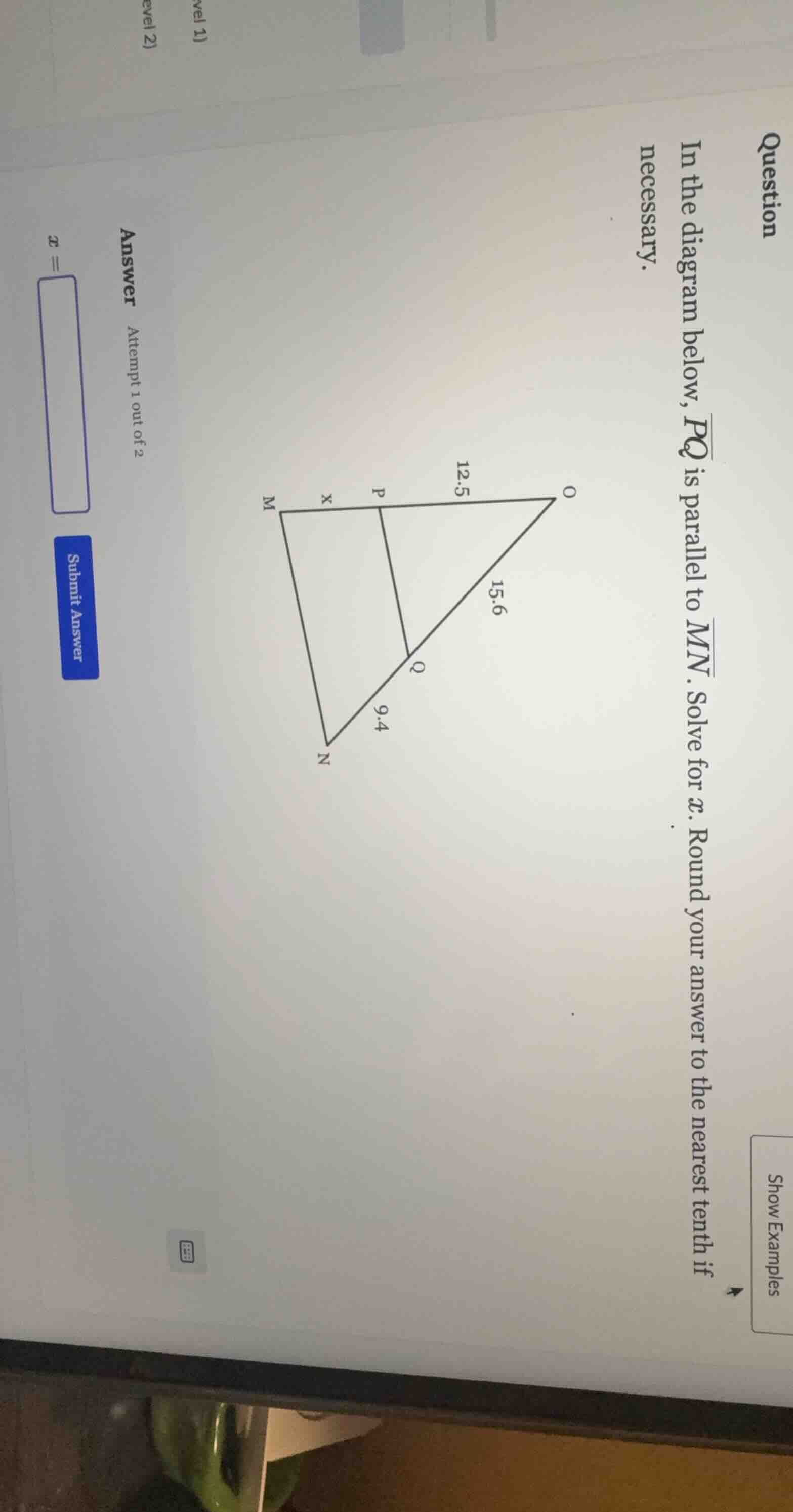
in the diagram below, (overline{pq}) is parallel to (overline{mn}). solve for (x). round your answer to the nearest tenth if necessary.
answer
attempt 1 out of 2
(x=)
submit answer
show examples
Step1: Identify Similar Triangles
Since \( \overline{PQ} \parallel \overline{MN} \), triangles \( \triangle OPQ \) and \( \triangle OMN \) are similar by the Basic Proportionality Theorem (Thales' theorem). So, the ratios of corresponding sides are equal: \( \frac{OP}{OM} = \frac{OQ}{ON} \).
First, find \( OM \): \( OM = OP + PM = 12.5 + x \).
Find \( ON \): \( ON = OQ + QN = 15.6 + 9.4 = 25 \).
Step2: Set Up Proportion
Substitute the known values into the proportion: \( \frac{12.5}{12.5 + x} = \frac{15.6}{25} \).
Step3: Cross - Multiply
Cross - multiply to solve for \( x \): \( 12.5\times25 = 15.6\times(12.5 + x) \).
Calculate \( 12.5\times25 \): \( 12.5\times25 = 312.5 \).
Expand the right - hand side: \( 15.6\times12.5+15.6x = 195+15.6x \).
So, the equation is \( 312.5 = 195 + 15.6x \).
Step4: Solve for \( x \)
Subtract 195 from both sides: \( 312.5−195 = 15.6x \).
\( 117.5 = 15.6x \).
Then, divide both sides by 15.6: \( x=\frac{117.5}{15.6}\approx7.5 \).

Snap & solve any problem in the app
Get step-by-step solutions on Sovi AI
Photo-based solutions with guided steps
Explore more problems and detailed explanations
\( 7.5 \)