QUESTION IMAGE
Question
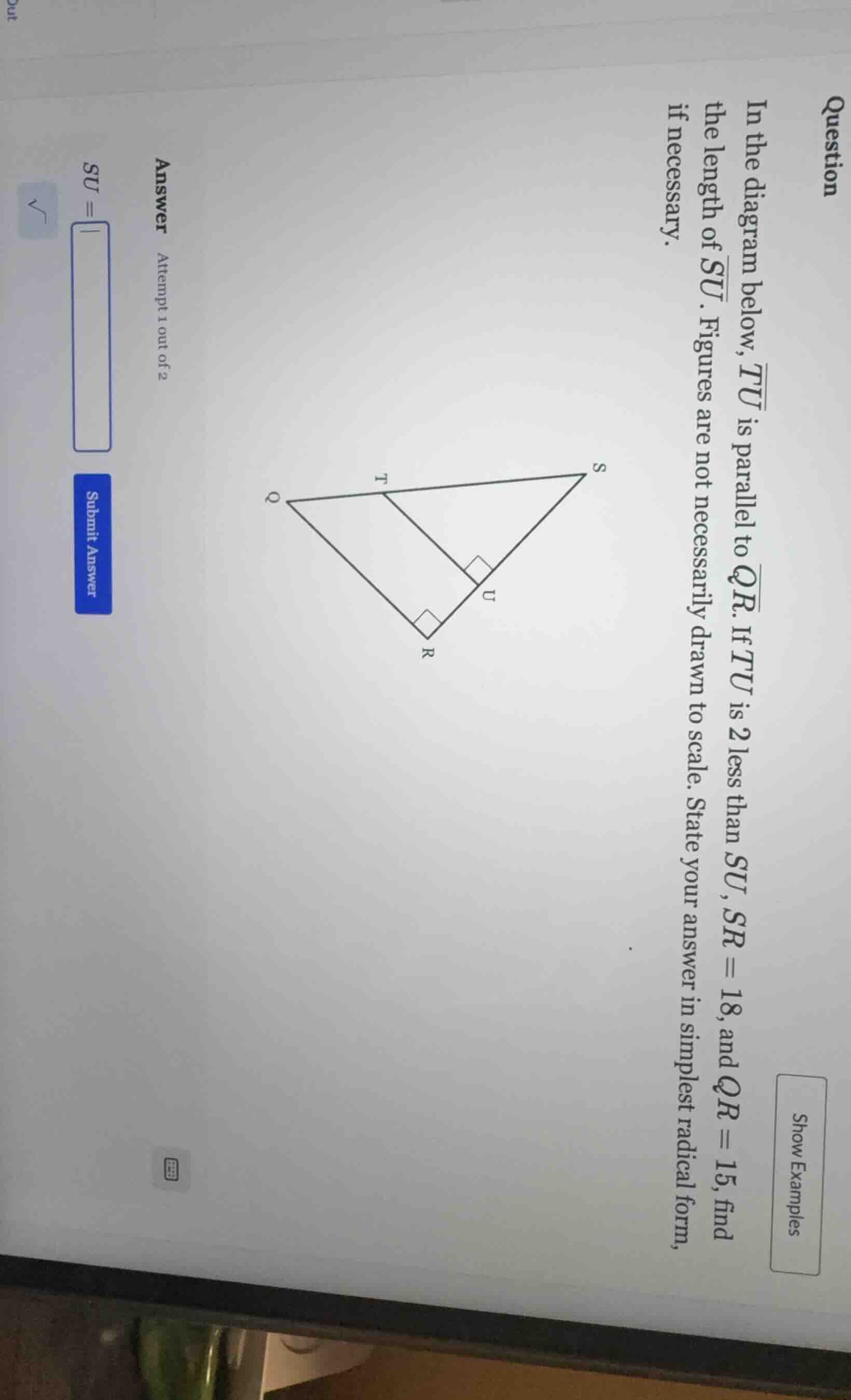
question in the diagram below, \\( \overline{tu} \\) is parallel to \\( \overline{qr} \\). if \\( tu \\) is 2 less than \\( su \\), \\( sr = 18 \\), and \\( qr = 15 \\), find the length of \\( \overline{su} \\). figures are not necessarily drawn to scale. state your answer in simplest radical form, if necessary. answer attempt 1 out of 2 \\( su = \\) \\( \sqrt{} \\) submit answer show examples
Step1: Identify Similar Triangles
Since \( \overline{TU} \parallel \overline{QR} \), triangles \( \triangle STU \) and \( \triangle SQR \) are similar by the Basic Proportionality Theorem (Thales' theorem). Let \( SU = x \), then \( TU = x - 2 \). The ratio of corresponding sides of similar triangles is equal, so \( \frac{SU}{SR}=\frac{TU}{QR} \).
Step2: Substitute Values
Substitute \( SU = x \), \( TU = x - 2 \), \( SR = 18 \), and \( QR = 15 \) into the proportion:
\[
\frac{x}{18}=\frac{x - 2}{15}
\]
Step3: Cross - Multiply
Cross - multiply to get rid of the fractions:
\[
15x=18(x - 2)
\]
Step4: Expand and Solve for \( x \)
Expand the right - hand side: \( 15x = 18x-36 \)
Subtract \( 15x \) from both sides: \( 0 = 3x - 36 \)
Add 36 to both sides: \( 3x=36 \)
Divide both sides by 3: \( x = 12 \)
Wait, but we also have right - angled triangles. Let's re - examine. Since \( \angle U\) and \( \angle R\) are right angles, and \( \triangle STU\sim\triangle SQR\), we can also use the Pythagorean theorem. Let's correct the approach.
Let \( SU = x \), \( TU = x - 2 \), \( SR = 18 \), \( QR = 15 \). Since \( \triangle STU\sim\triangle SQR \), \( \frac{SU}{SR}=\frac{TU}{QR}=\frac{ST}{SQ} \)
From the similarity ratio \( \frac{x}{18}=\frac{x - 2}{15} \), cross - multiplying gives \( 15x=18x - 36\), \( 3x = 36\), \( x = 12 \). But let's check with Pythagoras.
In \( \triangle SQR \), by Pythagoras, \( SQ=\sqrt{SR^{2}+QR^{2}}=\sqrt{18^{2}+15^{2}}=\sqrt{324 + 225}=\sqrt{549}=\sqrt{9\times61}=3\sqrt{61} \)
In \( \triangle STU \), \( SQ=ST + TQ \), and \( \frac{ST}{SQ}=\frac{SU}{SR}=\frac{x}{18} \), \( ST=\frac{x}{18}\times SQ \), \( TQ=\frac{18 - x}{18}\times SQ \)
But wait, the first approach was wrong because we assumed the ratio of sides, but actually, the right - angled sides are \( SR, QR \) and \( SU, TU \). So the correct similarity ratio for right - angled triangles (since \( \angle S\) is common) is \( \frac{SU}{SR}=\frac{TU}{QR}=\frac{ST}{SQ} \)
So \( \frac{x}{18}=\frac{x - 2}{15} \), solving:
\( 15x=18x - 36\)
\( 36 = 3x\)
\( x = 12 \)
Now, let's verify using Pythagoras in \( \triangle STU \) and \( \triangle SQR \)
In \( \triangle SQR \), \( SQ=\sqrt{18^{2}+15^{2}}=\sqrt{324 + 225}=\sqrt{549}=3\sqrt{61} \)
In \( \triangle STU \), \( ST=\sqrt{SU^{2}+TU^{2}}=\sqrt{12^{2}+10^{2}}=\sqrt{144 + 100}=\sqrt{244}=2\sqrt{61} \)
And \( \frac{ST}{SQ}=\frac{2\sqrt{61}}{3\sqrt{61}}=\frac{2}{3} \), and \( \frac{SU}{SR}=\frac{12}{18}=\frac{2}{3} \), \( \frac{TU}{QR}=\frac{10}{15}=\frac{2}{3} \). So the ratio is consistent.

Snap & solve any problem in the app
Get step-by-step solutions on Sovi AI
Photo-based solutions with guided steps
Explore more problems and detailed explanations
\( 12 \)