QUESTION IMAGE
Question
question
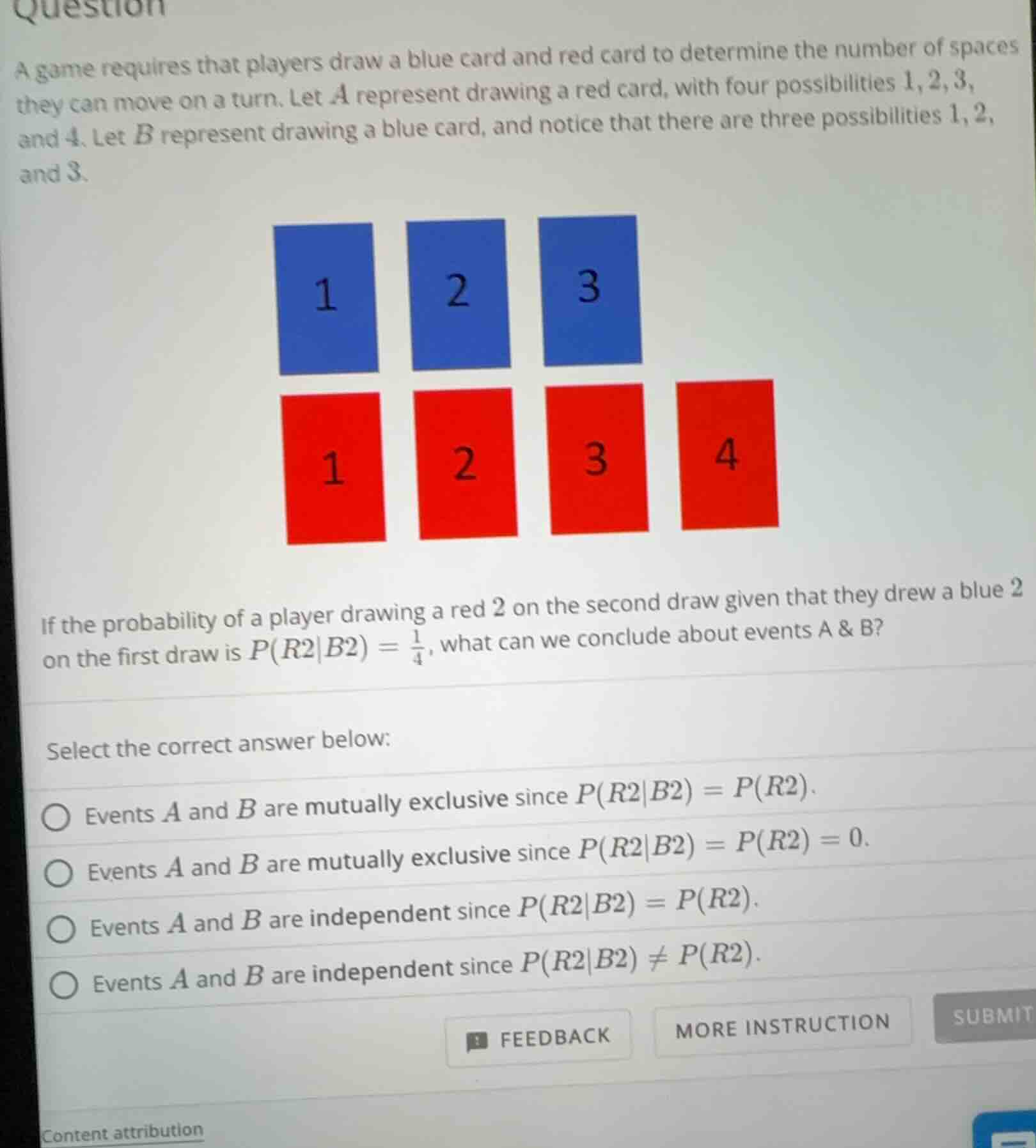
a game requires that players draw a blue card and red card to determine the number of spaces
they can move on a turn. let ( a ) represent drawing a red card, with four possibilities 1, 2, 3,
and 4. let ( b ) represent drawing a blue card, and notice that there are three possibilities 1, 2,
and 3.
if the probability of a player drawing a red 2 on the second draw given that they drew a blue 2
on the first draw is ( p(r2|b2) = \frac{1}{4} ), what can we conclude about events a & b?
select the correct answer below:
( \bigcirc ) events ( a ) and ( b ) are mutually exclusive since ( p(r2|b2) = p(r2) ).
( \bigcirc ) events ( a ) and ( b ) are mutually exclusive since ( p(r2|b2) = p(r2) = 0 ).
( \bigcirc ) events ( a ) and ( b ) are independent since ( p(r2|b2) = p(r2) ).
( \bigcirc ) events ( a ) and ( b ) are independent since ( p(r2|b2)
eq p(r2) ).
- First, recall the formula for conditional probability and independence: Two events \( A \) and \( B \) are independent if \( P(A|B) = P(A) \) (or \( P(B|A)=P(B) \)). Also, mutually exclusive events cannot occur at the same time, and for mutually exclusive events \( P(A \cap B) = 0 \), which is not related to conditional probability in this way.
- Calculate \( P(R2) \): The red card (event \( A \)) has 4 possibilities (1, 2, 3, 4). So the probability of drawing a red 2 (\( R2 \)) is \( P(R2)=\frac{1}{4} \) (since there are 4 red cards and 1 is red 2).
- We are given \( P(R2|B2)=\frac{1}{4} \). Since \( P(R2|B2) = P(R2)=\frac{1}{4} \), this satisfies the condition for independence of events \( A \) (drawing red card) and \( B \) (drawing blue card). Mutually exclusive is incorrect here because the events can occur (drawing a blue card and a red card are separate draws, not mutually exclusive). So we conclude events \( A \) and \( B \) are independent because \( P(R2|B2)=P(R2) \).

Snap & solve any problem in the app
Get step-by-step solutions on Sovi AI
Photo-based solutions with guided steps
Explore more problems and detailed explanations
Events \( A \) and \( B \) are independent since \( P(R2|B2) = P(R2) \) (the option with this statement, e.g., the fourth option in the list: "Events \( A \) and \( B \) are independent since \( P(R2|B2) = P(R2) \)").