QUESTION IMAGE
Question
question
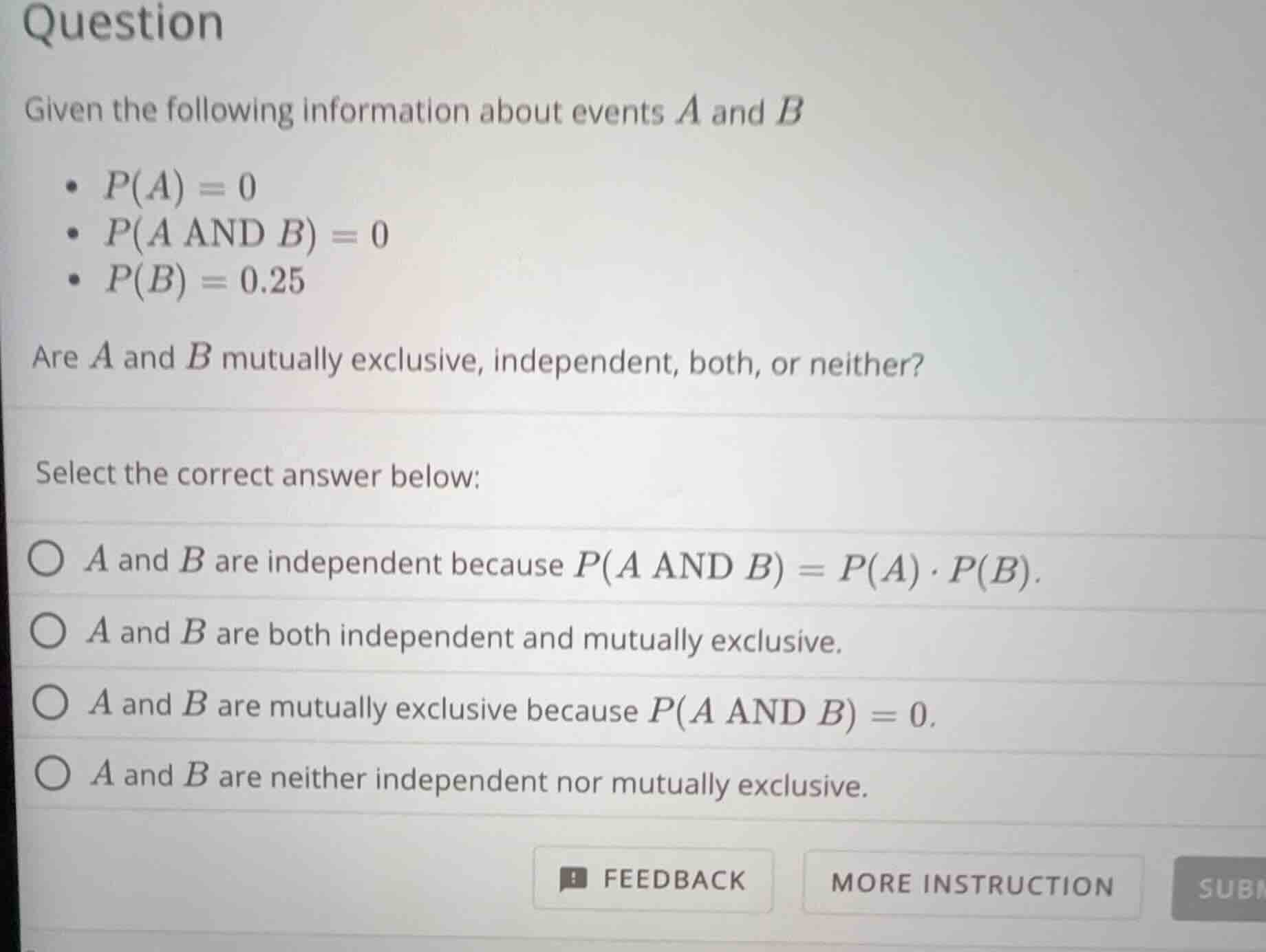
given the following information about events ( a ) and ( b )
- ( p(a) = 0 )
- ( p(a \text{ and } b) = 0 )
- ( p(b) = 0.25 )
are ( a ) and ( b ) mutually exclusive, independent, both, or neither?
select the correct answer below:
( \bigcirc ) ( a ) and ( b ) are independent because ( p(a \text{ and } b) = p(a) cdot p(b) ).
( \bigcirc ) ( a ) and ( b ) are both independent and mutually exclusive.
( \bigcirc ) ( a ) and ( b ) are mutually exclusive because ( p(a \text{ and } b) = 0 ).
( \bigcirc ) ( a ) and ( b ) are neither independent nor mutually exclusive.
Step1: Recall definitions of mutually exclusive and independent events
- Mutually exclusive events: \( P(A \text{ AND } B) = 0 \) (they can't occur at the same time).
- Independent events: \( P(A \text{ AND } B) = P(A) \cdot P(B) \).
Step2: Check for mutually exclusive
Given \( P(A \text{ AND } B) = 0 \), so \( A \) and \( B \) are mutually exclusive.
Step3: Check for independent
Calculate \( P(A) \cdot P(B) \): \( P(A) = 0 \), \( P(B) = 0.25 \), so \( P(A) \cdot P(B) = 0 \times 0.25 = 0 \). And \( P(A \text{ AND } B) = 0 \), so \( P(A \text{ AND } B) = P(A) \cdot P(B) \), meaning they are also independent.

Snap & solve any problem in the app
Get step-by-step solutions on Sovi AI
Photo-based solutions with guided steps
Explore more problems and detailed explanations
B. \( A \) and \( B \) are both independent and mutually exclusive.