QUESTION IMAGE
Question
question 5 of 5
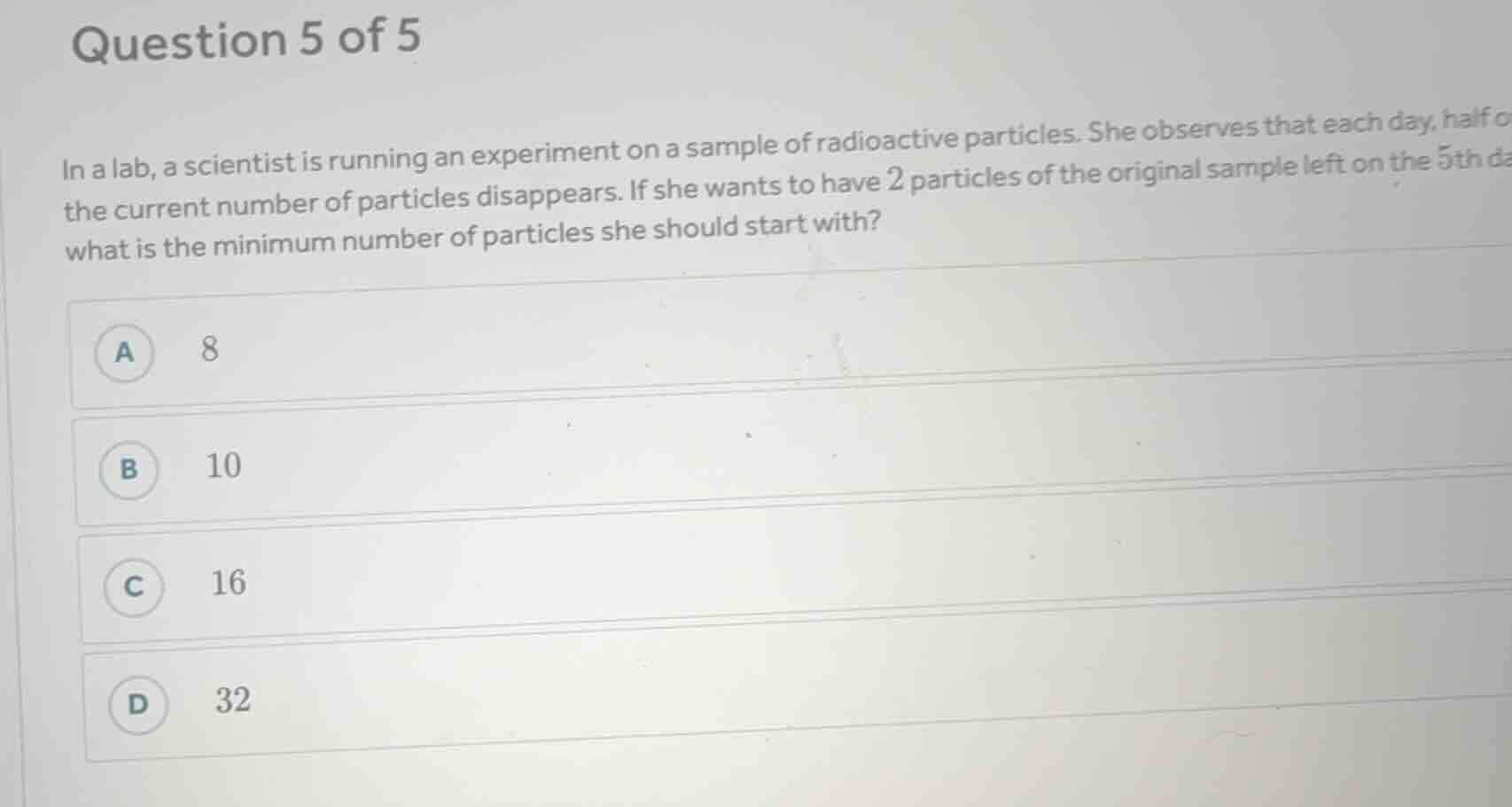
in a lab, a scientist is running an experiment on a sample of radioactive particles. she observes that each day, half of the current number of particles disappears. if she wants to have 2 particles of the original sample left on the 5th day, what is the minimum number of particles she should start with?
a 8
b 10
c 16
d 32
Step1: Understand the decay pattern
Each day, half of the particles disappear, so we can work backwards from the 5th day. Let \( N_5 = 2 \) (particles on 5th day).
Step2: Find particles on 4th day
To find the number of particles on the 4th day (\( N_4 \)), since half disappear to get to \( N_5 \), we have \( N_5=\frac{N_4}{2} \), so \( N_4 = 2\times N_5=2\times2 = 4 \).
Step3: Find particles on 3rd day
Using the same logic, \( N_4=\frac{N_3}{2} \), so \( N_3 = 2\times N_4=2\times4 = 8 \).
Step4: Find particles on 2nd day
\( N_3=\frac{N_2}{2} \), so \( N_2 = 2\times N_3=2\times8 = 16 \).
Step5: Find initial particles (\( N_0 \))
\( N_2=\frac{N_1}{2} \), \( N_1 = 2\times N_2 = 32 \)? Wait, no, wait. Wait, we need to go from day 5 back to day 1? Wait, no, let's correct. Wait, the 5th day: let's index the days as day 1, day 2, day 3, day 4, day 5.
Wait, actually, if on day \( n \), the number of particles is \( N_n \), then \( N_{n + 1}=\frac{N_n}{2} \). So to go back, \( N_n = 2\times N_{n+1} \).
We know \( N_5 = 2 \).
Then \( N_4=2\times N_5 = 4 \) (day 4)
\( N_3=2\times N_4 = 8 \) (day 3)
\( N_2=2\times N_3 = 16 \) (day 2)
\( N_1=2\times N_2 = 32 \)? Wait, no, that can't be. Wait, maybe I messed up the day indexing. Wait, the problem says "on the 5th day" she wants 2 particles. So let's think:
Let the initial number be \( x \).
Day 1: \( \frac{x}{2} \)
Day 2: \( \frac{x}{2^2} \)
Day 3: \( \frac{x}{2^3} \)
Day 4: \( \frac{x}{2^4} \)
Day 5: \( \frac{x}{2^4} \)? Wait, no. Wait, day 1: after first day (day 1 ends), number is \( x/2 \). Day 2 ends: \( x/4 \). Day 3 ends: \( x/8 \). Day 4 ends: \( x/16 \). Day 5 ends: \( x/32 \)? Wait, that's not matching. Wait, I think I had the day count wrong.
Wait, the problem says "on the 5th day" she wants 2 particles. So let's re - index:
Let the starting day be day 0 (initial), day 1: after 1 day, day 2: after 2 days, ..., day 5: after 5 days.
The formula for radioactive decay (half - life) is \( N(t)=N_0\times(\frac{1}{2})^t \), where \( N(t) \) is the number of particles at time \( t \), \( N_0 \) is initial number, \( t \) is number of days.
We want \( N(5) = 2 \). So \( 2=N_0\times(\frac{1}{2})^5 \)
\( 2=N_0\times\frac{1}{32} \)
\( N_0=2\times32 = 64 \)? Wait, that's not one of the options. Wait, maybe the problem is that "on the 5th day" means the 5th day of observation, so the number of half - lives is 4? Wait, maybe the days are counted as day 1: after 1 day, day 2: after 2 days, ..., day 5: after 4 days? No, that doesn't make sense.
Wait, let's look at the options. The options are 8,10,16,32. Let's try working backwards from the 5th day:
5th day: 2 particles.
4th day: since half disappears to get to 5th day, 4th day has \( 2\times2 = 4 \)
3rd day: \( 4\times2 = 8 \)
2nd day: \( 8\times2 = 16 \)
1st day: \( 16\times2 = 32 \)? No, but 32 is option D. Wait, but maybe the days are day 1: start, day 2: after 1 day, ..., day 5: after 4 days? No, the problem says "on the 5th day" she wants 2 particles. Wait, maybe the initial day is day 1, and on day 5, the number is 2. So from day 1 to day 5, there are 4 half - lives? Wait, no, day 1: \( N_1 \)
day 2: \( N_1/2 \)
day 3: \( N_1/4 \)
day 4: \( N_1/8 \)
day 5: \( N_1/16 \)
Set \( N_1/16 = 2 \), then \( N_1=32 \)? But 32 is option D. But wait, maybe I made a mistake in the number of half - lives. Wait, the problem says "each day, half of the current number of particles disappears". So day 1: start with \( x \), end of day 1: \( x/2 \)
end of day 2: \( x/4 \)
end of day 3: \( x/8 \)
end of day 4: \( x/16 \…

Snap & solve any problem in the app
Get step-by-step solutions on Sovi AI
Photo-based solutions with guided steps
Explore more problems and detailed explanations
D. 32