QUESTION IMAGE
Question
question 1 (mandatory) (1 point) saved
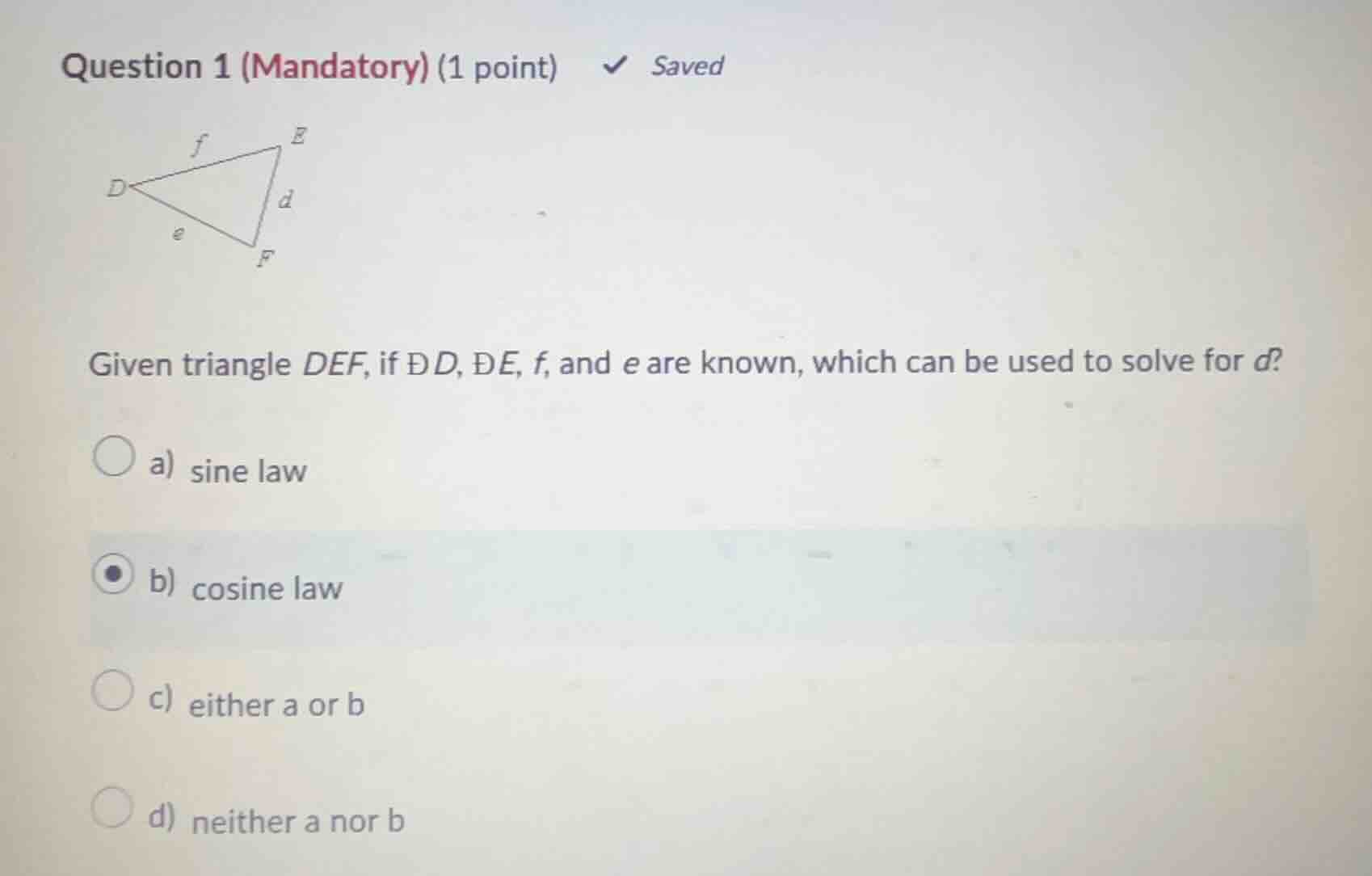
given triangle def, if ∠d, de, f, and e are known, which can be used to solve for d?
a) sine law
b) cosine law
c) either a or b
d) neither a nor b
To solve for side \( d \) in triangle \( DEF \) with known angle \( \angle D \), sides \( e \), \( f \), and \( DE \) (wait, actually, in triangle notation, side opposite \( D \) is \( d \), side opposite \( E \) is \( e \), side opposite \( F \) is \( f \)? Wait, no, the standard notation is side \( a \) opposite angle \( A \), etc. So in triangle \( DEF \), angle \( D \), sides \( e \) (maybe \( EF \)), \( f \) (maybe \( DE \)? Wait, the diagram: \( D \), \( E \), \( F \), with \( DE = f \), \( DF = e \), \( EF = d \). So we have two sides \( e \) ( \( DF \) ), \( f \) ( \( DE \) ), and the included angle \( \angle D \) between them, and we need to find the third side \( d \) ( \( EF \) ). The Law of Cosines states that for a triangle with sides \( a \), \( b \), \( c \) and included angle \( C \) between \( a \) and \( b \), \( c^2 = a^2 + b^2 - 2ab\cos C \). Here, \( d^2 = e^2 + f^2 - 2ef\cos D \), which is the Law of Cosines. The Law of Sines relates sides and opposite angles (\( \frac{a}{\sin A}=\frac{b}{\sin B}=\frac{c}{\sin C} \)), but we don't have a known angle opposite a known side here (we know angle \( D \), but the sides opposite other angles aren't known yet). So only the Law of Cosines applies here.

Snap & solve any problem in the app
Get step-by-step solutions on Sovi AI
Photo-based solutions with guided steps
Explore more problems and detailed explanations
b) cosine law