QUESTION IMAGE
Question
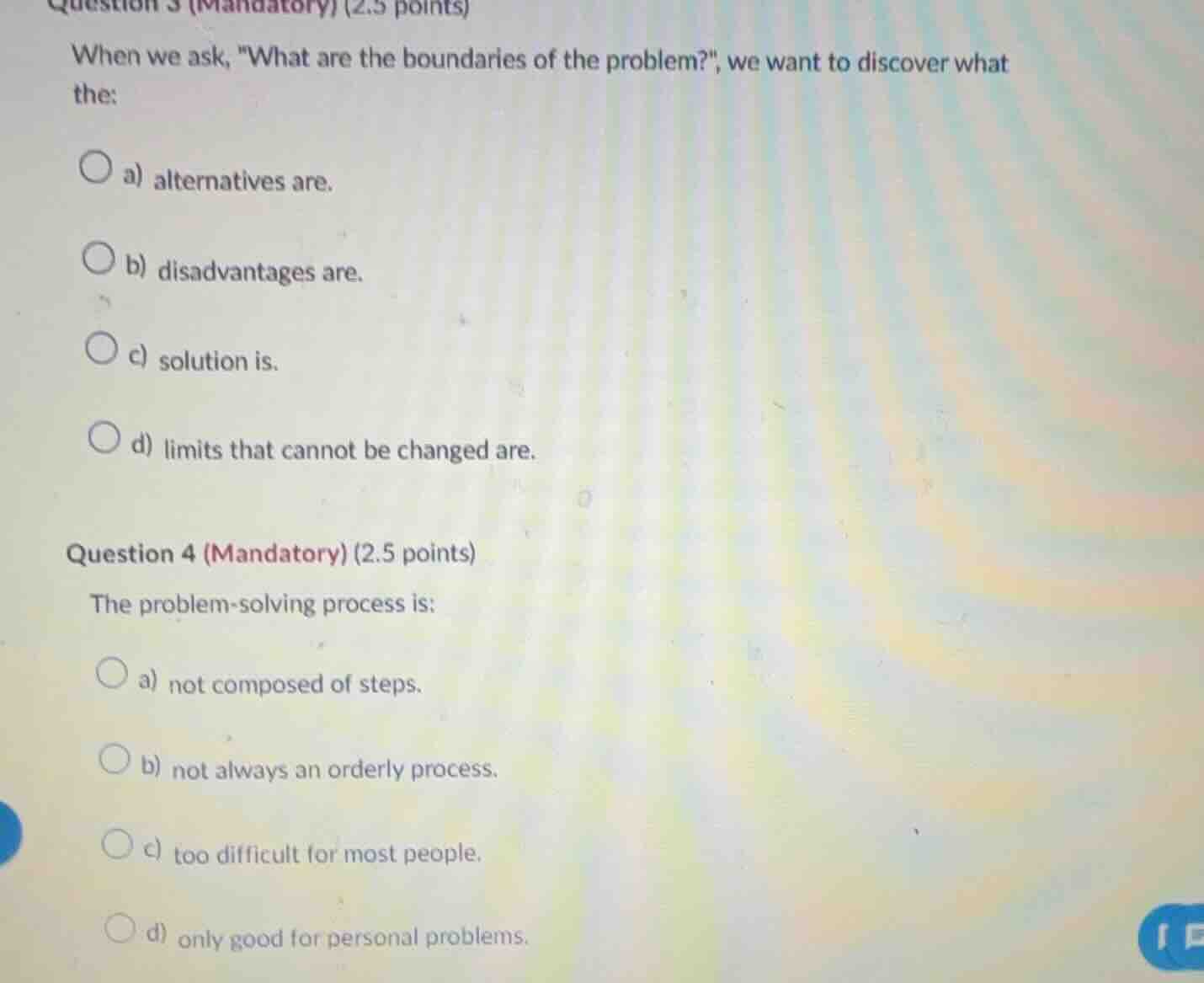
question 3 (mandatory) (2.5 points)
when we ask, \what are the boundaries of the problem?\, we want to discover what
the:
a) alternatives are.
b) disadvantages are.
c) solution is.
d) limits that cannot be changed are.
question 4 (mandatory) (2.5 points)
the problem - solving process is:
a) not composed of steps.
b) not always an orderly process.
c) too difficult for most people.
d) only good for personal problems.
Response
Question 3
Brief Explanations
To determine the answer, we analyze each option:
- Option a: Alternatives relate to choices, not boundaries. Eliminate.
- Option b: Disadvantages are negative aspects, not boundaries. Eliminate.
- Option c: The solution is the answer to the problem, not its boundaries. Eliminate.
- Option d: Boundaries of a problem refer to the limits or constraints that cannot be changed. This matches the definition of problem boundaries.
Brief Explanations
Analyzing each option:
- Option a: The problem - solving process typically has steps (e.g., defining the problem, generating solutions, implementing). So this is incorrect.
- Option b: The problem - solving process is not always orderly as problems can be complex, and the process may involve backtracking, re - evaluating, etc. This is a correct statement.
- Option c: Problem - solving is a skill that can be learned, and it's not too difficult for most people with practice. Eliminate.
- Option d: The problem - solving process is useful for both personal and professional/organizational problems. Eliminate.

Snap & solve any problem in the app
Get step-by-step solutions on Sovi AI
Photo-based solutions with guided steps
Explore more problems and detailed explanations
d) limits that cannot be changed are.