QUESTION IMAGE
Question
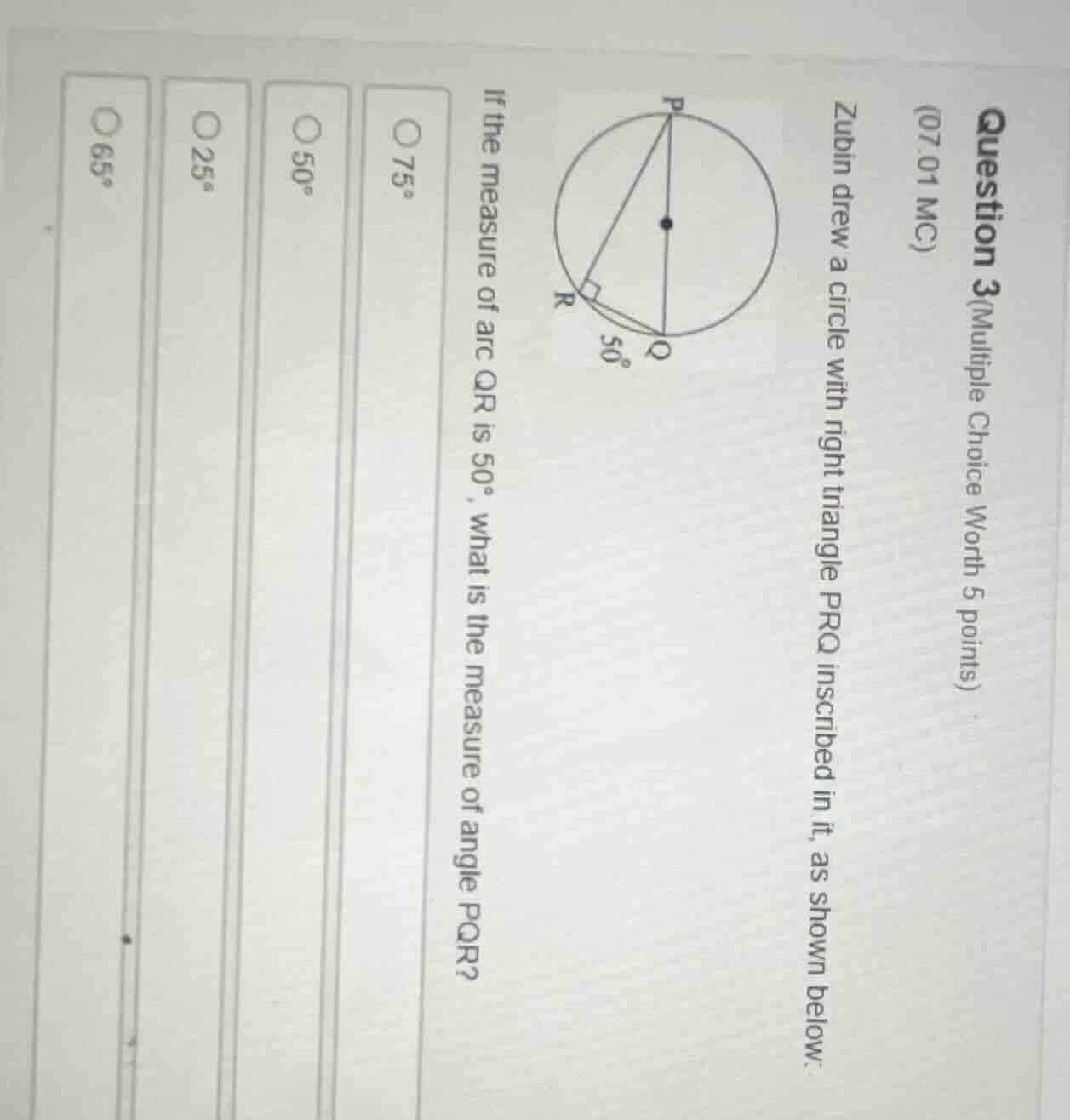
question 3(multiple choice worth 5 points) (07.01 mc) zubin drew a circle with right triangle prq inscribed in it, as shown below. if the measure of arc qr is 50°, what is the measure of angle pqr? 75° 50° 25° 65°
Step1: Recall the property of a semicircle
Since \( PRQ \) is a right triangle inscribed in the circle and \( PQ \) is a diameter (as the center is on \( PQ \)), arc \( PRQ \) is a semicircle, so the measure of arc \( PQ \) is \( 180^\circ \).
Step2: Find the measure of arc \( PR \)
Given arc \( QR = 50^\circ \), then arc \( PR=180^\circ - 50^\circ = 130^\circ \)? Wait, no, wait. Wait, angle at \( R \) is right angle, so \( \angle PRQ = 90^\circ \). The inscribed angle theorem: the measure of an inscribed angle is half the measure of its intercepted arc. Wait, we need to find \( \angle PQR \). The angle \( \angle PQR \) intercepts arc \( PR \). Wait, first, arc \( PQ \) is a diameter, so arc \( PQ = 180^\circ \). Arc \( QR = 50^\circ \), so arc \( PR=180^\circ - 50^\circ = 130^\circ \)? No, wait, no. Wait, \( \angle PQR \): the intercepted arc is arc \( PR \). Wait, no, let's correct. The inscribed angle \( \angle PQR \) intercepts arc \( PR \). Wait, the measure of an inscribed angle is half the measure of its intercepted arc. But also, since \( PQ \) is a diameter, \( \angle PRQ = 90^\circ \) (Thales' theorem). So in triangle \( PRQ \), \( \angle PRQ = 90^\circ \), and we can find \( \angle PQR \) by using the fact that the central angle or the arc. Wait, arc \( QR = 50^\circ \), so the inscribed angle intercepting arc \( QR \) would be \( \angle QPR \), which is \( \frac{50^\circ}{2}=25^\circ \). Then in triangle \( PRQ \), angles sum to \( 180^\circ \), so \( \angle PQR = 180^\circ - 90^\circ - 25^\circ = 65^\circ \)? Wait, no, wait. Wait, arc \( QR = 50^\circ \), so the inscribed angle \( \angle QPR \) (which is at \( P \)) intercepts arc \( QR \), so \( \angle QPR=\frac{1}{2}\times50^\circ = 25^\circ \). Then in right triangle \( PRQ \), \( \angle PQR = 90^\circ - 25^\circ = 65^\circ \)? Wait, no, wait. Wait, let's start over.
Thales' theorem: if you have a triangle inscribed in a circle where one side is the diameter, then the angle opposite that side is a right angle. So \( \angle PRQ = 90^\circ \). The measure of arc \( QR \) is \( 50^\circ \), so the central angle for arc \( QR \) is \( 50^\circ \). The inscribed angle \( \angle QPR \) (at \( P \)) intercepts arc \( QR \), so \( \angle QPR=\frac{1}{2}\times50^\circ = 25^\circ \). Then in triangle \( PRQ \), angles sum to \( 180^\circ \), so \( \angle PQR = 180^\circ - 90^\circ - 25^\circ = 65^\circ \). Wait, but let's check the arc. The angle \( \angle PQR \) intercepts arc \( PR \). Arc \( PR \) is \( 180^\circ - 50^\circ = 130^\circ \), so the inscribed angle \( \angle PQR \) should be \( \frac{1}{2}\times130^\circ = 65^\circ \). Yes, that's correct.

Snap & solve any problem in the app
Get step-by-step solutions on Sovi AI
Photo-based solutions with guided steps
Explore more problems and detailed explanations
\( 65^\circ \) (the option with \( 65^\circ \))