QUESTION IMAGE
Question
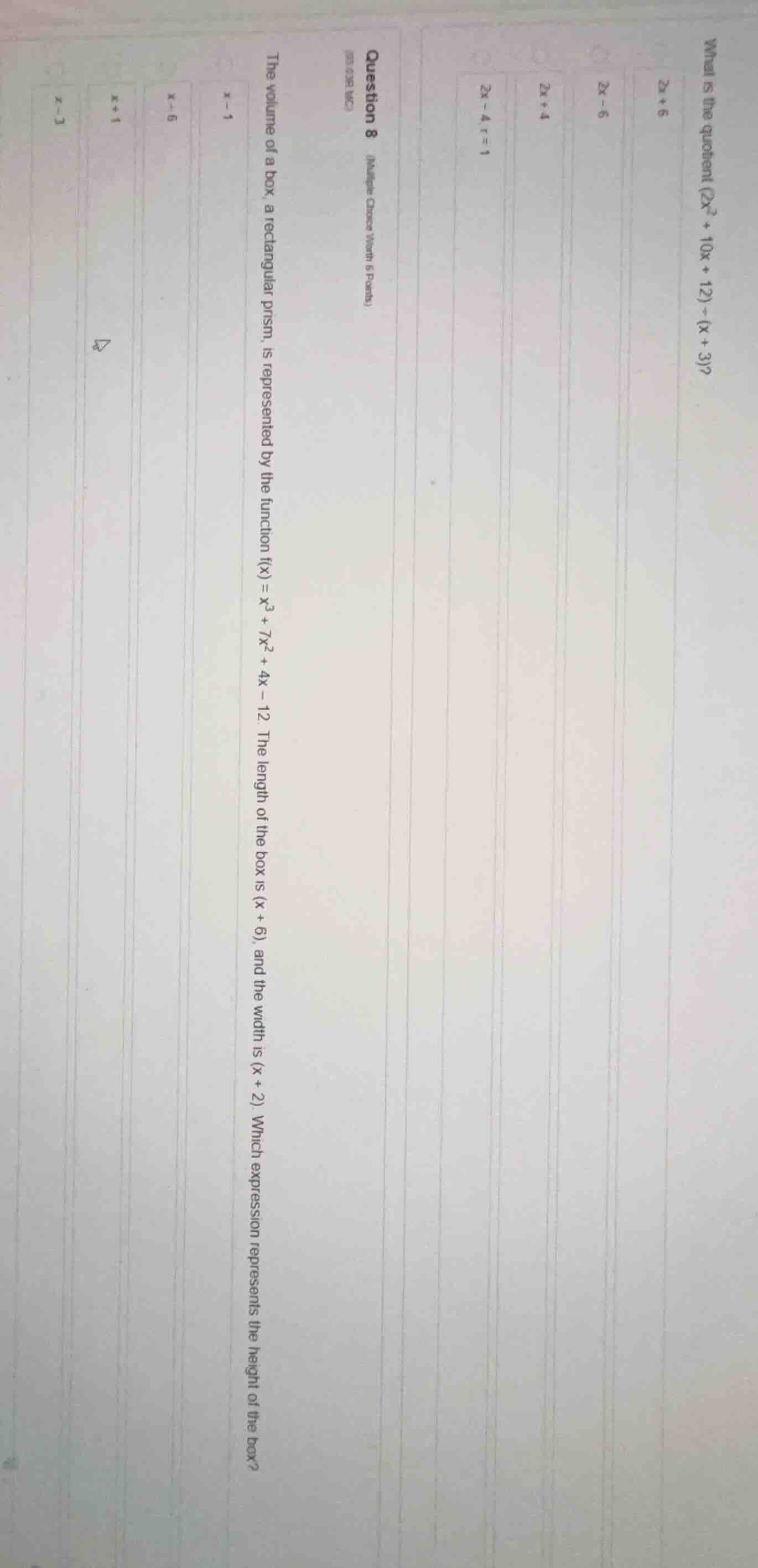
question 8 (multiple choice worth 6 points) the volume of a box, a rectangular prism, is represented by the function f(x) = x³ + 7x² + 4x − 12. the length of the box is (x + 6), and the width is (x + 2). which expression represents the height of the box? x - 1 x - 6 x + 1 x - 3
First Question: What is the quotient \((2x^2 + 10x + 12)\div(x + 3)\)?
Step 1: Factor the numerator
We factor the quadratic expression \(2x^2 + 10x + 12\). First, factor out the common factor of 2:
\(2x^2 + 10x + 12 = 2(x^2 + 5x + 6)\)
Then, factor the quadratic inside the parentheses. We need two numbers that multiply to 6 and add to 5. Those numbers are 2 and 3:
\(x^2 + 5x + 6 = (x + 2)(x + 3)\)
So, the numerator becomes \(2(x + 2)(x + 3)\).
Step 2: Divide by the denominator
Now we divide \(2(x + 2)(x + 3)\) by \((x + 3)\). The \((x + 3)\) terms cancel out (assuming \(x
eq -3\)):
\(\frac{2(x + 2)(x + 3)}{x + 3} = 2(x + 2)\)
Step 3: Simplify the result
Distribute the 2:
\(2(x + 2) = 2x + 4\)
Second Question: The volume of a box (rectangular prism) is \(f(x)=x^3 + 7x^2 + 4x - 12\). The length is \((x + 6)\) and the width is \((x + 2)\). Find the height.
Step 1: Recall the volume formula for a rectangular prism
The volume \(V\) of a rectangular prism is given by \(V=\text{length}\times\text{width}\times\text{height}\). So, \(\text{height}=\frac{V}{\text{length}\times\text{width}}\).
Step 2: Multiply length and width
First, multiply the length \((x + 6)\) and the width \((x + 2)\):
\((x + 6)(x + 2)=x^2 + 2x + 6x + 12=x^2 + 8x + 12\)
Step 3: Divide the volume by the product of length and width
We need to divide \(x^3 + 7x^2 + 4x - 12\) by \(x^2 + 8x + 12\). We can use polynomial long division or factor the volume. Let's try factoring the volume.
Test possible roots using the Rational Root Theorem. Possible roots are factors of 12 over factors of 1: \(\pm1, \pm2, \pm3, \pm4, \pm6, \pm12\).
Test \(x = 1\): \(1 + 7 + 4 - 12 = 0\). So, \((x - 1)\) is not a factor (wait, \(1 + 7 + 4 - 12 = 0\)? Wait, \(1 + 7 = 8\), \(8 + 4 = 12\), \(12 - 12 = 0\). Wait, no, \(x = 1\) gives \(1 + 7 + 4 - 12 = 0\)? Wait, \(1^3 + 7(1)^2 + 4(1) - 12 = 1 + 7 + 4 - 12 = 0\). Wait, but we know length is \(x + 6\) (root at \(x = -6\)) and width is \(x + 2\) (root at \(x = -2\)). Let's test \(x = -6\): \((-6)^3 + 7(-6)^2 + 4(-6) - 12 = -216 + 252 - 24 - 12 = 0\). So, \((x + 6)\) is a factor. Let's perform polynomial division or use synthetic division.
Using synthetic division with root \(x = -6\) for \(x^3 + 7x^2 + 4x - 12\):
Coefficients: \(1\) (x³), \(7\) (x²), \(4\) (x), \(-12\) (constant)
Bring down the 1. Multiply by -6: \(1\times -6 = -6\). Add to next coefficient: \(7 + (-6) = 1\). Multiply by -6: \(1\times -6 = -6\). Add to next coefficient: \(4 + (-6) = -2\). Multiply by -6: \(-2\times -6 = 12\). Add to last coefficient: \(-12 + 12 = 0\).
So, the quotient is \(x^2 + x - 2\). Now factor \(x^2 + x - 2\): we need two numbers that multiply to -2 and add to 1. Those numbers are 2 and -1: \(x^2 + x - 2 = (x + 2)(x - 1)\). Wait, but we already have length \((x + 6)\) and width \((x + 2)\). Wait, maybe I made a mistake. Wait, the volume is \(x^3 + 7x^2 + 4x - 12\). Let's factor it as \((x + 6)(x + 2)(x - 1)\)? Wait, \((x + 6)(x + 2)=x^2 + 8x + 12\), then multiply by \((x - 1)\): \(x^3 + 8x^2 + 12x - x^2 - 8x - 12 = x^3 + 7x^2 + 4x - 12\). Yes! So the volume factors as \((x + 6)(x + 2)(x - 1)\).
Since volume = length × width × height, and length = \(x + 6\), width = \(x + 2\), then height = \(\frac{(x + 6)(x + 2)(x - 1)}{(x + 6)(x + 2)} = x - 1\) (assuming \(x
eq -6, -2\)).

Snap & solve any problem in the app
Get step-by-step solutions on Sovi AI
Photo-based solutions with guided steps
Explore more problems and detailed explanations
s:
- The quotient \((2x^2 + 10x + 12)\div(x + 3)\) is \(\boldsymbol{2x + 4}\).
- The height of the box is \(\boldsymbol{x - 1}\).