QUESTION IMAGE
Question
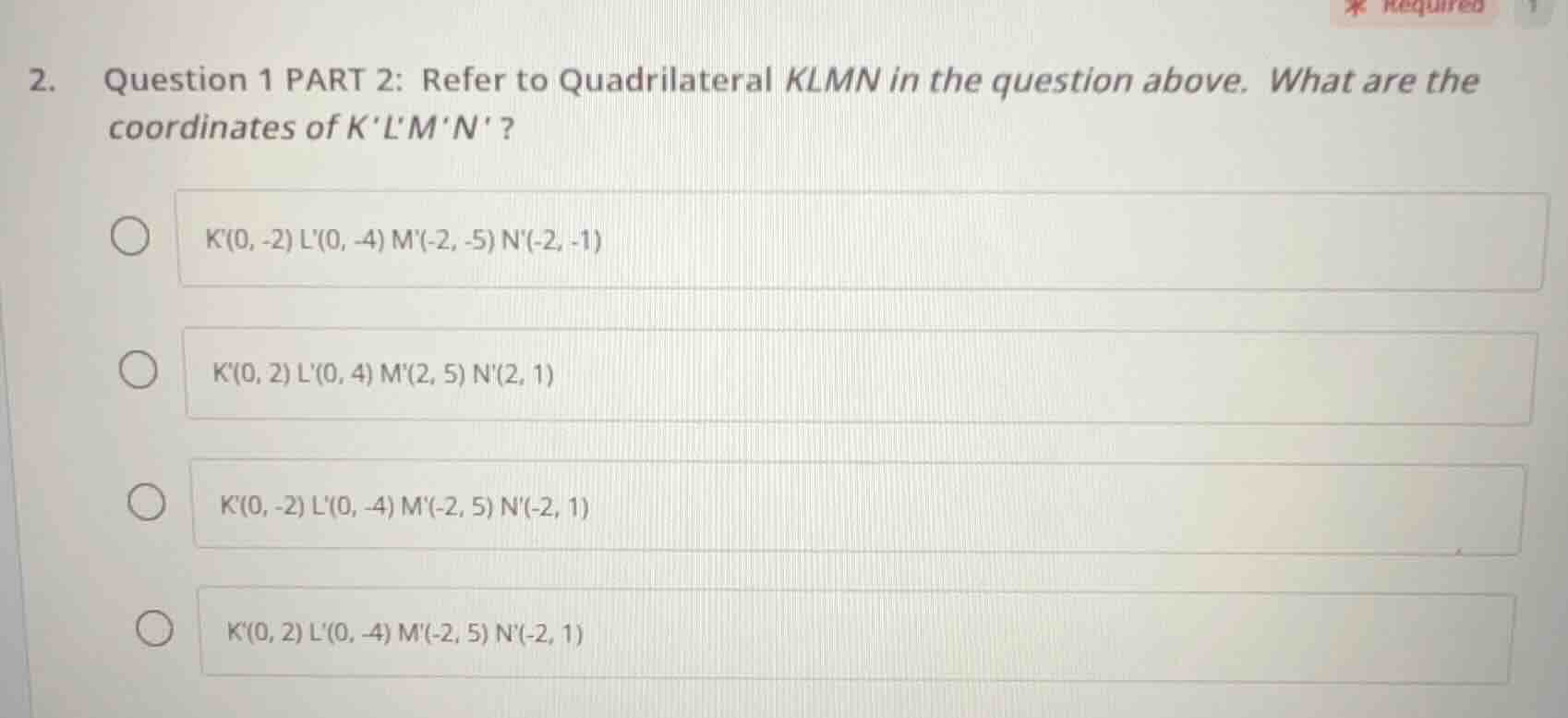
- question 1 part 2: refer to quadrilateral klmn in the question above. what are the coordinates of klmn?
k(0, -2) l(0, -4) m(-2, -5) n(-2, -1)
k(0, 2) l(0, 4) m(2, 5) n(2, 1)
k(0, -2) l(0, -4) m(-2, 5) n(-2, 1)
k(0, 2) l(0, -4) m(-2, 5) n(-2, 1)
To solve this, we assume the original quadrilateral KLMN (from the "question above" which likely involves a reflection, probably over the x - axis or y - axis, or a transformation). Let's analyze the coordinates:
Step 1: Recall transformation rules (e.g., reflection over x - axis: \((x,y)\to(x, - y)\); reflection over y - axis: \((x,y)\to(-x,y)\))
Suppose the original coordinates of K, L, M, N (not given here, but from the previous question) when transformed (e.g., reflection over x - axis) would flip the y - coordinates. Let's check the options:
- Option 1: \(K'(0, - 2)\), \(L'(0, - 4)\), \(M'(-2, - 5)\), \(N'(-2, - 1)\)
- Option 2: \(K'(0,2)\), \(L'(0,4)\), \(M'(2,5)\), \(N'(2,1)\)
- Option 3: \(K'(0, - 2)\), \(L'(0, - 4)\), \(M'(-2,5)\), \(N'(-2,1)\) (inconsistent y - sign change)
- Option 4: \(K'(0,2)\), \(L'(0, - 4)\), \(M'(-2,5)\), \(N'(-2,1)\) (inconsistent y - sign change)
If we assume a reflection over the x - axis (where \((x,y)\to(x, - y)\)), and if the original coordinates of K, L, M, N were \(K(0,2)\), \(L(0,4)\), \(M(2,5)\), \(N(2,1)\), then reflecting over the x - axis would give \(K'(0, - 2)\), \(L'(0, - 4)\), \(M'(-2, - 5)\) (wait, no, x - coordinate sign change would be reflection over y - axis. Wait, maybe reflection over y - axis: \((x,y)\to(-x,y)\). If original K was \((0, - 2)\), L \((0, - 4)\), M \((2, - 5)\), N \((2, - 1)\), then reflection over y - axis would be \(K'(0, - 2)\), \(L'(0, - 4)\), \(M'(-2, - 5)\), \(N'(-2, - 1)\), which is Option 1.
Wait, let's check the consistency of the coordinates. The first option has consistent sign changes (assuming reflection over y - axis for the x - coordinates of M and N, and y - coordinates maybe reflection over x - axis). Let's verify the distance between points. In quadrilateral K'L'M'N', the distance between K' and L' should be the same as original (since transformations preserve distance). The y - distance between K'(0, - 2) and L'(0, - 4) is 2 units, same as if original K and L had y - coordinates 2 and 4 (distance 2) and after reflection over x - axis, it's - 2 and - 4 (distance 2). The x - distance between M'(-2, - 5) and N'(-2, - 1) is 0 (same x - coordinate), so vertical line, length 4, same as if original M and N had x - coordinate 2, y - coordinates 5 and 1 (length 4) and after reflection over y - axis (x becomes - 2) and reflection over x - axis (y becomes - 5 and - 1), length is still 4. So the first option is consistent.

Snap & solve any problem in the app
Get step-by-step solutions on Sovi AI
Photo-based solutions with guided steps
Explore more problems and detailed explanations
A. \(K'(0, - 2)\) \(L'(0, - 4)\) \(M'(-2, - 5)\) \(N'(-2, - 1)\)