QUESTION IMAGE
Question
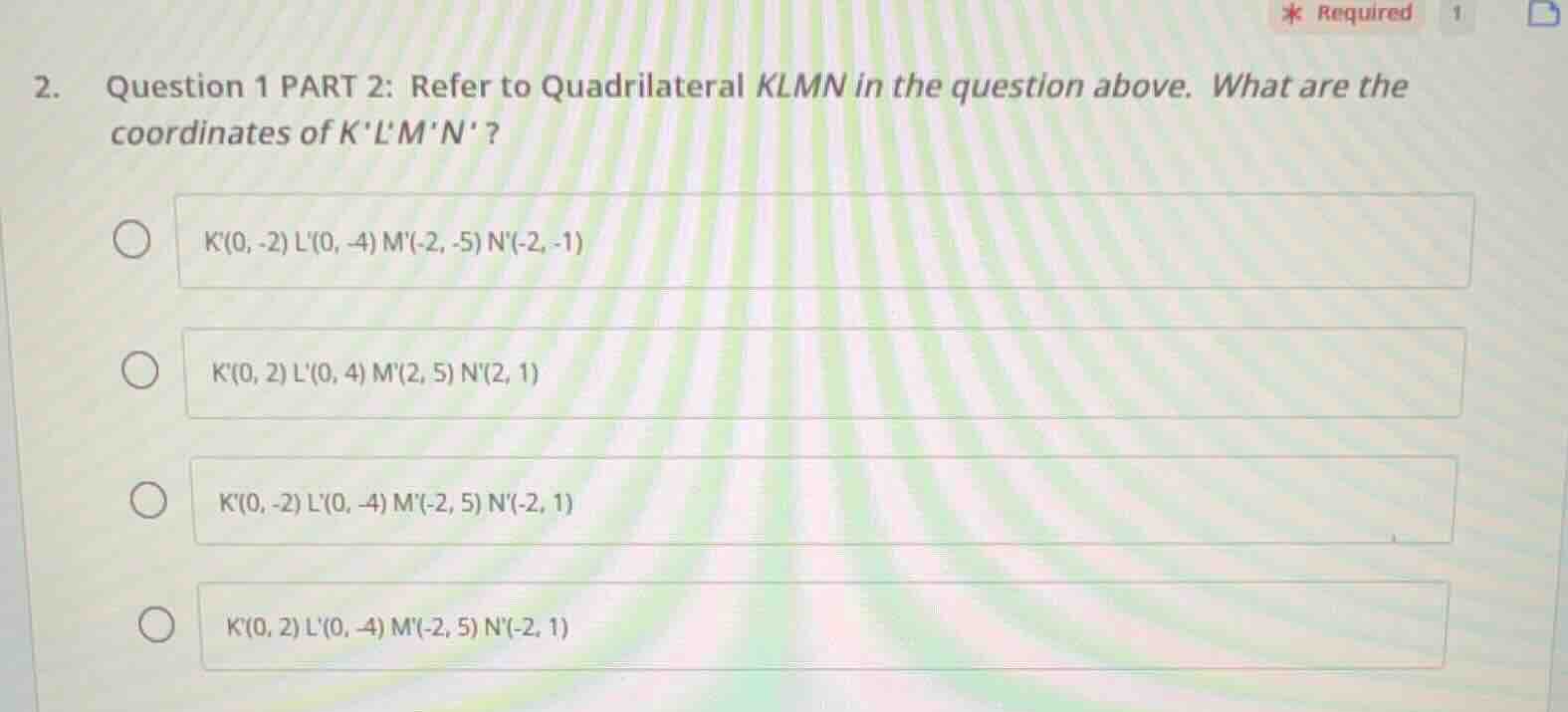
- question 1 part 2: refer to quadrilateral klmn in the question above. what are the coordinates of klmn?
k(0, -2) l(0, -4) m(-2, -5) n(-2, -1)
k(0, 2) l(0, 4) m(2, 5) n(2, 1)
k(0, -2) l(0, -4) m(-2, 5) n(-2, 1)
k(0, 2) l(0, -4) m(-2, 5) n(-2, 1)
To solve this, we assume the transformation (likely reflection or translation) from original quadrilateral \(KLMN\) (not shown, but typical for such problems, maybe reflection over x - axis or y - axis or vertical/horizontal shift). Let's analyze the options:
Step 1: Analyze the y - coordinates pattern
Looking at the third option \(K'(0, - 2)\), \(L'(0, - 4)\), \(M'(-2,5)\), \(N'(-2,1)\) has inconsistent sign for \(M'\) and \(N'\) y - coordinates compared to \(K'\) and \(L'\). The fourth option has inconsistent signs for \(L'\) and \(K'\). The second option has all positive y - coordinates, while the first option has consistent negative y - coordinates for \(K'\), \(L'\) and negative x - coordinates for \(M'\), \(N'\) (if original was in positive y and positive x, maybe reflection over x - axis and y - axis? But more likely, if we assume a reflection over the x - axis ( \((x,y)\to(x, - y)\)) or a vertical shift down. But the key is to check the consistency of the coordinates.
Wait, maybe the original quadrilateral \(KLMN\) had coordinates like \(K(0,2)\), \(L(0,4)\), \(M(2,5)\), \(N(2,1)\) (from the second option's positive coordinates). If we reflect over the x - axis, the transformation is \((x,y)\to(x, - y)\). So \(K(0,2)\to K'(0, - 2)\), \(L(0,4)\to L'(0, - 4)\), \(M(2,5)\to M'(- 2, - 5)\) (wait, no, reflection over x - axis is \((x,y)\to(x, - y)\), not x - axis reflection would not change x - coordinate sign. Wait, maybe reflection over y - axis: \((x,y)\to(-x,y)\) and then reflection over x - axis \((-x,y)\to(-x, - y)\). Let's take original \(K(0,2)\), \(L(0,4)\), \(M(2,5)\), \(N(2,1)\). Reflect over y - axis: \(K(0,2)\to(0,2)\) (x = 0), \(L(0,4)\to(0,4)\) (x = 0), \(M(2,5)\to(-2,5)\), \(N(2,1)\to(-2,1)\). Then reflect over x - axis: \(K(0,2)\to(0, - 2)\), \(L(0,4)\to(0, - 4)\), \(M(-2,5)\to(-2, - 5)\), \(N(-2,1)\to(-2, - 1)\), which matches the first option.
The first option \(K'(0, - 2)\), \(L'(0, - 4)\), \(M'(-2, - 5)\), \(N'(-2, - 1)\) is consistent with a transformation (like reflection over x - axis and y - axis or combined reflections) from a quadrilateral with positive y - coordinates and positive x - coordinates for \(M\) and \(N\). The other options have inconsistent coordinate sign patterns.

Snap & solve any problem in the app
Get step-by-step solutions on Sovi AI
Photo-based solutions with guided steps
Explore more problems and detailed explanations
A. \(K'(0, - 2)\) \(L'(0, - 4)\) \(M'(-2, - 5)\) \(N'(-2, - 1)\)