QUESTION IMAGE
Question
question 3 (1 point)
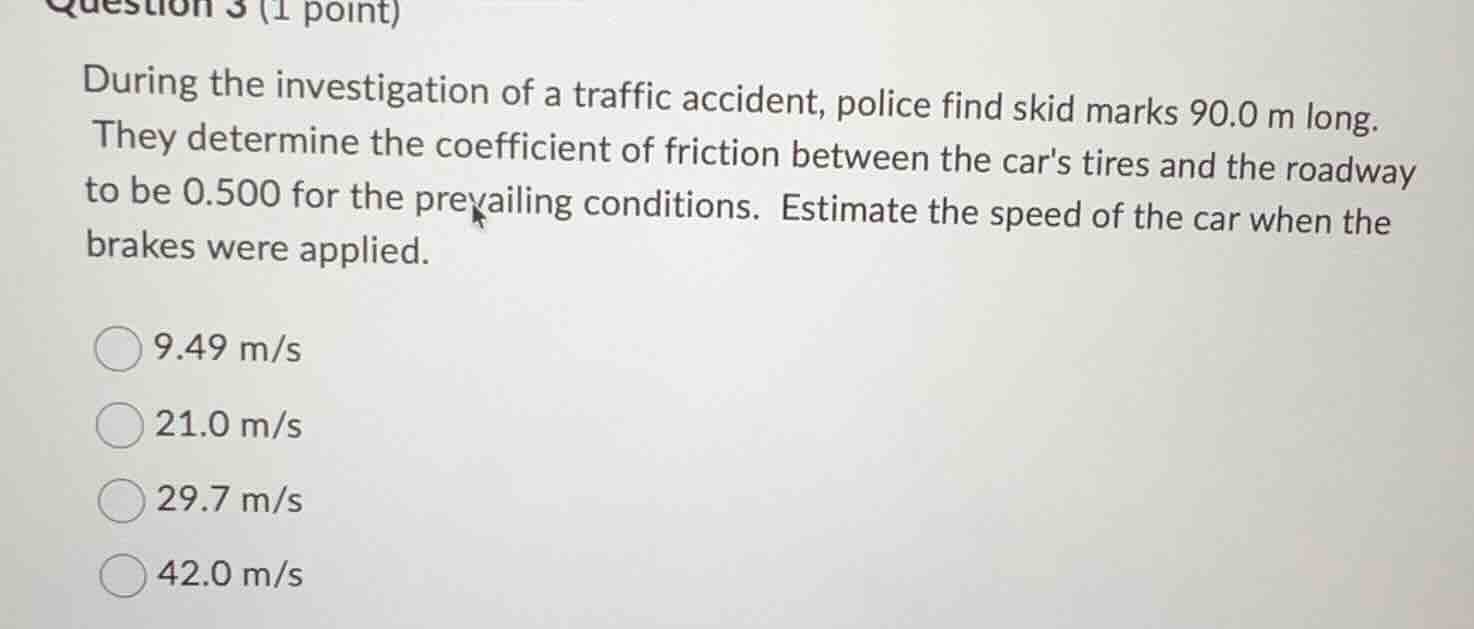
during the investigation of a traffic accident, police find skid marks 90.0 m long. they determine the coefficient of friction between the cars tires and the roadway to be 0.500 for the prevailing conditions. estimate the speed of the car when the brakes were applied.
9.49 m/s
21.0 m/s
29.7 m/s
42.0 m/s
Step1: Determine the deceleration
The frictional force provides the deceleration. The frictional force \( F_f=\mu N \), and for a car on a horizontal road, \( N = mg \) (normal force equals weight). By Newton's second law \( F = ma \), so the deceleration \( a=\frac{F_f}{m}=\mu g \). Here, \( \mu = 0.500 \) and \( g = 9.8\ m/s^2 \), so \( a=\mu g=0.500\times9.8\ m/s^2 = 4.9\ m/s^2 \).
Step2: Use kinematic equation
We use the kinematic equation \( v_f^2=v_i^2 + 2ax \), where \( v_f = 0\ m/s \) (final velocity when the car stops), \( a=- 4.9\ m/s^2 \) (negative because it's deceleration), and \( x = 90.0\ m \). Rearranging for \( v_i \), we get \( v_i=\sqrt{- 2ax} \). Substituting the values: \( v_i=\sqrt{-2\times(- 4.9\ m/s^2)\times90.0\ m}=\sqrt{882\ m^2/s^2}\approx29.7\ m/s \).

Snap & solve any problem in the app
Get step-by-step solutions on Sovi AI
Photo-based solutions with guided steps
Explore more problems and detailed explanations
29.7 m/s (corresponding to the option "29.7 m/s")