QUESTION IMAGE
Question
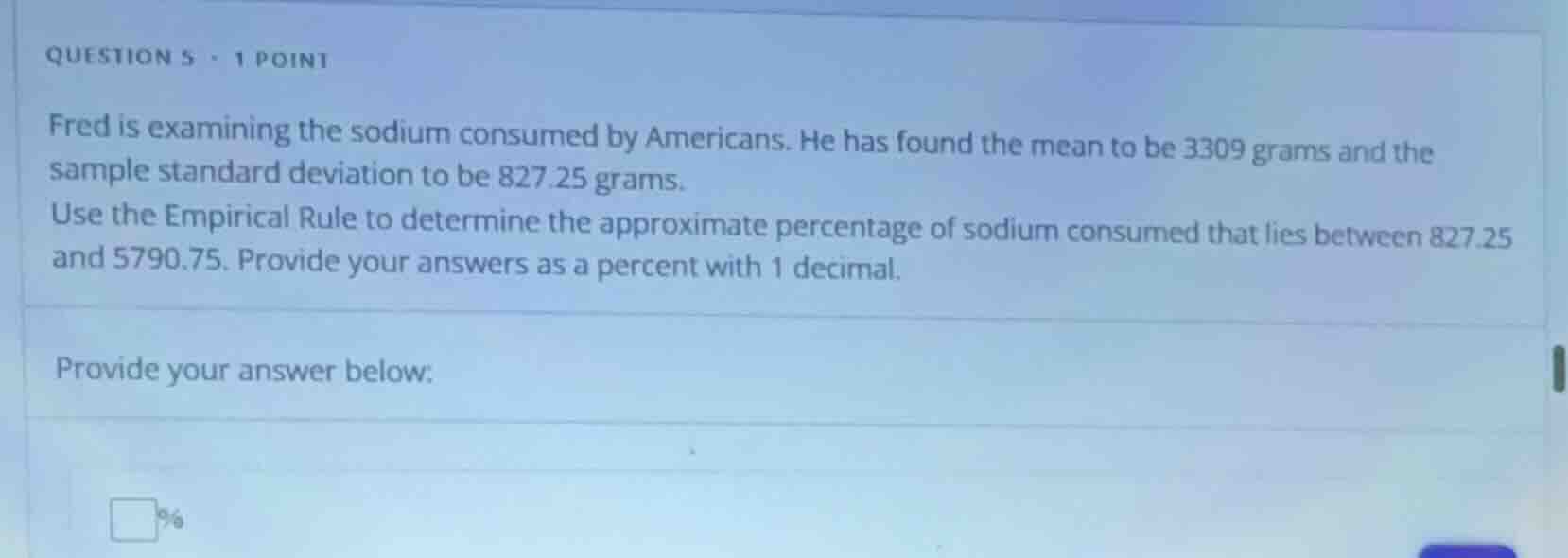
question 5 · 1 point fred is examining the sodium consumed by americans. he has found the mean to be 3309 grams and the sample standard deviation to be 827.25 grams. use the empirical rule to determine the approximate percentage of sodium consumed that lies between 827.25 and 5790.75. provide your answers as a percent with 1 decimal. provide your answer below: %
Step1: Identify mean and standard deviation
Mean ($\mu$) = 3309, Standard Deviation ($s$) = 827.25
Step2: Find how many standard deviations from mean
For 827.25: $3309 - 3\times827.25 = 3309 - 2481.75 = 827.25$ (3 standard deviations below)
For 5790.75: $3309 + 3\times827.25 = 3309 + 2481.75 = 5790.75$ (3 standard deviations above)
Step3: Apply Empirical Rule
Empirical Rule: ~99.7% within 3σ of μ, but we need the percentage between 3σ below and 3σ above. Wait, but also, the total within 3σ is 99.7%, but we can also consider the symmetry. Wait, actually, the Empirical Rule states that about 68% within 1σ, 95% within 2σ, 99.7% within 3σ. But since our interval is from 3σ below to 3σ above, but wait, no: wait, 827.25 is 3σ below (μ - 3σ), 5790.75 is 3σ above (μ + 3σ). But also, we can check if there's a mix? Wait no, let's recalculate:
Wait, μ = 3309, σ = 827.25.
μ - 3σ = 3309 - 3*827.25 = 3309 - 2481.75 = 827.25
μ + 3σ = 3309 + 3*827.25 = 3309 + 2481.75 = 5790.75
But also, what about the area from μ - 3σ to μ + 3σ is 99.7%. But wait, is there a mistake? Wait, no, but wait, the Empirical Rule: the percentage within k standard deviations. But also, the normal distribution is symmetric. So the area from -3σ to +3σ is 99.7%, but also, the area from -3σ to μ is half of that (since symmetric), and μ to +3σ is half. But wait, our interval is from -3σ to +3σ, so that's 99.7%? But wait, no, wait, maybe I made a mistake. Wait, no, let's check again:
Wait, the Empirical Rule:
- Approximately 68% of the data lies within 1 standard deviation of the mean (μ ± σ)
- Approximately 95% of the data lies within 2 standard deviations of the mean (μ ± 2σ)
- Approximately 99.7% of the data lies within 3 standard deviations of the mean (μ ± 3σ)
But our interval is from μ - 3σ to μ + 3σ, so that's exactly the 3σ interval. But wait, but the question is the percentage between 827.25 (μ - 3σ) and 5790.75 (μ + 3σ). So according to the Empirical Rule, that's approximately 99.7%. But wait, but let's confirm:
Wait, but maybe I messed up the number of standard deviations. Wait, let's check the distance from μ to 827.25: (3309 - 827.25)/827.25 = 2481.75/827.25 = 3. So that's 3 standard deviations below. Similarly, (5790.75 - 3309)/827.25 = 2481.75/827.25 = 3. So 3 standard deviations above. So the interval is from μ - 3σ to μ + 3σ. So the percentage within that interval is approximately 99.7%. But wait, the problem says "provide your answers as a percent with 1 decimal". So 99.7%? Wait, but let's check again. Wait, maybe I made a mistake in the number of standard deviations. Wait, let's recalculate:
Wait, μ = 3309, σ = 827.25.
μ - 1σ = 3309 - 827.25 = 2481.75
μ - 2σ = 3309 - 2*827.25 = 3309 - 1654.5 = 1654.5
μ - 3σ = 3309 - 3*827.25 = 3309 - 2481.75 = 827.25 (matches)
μ + 1σ = 3309 + 827.25 = 4136.25
μ + 2σ = 3309 + 1654.5 = 4963.5
μ + 3σ = 3309 + 2481.75 = 5790.75 (matches)
So the interval is from μ - 3σ to μ + 3σ. So according to the Empirical Rule, approximately 99.7% of the data lies within 3 standard deviations of the mean. So the percentage between 827.25 (μ - 3σ) and 5790.75 (μ + 3σ) is approximately 99.7%.
Wait, but let's confirm the Empirical Rule: the percentages are approximately 68% (1σ), 95% (2σ), 99.7% (3σ) of the data within μ ± 1σ, μ ± 2σ, μ ± 3σ respectively. So yes, within μ ± 3σ, it's 99.7%. So the answer should be 99.7%.

Snap & solve any problem in the app
Get step-by-step solutions on Sovi AI
Photo-based solutions with guided steps
Explore more problems and detailed explanations
99.7%