QUESTION IMAGE
Question
question 8 (1 point)
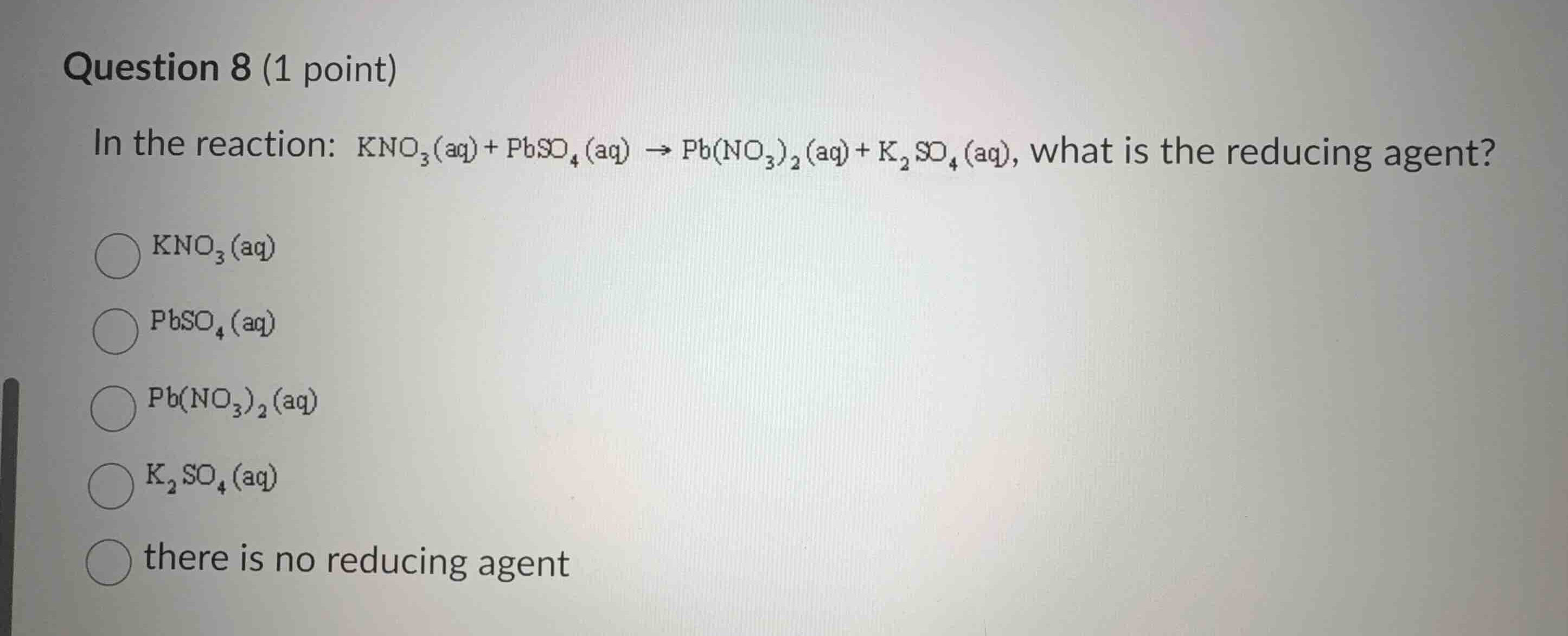
in the reaction: $\ce{kno_{3}(aq) + pbso_{4}(aq) -> pb(no_{3})_{2}(aq) + k_{2}so_{4}(aq)}$, what is the reducing agent?
$\bigcirc$ $\ce{kno_{3}(aq)}$
$\bigcirc$ $\ce{pbso_{4}(aq)}$
$\bigcirc$ $\ce{pb(no_{3})_{2}(aq)}$
$\bigcirc$ $\ce{k_{2}so_{4}(aq)}$
$\bigcirc$ there is no reducing agent
To determine the reducing agent, we first check the type of reaction. The given reaction is a double - displacement reaction (ions exchange partners: $K^+$ and $Pb^{2 + }$ swap with $NO_3^-$ and $SO_4^{2 - }$). In a double - displacement reaction, there is no change in the oxidation states of the elements. For a reducing agent (or oxidizing agent) to exist, there must be a redox reaction (a change in oxidation states). Since the oxidation states of all elements ($K$, $N$, $O$, $Pb$, $S$) remain the same before and after the reaction, there is no redox process occurring. So, there is no reducing agent.

Snap & solve any problem in the app
Get step-by-step solutions on Sovi AI
Photo-based solutions with guided steps
Explore more problems and detailed explanations
there is no reducing agent